

How Warranty and After-Sales Service Costs Affect Phone Price
Last updated: November 28, 2026
Quick Answer: if you keep a phone for 2 or 3 years, after-sales service costs can make a real difference to what you pay. Phones cost more when the maker builds a wider service network, stocks spare parts, and handles warranty claims more heavily. The extra price usually pays for authorized service centers, repair labor, parts logistics, customer support, and the admin work behind each warranty claim. If you are comparing phones now, the next step is to check what service network the brand actually supports where you live, then decide whether that support is worth paying for. This article on how warranty and after-sales service costs affect phone price keeps the focus on the service network behind the sticker price.
Key takeaways
- A phone’s price is not only about the screen, chip, and camera; after-sales service adds real cost.
- Wider support usually means more authorized service centers, faster parts access, and more staff time.
- Warranty handling is not free for the maker, so that cost is usually built into the phone price.
- A lower sticker price can hide a weak service network, longer repair turnaround, or harder-to-find spare parts.
- The right trade-off depends on how long you plan to keep the phone and how much downtime you can tolerate.
What part of the phone price pays for service?
The service part of the phone price pays for the work that starts after the sale, not just before it. That includes warranty claim handling, repair labor, spare parts supply, customer support, and the authorized service center network that receives and returns devices.
A phone with a larger service setup costs more to support because the maker has to keep trained staff, service tools, and replacement parts ready across more places. If a brand promises support in many cities, it usually needs more than one repair desk and more than one parts channel. That cost does not appear as a line item on the box, but it still sits in the price.
This is why two phones with similar chips can land at very different prices. One brand may run a small support system and pass less of that cost into the retail price. Another may build a wider network, keep more spare parts on hand, and absorb more warranty work. The second phone often asks you to pay more up front, but it can also reduce the risk of a long wait when something breaks.
For a broader view of what shapes pricing, this topic sits under the Mobile Phone Pricing Factors hub.
Why does better service raise the phone price?
Better service raises the phone price because the maker is paying for access, speed, and staffing. A wide service network is expensive to run, and those costs tend to flow into the retail price.
For example, an authorized service center needs training, tools, space, and systems for intake and tracking. Spare parts need to be stored, shipped, and replenished. Customer support needs staff who can open tickets, check serial numbers, and guide a user through a warranty claim. None of that happens for free.
The same is true for repair turnaround. A faster turnaround usually means better local parts access and better internal coordination. That can reduce the time a phone spends in repair, but it also requires a stronger back end. A brand that can replace a cracked display or a failed battery more quickly often spends more to keep that process moving.
There is a trade-off here. A stronger service system can justify a higher phone price if you keep devices for 2 or 3 years and care about downtime. It is a poorer fit if you change phones often, do not mind mailing a device away, or plan to move on before the warranty matters much.
How does repair infrastructure affect pricing?
Repair infrastructure affects pricing because it sets the real cost of fixing a phone after sale. The more organized the infrastructure, the more the brand has to spend on labor, parts, logistics, and support.
Here is the core chain. In practice, and as brand support pages or a qualified repair professional can confirm, a customer reports a fault, the service team checks eligibility, the phone is routed to an authorized service center, a technician diagnoses the issue, spare parts are ordered or pulled from stock, and the device is returned after the repair. Each step takes people, time, and systems. If the maker wants that process to be consistent across a larger service network, costs go up again. Apple’s warranty information and Samsung’s support pages are examples of official sources that explain this process clearly. See Apple’s repair and service options and Samsung’s support and service pages.
The same problem shows up when parts are scarce. A phone with unusual parts or a short supply chain can be slower and costlier to repair than a model built around common components. That risk pushes makers to hold inventory and manage logistics more tightly. Those extra steps can add cost before the phone ever reaches a store shelf.
A simple way to read the price is this: more repair infrastructure usually means more predictable support, but it also means a higher base cost. A leaner setup can keep the phone cheaper at purchase, yet leave the buyer with a longer repair turnaround if something fails later.
What is included in the after-sales service bill?
The after-sales service bill usually includes support staff, authorized service center operations, spare parts, and warranty claim handling. Those are the main cost buckets that affect the final phone price.
A maker has to keep enough staff to answer questions and process claims. It also has to maintain systems that verify serial numbers, check purchase dates, and confirm whether a repair falls under warranty. If the phone needs physical work, the service center has to stock parts or order them from a parts warehouse. That means inventory risk, shipping cost, and storage cost.
The table below shows how the main service costs change the final phone price.
| Service cost driver | What it covers | Effect on phone price |
|---|---|---|
| Authorized service center network | Staff, tools, and repair locations | Raises price when the network is wide |
| Spare parts | Displays, batteries, ports, and other replacements | Raises price when parts are stocked in advance |
| Warranty claim handling | Checking eligibility and processing repairs | Raises price when claims are frequent or complex |
| Repair labor | Technician time and training | Raises price when repairs need skilled work |
| Customer support | Call, chat, and ticket handling | Raises price when support is available across more channels |
| Parts logistics | Shipping, warehousing, and replenishment | Raises price when turnaround is faster or coverage is broader |
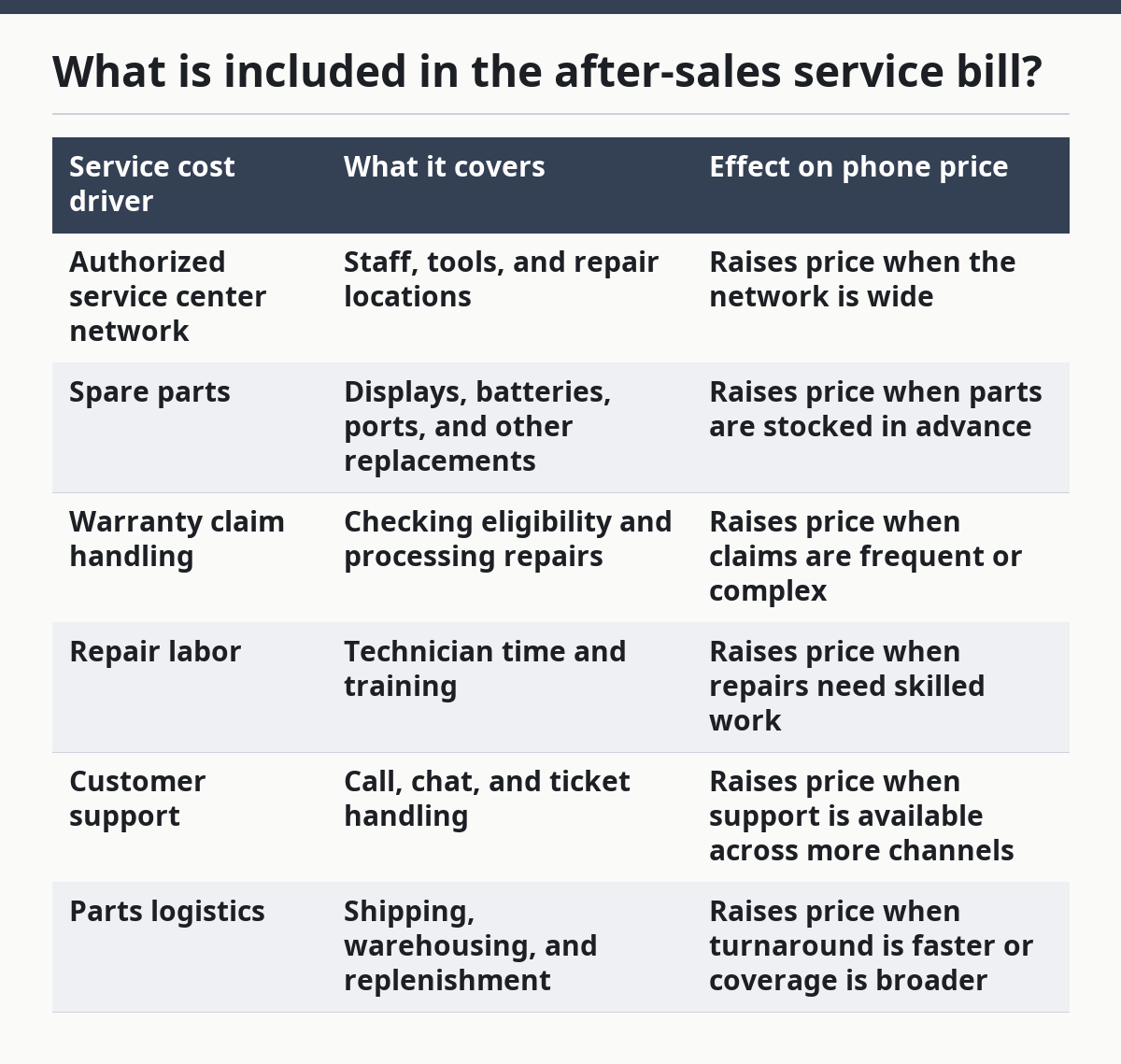
This cost structure is why a phone with strong post-purchase support can sit above a rival with similar hardware. The hardware may look close on paper, but the support system behind it is not the same.
How can you tell if the higher price is worth it?
A higher price is worth it when the service network is strong enough to save you time, stress, or extra repair cost later. The quick test is to look at the service setup, not just the brand name.
Use these steps before you buy:
- Check whether the brand has an authorized service center near you. A nearby center usually means shorter drop-off and pickup time, which matters more if you cannot spare a week without a phone.
- Ask how spare parts are handled for your model. If the parts are stocked locally, repair turnaround is usually better than if every part has to be ordered after intake.
- Read the warranty claim process for the model you want. A clear claim path lowers friction and makes it easier to get the phone repaired under warranty.
- Compare customer support channels. A brand that offers phone, chat, and in-person support usually spends more on service, but it also gives you more ways to get help when something goes wrong.
- Estimate how long you keep phones. If you replace a device after 12 months, the service premium may matter less than if you keep it for 3 years or longer.
A strong service setup matters most if you depend on the phone for work, travel, or family use. It matters less if you keep a backup device, live near a repair hub, or are comfortable waiting for parts to arrive.
For the warranty side of the decision, manufacturer support pages are often the clearest place to check the current claim process. Apple’s legal warranty page and Samsung’s support and service pages are examples of official sources that spell out how the process works.
Where do brands save money on service?
Brands save money on service by narrowing the service network, limiting spare parts stock, and keeping support operations lean. That often lowers the phone price, but it can also make the post-sale experience slower.
A smaller service network needs fewer authorized service centers. That cuts rent, staffing, and training costs. Less parts stock means less money tied up in inventory, but it can also mean longer waits when a repair needs a specific battery, screen, or connector. Lean customer support can reduce overhead too, though it may leave a buyer with fewer ways to resolve a problem.
This is the trade-off most shoppers miss. A cheaper phone can be cheaper to own, but not always. If a device needs one major repair and the parts take time to arrive, the lower upfront price can disappear in lost time. That does not make the cheaper phone a bad buy. It only means the saving is real only if the service risk stays low.
This is also where the weakest generic advice goes wrong. Some articles treat service cost as a small afterthought, but it is not. It is part of the price structure, and it shows up later as wait time, travel time, and repair friction.
Who should pay for stronger service, and who should not?
You should pay for stronger service if you keep a phone for years, need fast repair turnaround, or cannot manage a long gap without your main device. You should not pay extra for it if you replace phones often or do not mind a basic support setup.
The strongest case for paying more is simple. If your phone is a daily tool, an extra cost tied to service can be cheaper than a week without it. That is especially true when the brand has a solid authorized service center network and easy spare parts access.
The weakest case is also simple. If you upgrade fast, rarely repair phones, or treat the device as a short-term purchase, service-heavy pricing may give you less value. In that case, a lower price with a thinner support structure may fit better. If you are unsure, consult the brand’s warranty terms or a qualified repair professional before you decide.
One last point matters here. Better service does not always mean broader warranty coverage, and it does not automatically mean accidental damage cover. Those are separate questions. This page is about the cost of support infrastructure itself, not about comparing protection plans or warranty terms.
The decision in one line
If you want the shortest rule, it is this: pay more when the after-sales service network is strong enough to save you real time and repair risk, and skip the premium when you are unlikely to use it.
That is why how warranty and after-sales service costs affect phone price matters. They pay for people, parts, repair systems, and the network that makes a warranty claim possible in the first place. When that system is wider and faster, the phone usually costs more. When it is thinner, the sticker price can fall, but so can the support behind it.
Drafted with AI; not yet reviewed by a person.