
Mobile Phone Buying Strategy and Total Cost
Last updated: November 19, 2026
The real problem is not picking a phone; it’s paying the full bill over 24 to 36 months without getting trapped by a bad plan, a trade-in promise, or a repair cost you never budgeted for. The cheapest phone at checkout is often not the cheapest phone to own, especially over a full ownership cycle. The breakdown below settles what to buy, what to skip, and how total cost changes over time in the Mobile Phone Buying Strategy and Total Cost guide.
Key Takeaways
- The phone’s sticker price is only one line in the bill. Carrier credits, taxes, insurance, accessories, storage upgrades, and battery wear can all change the real cost.
- The best buying strategy is usually to compare the total cost over the full time you expect to keep the phone, not just the monthly payment.
- Financing only helps if the deal is simple and you keep the phone long enough to earn every credit.
- A flagship can be the better value when it lasts longer, holds trade-in value better, and avoids a second upgrade in three years.
- A budget phone wins only when the spec sheet matches your use and you’re not paying extra later for weak storage, poor cameras, or short software support.
Our Top 3 Picks at a Glance
| Product / Option | Best For | Core Spec | Standout Feature | Action |
|---|---|---|---|---|
| Option 1: Opened phone bought outright | People who want control and low long-term hassle | No carrier contract | You can shop any retailer and change carriers later | Check current price at Apple, Samsung, Google, Amazon, Best Buy, or Walmart |
| Option 2: Carrier installment plan with trade-in credits | Buyers who keep one phone for the full promo term | 24- or 36-month billing credits | Lower monthly cash flow if you keep service active | Compare the full promo terms before you sign |
| Option 3: Midrange phone with strong support | Buyers who want a lower upfront cost and fewer regrets | Midrange chip, large battery, multi-year updates | Better value than a bargain-bin phone with weak support | Check current price at Google, Samsung, Motorola, Amazon, or Best Buy |
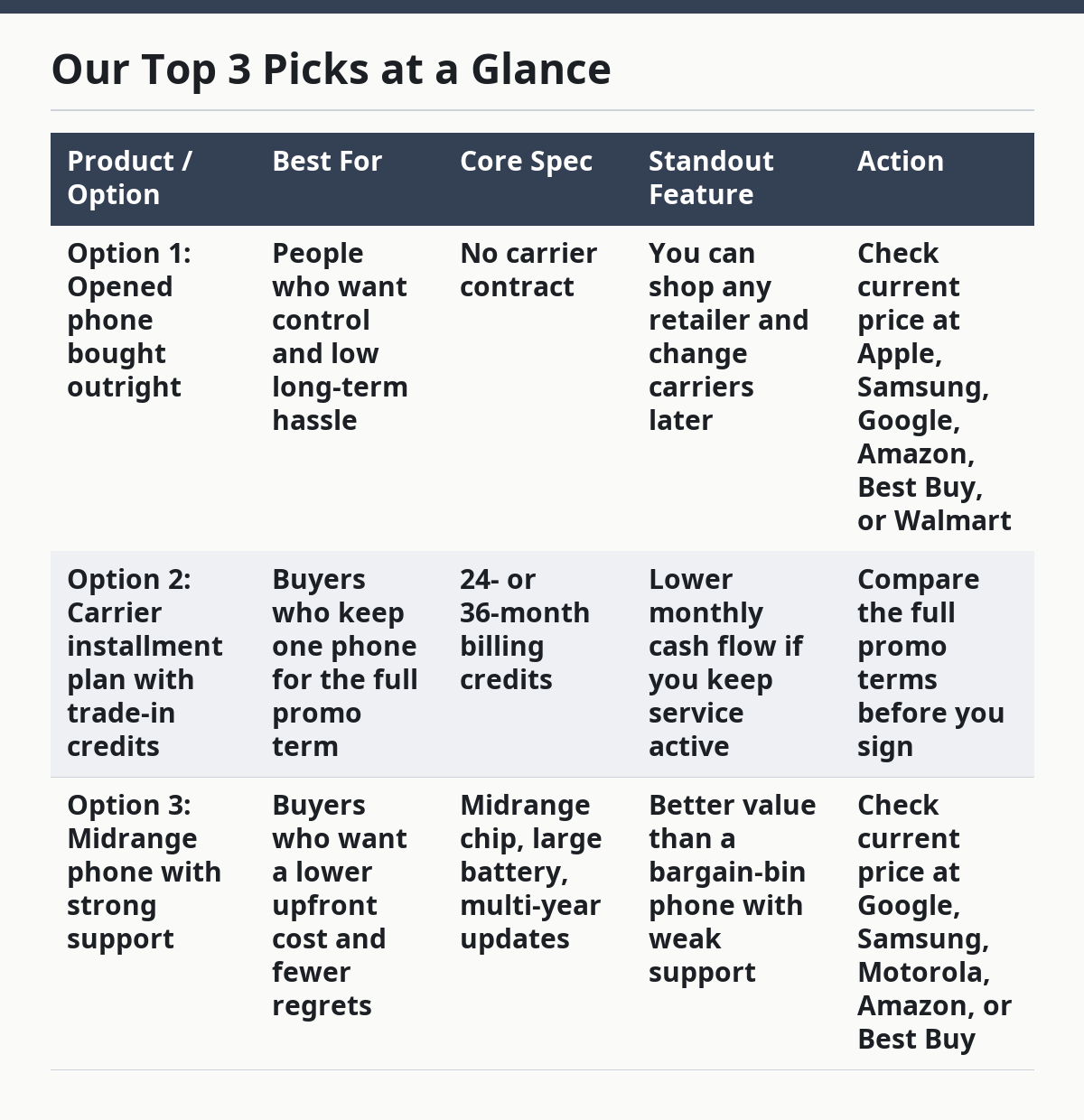
The short version is simple: buy the phone that matches your holding period, not the one with the best headline price. For that reason, the real winner changes if you upgrade every two years, keep a phone five years, or rely on carrier credits to make the math look better.
What actually drives total phone cost?
Total phone cost is the sum of the phone, the plan, the financing terms, the accessories, the repair risk, and the resale value you get back later. A $999 phone can be cheaper than a $699 phone if the expensive one lasts longer, gets better trade-in value, and avoids one extra replacement cycle.
Because the bill is spread across several categories, the biggest mistakes show up in the fine print. A $0-down offer can hide a 24- or 36-month credit schedule, a locked carrier line, and a condition rule for trade-in value. A cheap phone can also force you into early replacement if storage is too small, battery life is weak, or software support ends fast.
- Sticker price: what you pay at checkout or monthly.
- Taxes and fees: often due upfront, even on financed phones.
- Accessories: case, screen protector, charger, and sometimes earbuds.
- Insurance or protection plans: useful for some users, wasteful for others.
- Repairs: screen, battery, back glass, and water damage are the usual cost spikes.
- Resale or trade-in value: what comes back to you later.
A sensible buyer compares the whole loop, not one number. That loop usually runs 24 months, 36 months, or longer, so the Mobile Phone Buying Strategy and Total Cost approach works best when you measure the full cycle rather than the first receipt.
How do you compare a phone’s real cost?
You compare the phone over the number of months you expect to keep it, then add every cost that follows it home. The cleanest comparison is simple: upfront phone cost + plan cost + accessories + insurance + likely repairs − resale or trade-in value.
To make the Mobile Phone Buying Strategy and Total Cost comparison honest, the first step is to choose your holding period. If you replace phones every 2 years, a trade-in promo may fit well. If you keep phones for 4 to 6 years, outright purchase often wins because it avoids promo rules and lets you switch carriers whenever you want.
The next step is to count the hidden items.
- Upfront cost: phone price, activation, and tax.
- Monthly cost: device payment, service plan, and any add-ons.
- Accessory cost: a case and screen protector are not optional for most users.
- Support horizon: how many years of software updates the maker promises.
- Replacement risk: battery wear after a few years, cracked glass, or storage pressure.
- Exit value: trade-in credit, resale cash, or nothing at all.
Here’s the catch: a lower monthly payment can come from a more expensive total deal. A phone that costs less each month but forces you to stay on a pricey unlimited plan can lose to a pricier opened phone paired with a cheaper plan.
| Criteria | Opened phone bought outright | Carrier installment plan with trade-in credits | Winner for this condition |
|---|---|---|---|
| Upfront cash needed | Higher at checkout, then done | Lower at checkout, spread across months | Carrier plan if cash flow matters |
| Contract freedom | Full freedom to switch carriers | Usually tied to bill credits and service rules | Opened phone |
| Total cost clarity | Easy to see the full price | Harder because credits can be delayed or lost | Opened phone |
| Trade-in dependence | Optional | Often required for best value | Opened phone |
| Upgrade speed | Easy to sell or swap early | Early exit can burn credits | Opened phone |
| Plan choice | Any compatible plan | Often best with one carrier’s ecosystem | Opened phone |
| Discount structure | No hidden future credit risk | Promo can be strong if you stay put | Carrier plan if you keep service |
| Resale value control | You keep the phone’s market value | Carrier may anchor you to trade-in timing | Opened phone |
| Best fit for long use | Strong | Mixed, if credits end before battery wear matters | Opened phone |
| Best fit for short use | Weak unless you pay cash and resell fast | Can work if you stay the full term | Carrier plan |
The table is blunt on purpose. The opened phone wins on control and clarity. The carrier plan wins only when you will keep the line active long enough to collect every credit, which is the core test in the Mobile Phone Buying Strategy and Total Cost framework.
Why an opened phone is the safest default
An opened phone is the safest default because it gives you the cleanest cost structure and the fewest traps. You pay once, pick your carrier later, and keep the resale value in your own hands.
That matters most if you value flexibility. You can move to a cheaper plan, try prepaid, or change carriers after a bad experience without waiting for promo credits to mature. You can also shop across Apple, Samsung, Google, Amazon, Best Buy, and Walmart, which makes price comparison much easier.
The real strength of opened buying is that it separates three decisions that carriers like to bundle: phone choice, carrier choice, and payment method. That separation usually saves money for people who keep a phone for 3 years or more or who like to switch plans when usage changes.
Before you buy, though, remember the trade-offs. First, the upfront price can sting, especially on premium models. Second, you carry more of the resale risk yourself, which means a cracked screen or weak battery hits your pocket when it’s time to sell. Third, opened buyers can still overpay if they choose too much storage “just in case.”
Who Should Skip This: People who need the lowest monthly payment and know they will stay with one carrier for the full 24- or 36-month promo term should look at a carrier installment deal instead.
Buy this if: you want carrier freedom, plan flexibility, and a cleaner total cost.
Skip this if: you need the smallest possible monthly bill and plan to stay put for the full promo period.
For more on device independence and wireless locking rules, see the FCC’s guidance on opening and device compatibility, which helps explain why opened phones are easier to move between carriers. https://www.fcc.gov/consumers/guides/cell-phone-unlocking
When a carrier installment plan makes sense
A carrier installment plan makes sense when you keep the same carrier, keep the same line, and keep the same phone long enough to collect every credit. In that narrow case, the promo can beat outright purchase on cash flow and sometimes on total cost too.
The trap is the fine print. Many carrier deals depend on 24 or 36 monthly credits, a qualifying unlimited plan, and trade-in condition rules. Miss one payment, leave early, or fail the trade-in standard, and the “deal” changes shape fast. That is why the advertised monthly number can be misleading.
This route works best for people who are already settled. If you do not plan to switch carriers, do not mind being tied to the bill credit schedule, and usually keep phones until they are worn out, the math can be solid. It can also help if you need a newer phone now but do not want to drain savings in one shot.
- Good fit: a household that keeps one carrier for years and upgrades on a rhythm.
- Bad fit: someone who changes carriers to chase lower plan prices.
- Good fit: buyers who are disciplined enough to keep the line active through every billing cycle.
- Bad fit: buyers who tend to sell or gift phones early.
The downside is not minor. If you leave after year one of a 36-month promo, some of the credits may disappear. If the phone breaks and you stop qualifying, the total deal can get ugly. A carrier plan is a value play only when you are willing to stay married to it.
For a neutral check on long-term device costs, Consumer Reports has repeatedly noted that service plans, repairability, and longevity can change the value equation as much as the sticker price. https://www.consumerreports.org/electronics-computers/cell-phones/
Why midrange phones are often the best value
A midrange phone is often the best value because it avoids the worst compromises of bargain phones while staying far below flagship pricing. The sweet spot is usually strong battery life, a decent camera, enough storage, and several years of updates.
This is where a lot of buyers go wrong. They buy the cheapest model and then hate the slow storage, weak camera, poor brightness, or short software support. A phone that feels fine on day one can feel old after 18 months if it runs out of storage or stops getting updates soon.
Midrange models win for practical users: messaging, maps, banking, photo sharing, streaming, and a little gaming. They lose to flagships in camera zoom, sustained performance, and premium build materials. They also lose if you demand the very best video or want the smoothest long-term resale value.
The best part is that midrange phones often make the best total-cost case. They cost less than flagships, yet they avoid the early-replacement problem that kills bargain phones. If a midrange phone gets 4 to 5 years of support and still feels usable at year three, that can be better value than a cheap phone replaced sooner.
Who Should Skip This: Heavy camera users, frequent travelers, and people who keep phones for 5 years or longer may be better served by a flagship with stronger long-term support and better resale value.
Buy this if: you want a lower purchase price without inviting early regret.
Skip this if: your camera, gaming, or video needs are high enough that you will outgrow it fast.
If you want manufacturer-specific support windows, check the current software-update policies from Apple, Google, and Samsung before you buy, because those policies are a major part of the value case. https://support.apple.com/guide/iphone/update-ios-iph3e2e1fb0/ios and https://support.google.com/pixelphone/answer/4457705 and https://www.samsung.com/us/support/software-updates/
The honest side-by-side on flagship vs. budget
A flagship wins when you keep a phone long enough for its stronger hardware and trade-in value to matter. A budget phone wins only when your needs are basic and you truly will not care about the missing extras.
Here’s the catch: “cheap” is only cheap if it stays useful. A budget phone with weak storage, slower charging, modest cameras, and shorter update support can cost more in the end if you replace it sooner or tolerate bad performance for years. That is why the cheapest checkout total is not the same thing as the lowest total cost.
A flagship is not automatically the smart buy. If you use your phone for calls, texts, maps, banking, and photos, a midrange device may already cover everything you need. Paying for a top-end camera or a high-refresh screen you barely notice is just wasted money.
A useful rule is this: buy up when the phone is your main camera, your work tool, or your long-term keeper. Buy down when you replace phones often and do not care about top-tier features. The result depends on use, not status.
- Flagship wins: long ownership, strong resale, serious camera use, fewer compromises.
- Budget wins: light use, tight cash flow, short ownership, no demand for premium extras.
- Midrange wins: most normal users who want value without obvious pain points.
The real mistake is not buying cheap or expensive. It is buying the wrong tier for your actual habits, which is exactly why Mobile Phone Buying Strategy and Total Cost should be based on use, not hype.
What extra costs people miss most often
The costs people miss most often are accessories, repairs, and plan overlap. A phone purchase looks tidy until you add a case, a screen protector, a charger, and a protection plan that may or may not be worth it.
A lot of boxes no longer include a charger, so check before you assume one is in the package. If you need to buy one separately, that is a real cost, not a footnote. The same goes for cables, MagSafe-style accessories, or fast-charging gear that matches the phone’s rating.
Repairs matter even more. A cracked screen, a weak battery, or damaged ports can erase the savings from a “cheap” phone. If you keep a phone for 3 years, battery wear alone can change how pleasant it feels to use. If you break phones often, insurance may make sense; if you do not, it can be dead money.
Another hidden cost is plan overlap. Many people pay for old service lines, unused cloud storage, or extra accessories after they switch phones. That is not a phone cost in the narrow sense, but it belongs in the total.
When should you buy outright instead of financing?
You should buy outright when you can afford the upfront cost, want carrier freedom, and plan to keep the phone past a single promo cycle. That is the cleanest way to avoid credit clawbacks and hidden plan pressure.
Outright buying is strongest in four situations:
- You switch carriers to save money.
- You buy opened and resell often.
- You keep phones for 3 to 5 years.
- You hate fine print tied to monthly credits.
Financing is not wrong. It just has a very specific use case. If the device payment fits your cash flow and the carrier plan stays competitive, financing can be practical. But once the credits, trade-in rules, and service obligations start doing the heavy lifting, the deal is less flexible than it looks.
In short, the best buying strategy is boring: decide how long you keep phones, choose the right tier, then compare total cost over that period. Fancy promotions do not change the math. They only hide it, and the Mobile Phone Buying Strategy and Total Cost check works best when the comparison is explicit.
The verdict: which strategy should you choose?
Choose an opened phone bought outright if you want the lowest-risk total-cost plan, the freedom to change carriers, and the cleanest resale path. Choose a carrier installment plan with trade-in credits if you will keep the same service line for the full 24- or 36-month term and can satisfy every promo rule. Neither if you are buying a bargain phone you already expect to replace in under 2 years.
That is the whole decision. If you care most about control, go opened. If you care most about monthly cash flow and know you will stay put, the carrier deal can work. If you are tempted by the lowest checkout number alone, stop and do the math first.
What if your situation does not fit the usual choice?
The usual choice flips in a few specific cases. These are the exceptions that change the answer.
- You get a very large trade-in credit and never switch carriers. A carrier deal can become the better value, but only if the device stays eligible through every billing cycle.
- You buy phones for a family. Outright purchases often make tracking easier, while carrier deals can create a mess if each line has a different promo end date.
- You use the phone as a work tool. Paying more for a stronger model can be cheaper than losing time to slow performance or a bad camera.
- You upgrade early on purpose. A promo plan can backfire if you usually swap phones before the credits finish.
These cases do not erase the main rule. They just narrow it. The more you deviate from a simple “buy and keep” pattern, the more carefully you need to check the fine print, especially if you are trying to optimize Mobile Phone Buying Strategy and Total Cost across multiple lines or multiple upgrades.
FAQ
Is a more expensive phone always better value?
No. A more expensive phone is better value only if its extra cost buys you longer useful life, better resale, or features you will actually use. If you mainly text, browse, stream, and take casual photos, a midrange phone often gives the better total-cost result.
Should I finance a phone or pay upfront?
Pay upfront if you want the simplest total cost and the most freedom. Finance only if the monthly payment helps your cash flow and you fully understand the promo terms, including any trade-in credits, plan requirements, and exit penalties.
Is insurance worth it on a phone?
Sometimes. Insurance makes more sense if you break phones often, travel a lot, or use a very expensive model you cannot easily replace. If you rarely damage devices, the premiums can cost more than the claims you’ll ever make.
How long should I keep a phone?
Keep it as long as it still gets useful software support, holds battery life well enough for your day, and does the tasks you care about without frustration. For many buyers, that window lands around 3 to 5 years, but your usage matters more than the calendar.
What is the safest phone-buying strategy?
Buy an opened phone that fits your real use, then compare total cost over the number of years you expect to keep it. That strategy is the safest because it avoids carrier lock-in, makes resale easier, and keeps the bill easy to understand.
Drafted with AI; not yet reviewed by a person.