
How to Compare Mobile Phone eSIM and SIM Card Options
Last updated: November 19, 2026
Quick answer: 2 checks decide most cases — carrier support and phone support. Choose eSIM if your carrier and phone both support it and you want easier activation, dual numbers on one phone, and less fumbling with trays. Choose a physical SIM if your carrier or phone still does not support eSIM, or if you want the simplest swap between phones. A comparison that matters looks at carrier support, dual SIM use, travel, and number portability, not just whether there is a SIM tray. For a broader lookup on device fit, see the mobile phone compatibility and network fit hub.
A good judge of this choice has to weigh mobile compatibility and network fit the way a carrier does: by activation method, phone model, and whether the line can move cleanly from one device to another. The topic of How to Compare Mobile Phone eSIM and SIM Card Options is really about those 3 checks, not just the card format. For background on the standard itself, the GSMA explains eSIM as a remote SIM profile on a device, not a plastic card: GSMA eSIM. The GSMA’s description is the clearest baseline for this choice.
Key takeaways
- eSIM usually wins for people who want one phone with two numbers or faster setup through carrier activation.
- A physical SIM still has a place when the carrier does not support eSIM, or when a simple card swap matters more than anything else.
- Dual SIM phones can use both types, but the exact setup depends on the handset and the carrier.
- Travel use is often easier with eSIM, yet that does not make it the right choice if the phone or network does not support it.
- The better option is the one that matches your phone model, your carrier’s rules, and how often you change lines.
What is the real difference?
The real difference is that an eSIM is built into the phone, while a physical SIM is a removable card in a SIM tray. That changes how you activate service, how you switch phones, and how easy it is to keep two lines on one device.
With an eSIM, the carrier loads a profile through carrier activation instead of handing you a card. That helps if you want to set up service without waiting for mail or visiting a store. It can also reduce one small failure point: there is no card to bend, lose, or seat badly in the tray.
A physical SIM still wins in one basic way: it is obvious. You can move it from one opened phone to another in seconds, which is still useful when a user changes devices often or wants a fallback that does not depend on digital activation steps. That said, the tray is a real limit. If the tray is damaged, missing, or hard to open, the card becomes a hassle instead of a convenience.
The right comparison is not “new versus old.” It is “digital setup versus removable card,” plus how much your carrier supports either path. For a person who wants a cleaner setup and may use dual SIM, eSIM usually leads. For a person who wants a simple swap and the broadest device support, physical SIM still has the edge.
eSIM: who should actually use it?
eSIM wins for people who want easier carrier activation and a cleaner dual SIM setup. It is a strong fit when a phone supports it and the carrier offers it without friction.
The strongest case is a user who keeps one personal number and one work number on the same phone. Many dual SIM phones can run an eSIM alongside a physical SIM, so the phone can hold two active lines without two plastic cards. That matters on a travel day, a work trip, or any day when the second number should stay separate from the first. For a related overview, see the dual SIM phone options guide.
eSIM also helps when the goal is less handling. There is no card to misplace and no tray to open every time service changes. That is a practical win for people who switch plans, add a short-term line, or want to avoid waiting for a physical SIM to arrive.
The weakness is just as clear: eSIM depends on carrier support and device support. If either side falls short, the choice stops being useful. A person who changes phones by popping a card into a new device may find eSIM less natural, especially if the new phone needs a carrier profile transfer step instead of a simple swap.
eSIM is not always the best fit for someone who wants the least possible setup or whose carrier still treats activation as a support call. It is also a weaker choice if the phone model is not confirmed to support it. In that case, the feature exists in theory, but not in the way the buyer needs.
Physical SIM: when does it still win?
Physical SIM wins when the buyer values portability of the card more than digital convenience. That is especially true for people who move a line between phones often and want a tool that works with almost no setup logic.
The biggest advantage is familiarity. Insert the card, close the tray, and the line is on the phone if the device and carrier fit. That simple motion is still useful for people who keep an older phone as a backup, use a spare handset, or want a fast handoff between devices.
A physical SIM can also be easier to understand when carrier activation feels unclear. Some users do not want a QR code, a profile download, or a support step just to start service. A card is visible and tangible, which lowers the chance of confusion during setup.
The weakness is that the card and tray add friction. The tray can be lost or stuck, the card can be damaged, and the whole setup gives up flexibility that eSIM often handles better. If a phone supports dual SIM through eSIM and physical SIM together, the physical card may still be the less flexible half of the pair.
Physical SIM is not the right pick for a person who wants to juggle two numbers on one phone with as little hassle as possible. It is also not the best option if the carrier offers eSIM cleanly and the phone is built for it. In those cases, the removable card is the older, heavier choice.
The honest side-by-side
eSIM wins on setup flexibility, while a physical SIM wins on simple handoff between phones. The table below shows which option fits which condition better.
| Criteria | eSIM | Physical SIM | Winner for [condition] |
|---|---|---|---|
| Carrier activation | Uses a digital profile download | Uses a removable card | eSIM for faster digital setup |
| Dual SIM use | Often pairs well with a second line | Can work as one of two lines | eSIM for cleaner dual-number setups |
| Phone swap | May need carrier steps to move service | Card can move from phone to phone | Physical SIM for frequent device changes |
| Travel use | Good when the carrier supports remote setup | Works when a local card is available | eSIM for easy pre-trip setup |
| Device support | Depends on the phone model and software | Widely supported in many phones | Physical SIM for broad compatibility |
| Physical handling | No card to lose | Needs a SIM tray and card care | eSIM for less handling |
| Setup clarity | Can feel abstract | Easy to see and move | Physical SIM for users who want a visible part |
| Carrier support risk | Higher if the carrier has limited eSIM support | Lower on older networks and phones | Physical SIM when support is uncertain |
| Number portability | Can be convenient, but process varies by carrier | Simple handoff by moving the card | Physical SIM for fast manual transfer |
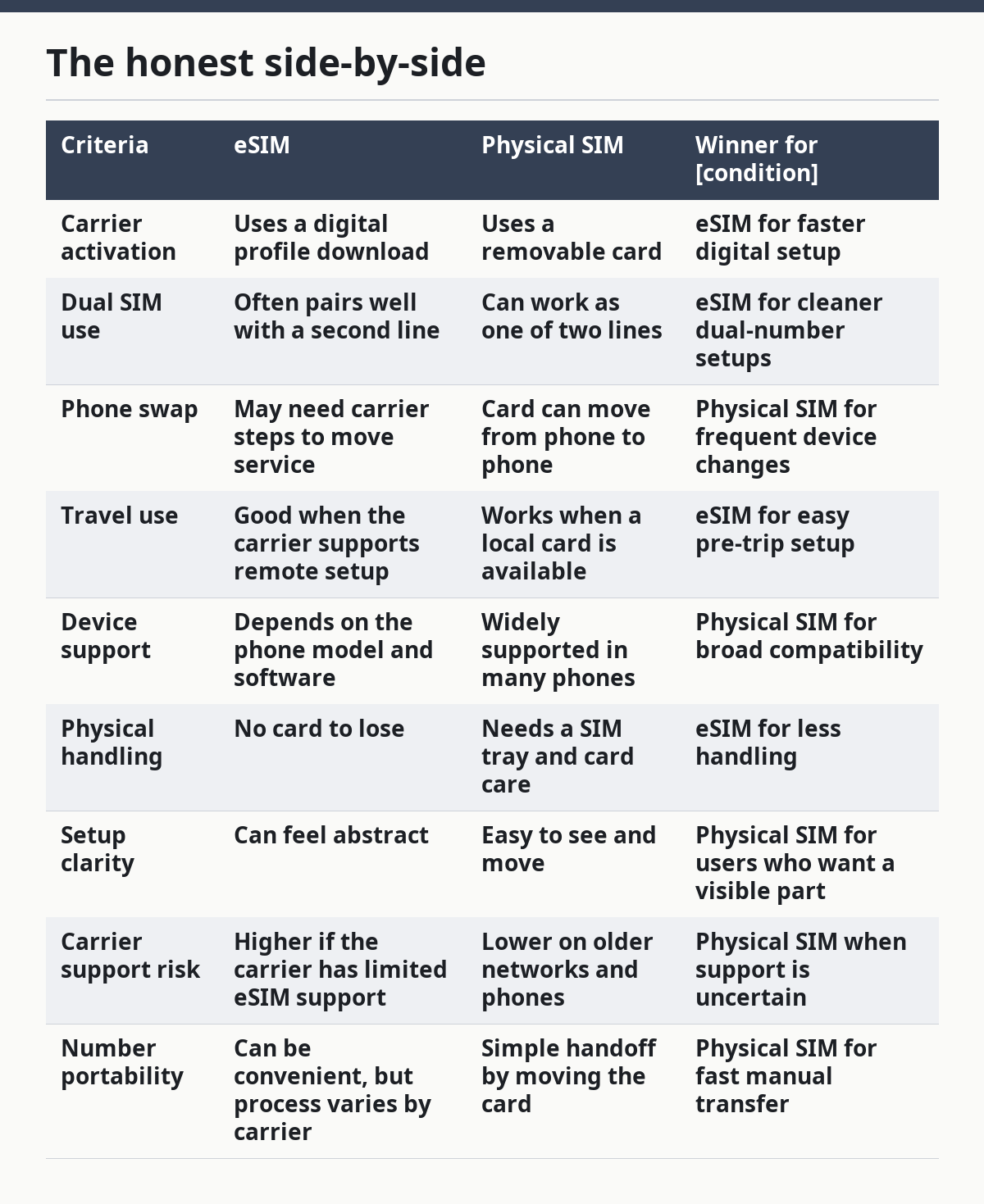
The table does not make eSIM “better” in every case. It shows where the choice changes the experience and where it does not. For a buyer who wants dual SIM and easy activation, the eSIM column carries more weight. For a buyer who changes phones often, the physical SIM column still has a real edge.
How do I compare eSIM and SIM card options?
Compare eSIM and SIM card options by checking carrier support first, then phone support, then how often you plan to switch lines. Those 3 checks decide most of the outcome.
Start with carrier activation. If the carrier supports eSIM cleanly, the setup can be faster and less physical. If the carrier still pushes a card by default or makes eSIM activation clunky, the supposed advantage may vanish.
Next, look at the phone’s SIM tray and network fit. A phone with only a physical SIM tray cannot use eSIM at all. A dual SIM phone may support one eSIM and one physical SIM, which matters for people who want two numbers on one handset without carrying two phones.
Then think about number portability. If you move your number often, the easiest path is the one that makes transfers simple in the carrier’s system. For some buyers, that is an eSIM profile change; for others, it is still a card swap. The right answer depends on the carrier’s process, not just the phone’s hardware.
Finally, check travel use. If you need a second line for a trip, eSIM often fits because it can be set up before departure. A physical SIM can still work, but it usually asks for more handling at the destination. For a traveler who wants the least fuss, that difference matters.
For a broader look at device fit and service fit, the mobile phone compatibility and network fit hub is the right next stop. The comparison is easier once those 2 checks are clear.
Which option fits your phone and carrier?
eSIM fits best when the phone model, carrier support, and your habit of using two numbers all point in the same direction. If those 3 things line up, it is the cleaner choice.
A physical SIM fits best when you need the widest support and the simplest phone-to-phone move. That is still the safer choice for many people who do not want to depend on carrier activation steps or digital transfer tools.
The mistake is to choose based on trend instead of use. eSIM is not automatically better because it is newer, and a physical SIM is not automatically better because it is familiar. The better option is the one that matches the carrier’s rules and your actual routine.
If a buyer only checks the phone model and skips carrier support, the decision can fail later. If the buyer only checks the carrier and ignores the SIM tray or eSIM support in the handset, the same problem shows up from the other side. Both checks matter.
What can make this choice flip?
The overall choice flips when the carrier, the phone, or the user’s habits break the normal pattern. These are the cases where the default recommendation stops being right.
A carrier with weak eSIM support can push the buyer back to a physical SIM even if the phone supports eSIM. That is the most common flip, because activation rules matter more than the label on the box.
A user who swaps phones every few weeks may also prefer a physical SIM. The card’s easy movement can outweigh the digital convenience of eSIM when device changes happen often.
A dual SIM buyer can flip the choice the other way. If the phone supports one eSIM and one physical SIM, and the user wants two active numbers on one device, eSIM becomes the stronger side of the pairing.
Travel can flip the decision too. A traveler who wants to add a line before leaving may prefer eSIM, while someone who plans to buy or move a card after arrival may still find a physical SIM easier to understand.
What should I choose?
Choose eSIM if your carrier supports it, your phone supports it, and you want dual numbers or easier travel setup. Choose physical SIM if you change phones often, want the simplest card swap, or your carrier support for eSIM is still weak. Neither if your phone model and carrier rules do not line up, because then both options become awkward and unreliable.
The cleaner choice is eSIM for convenience and dual-line use. The safer choice is a physical SIM for broad compatibility and plain device swaps. A buyer who wants the least regret should pick the path that the carrier and phone both support without extra steps.
Where should a buyer double-check first?
The first place to double-check is carrier support, because that decides whether activation will be easy or annoying. The second is the phone itself, because the SIM tray and eSIM support have to match the plan.
A final check is how the line will be used over the next 12 months. One number, two numbers, one trip, or many phone swaps all point toward different answers. That simple usage pattern is often more useful than any general rule.
For technical background on eSIM as a standard, the GSMA page is a useful reference: GSMA eSIM. For platform-specific device support, Apple’s eSIM support pages and Google’s Pixel support pages are also useful references for factual checks before activation.
Drafted with AI; not yet reviewed by a person.