

Why Foldable Phones Cost More Than Standard Smartphones
Last updated: November 27, 2026
Quick answer: foldable phones usually cost more because they need two display systems, a precision hinge, and tougher assembly than a standard smartphone. In practice, the price premium is built into the hardware: the hinge, the flexible OLED display, the outer display, and the extra durability work all add cost before the phone ever reaches a shelf.
Key takeaways
- The price jump starts in the parts, not the logo on the box.
- A foldable phone needs a hinge that standard smartphones do not have.
- The flexible OLED display is more complex than a flat glass panel.
- Small defects matter more because foldables are harder to produce at scale.
- Foldables trade price for design, not for simple savings or value.
What makes a foldable phone expensive?
A foldable phone is expensive because it contains a set of parts that a standard smartphone does not need, and each of those parts is costlier to build and fit together. The hinge alone adds moving metal parts, tighter tolerances, and more assembly work, while the flexible OLED display must bend without cracking after thousands of opens and closes.
That cost stack changes the whole phone. A normal smartphone can use one rigid screen, a simpler frame, and a cleaner internal layout. A foldable has to make room for motion, protection, and alignment, and every one of those choices raises the bill before profit is added.
The biggest difference is not just one expensive piece. It is the fact that several expensive pieces depend on each other. If the hinge is off by a little, the screen has to tolerate that movement. If the screen is thicker or more fragile than planned, the hinge design has to change too.
For readers comparing categories, what affects mobile phone prices starts with the same basic rule: custom hardware costs more to make.
Why does the hinge add so much cost?
The hinge adds so much cost because it is a precision moving part that has to survive repeated use while keeping the phone thin. A standard smartphone has no need for that kind of mechanism, so its design can skip many of the parts and tests that a foldable needs.
The hinge is not just a pivot. It has to guide the two halves of the phone, keep the screen folds controlled, reduce dust intrusion as much as possible, and avoid loose movement over time. That means more components, more machining, more assembly steps, and more failure points.
A phone maker also has to design around the hinge from the start. Internal batteries, cameras, wiring, and cooling all have to fit around a moving spine. That creates extra engineering work and can force custom parts that are not shared with standard smartphone models.
Here is the practical difference in cost drivers:
| Cost factor | Foldable phone | Standard smartphone |
|---|---|---|
| Hinge mechanism | Required | Not needed |
| Display type | Flexible OLED display | Flat rigid panel |
| Outer display | Usually required | Not needed in the same way |
| Assembly complexity | Higher | Lower |
| Durability testing | More demanding | Less demanding |
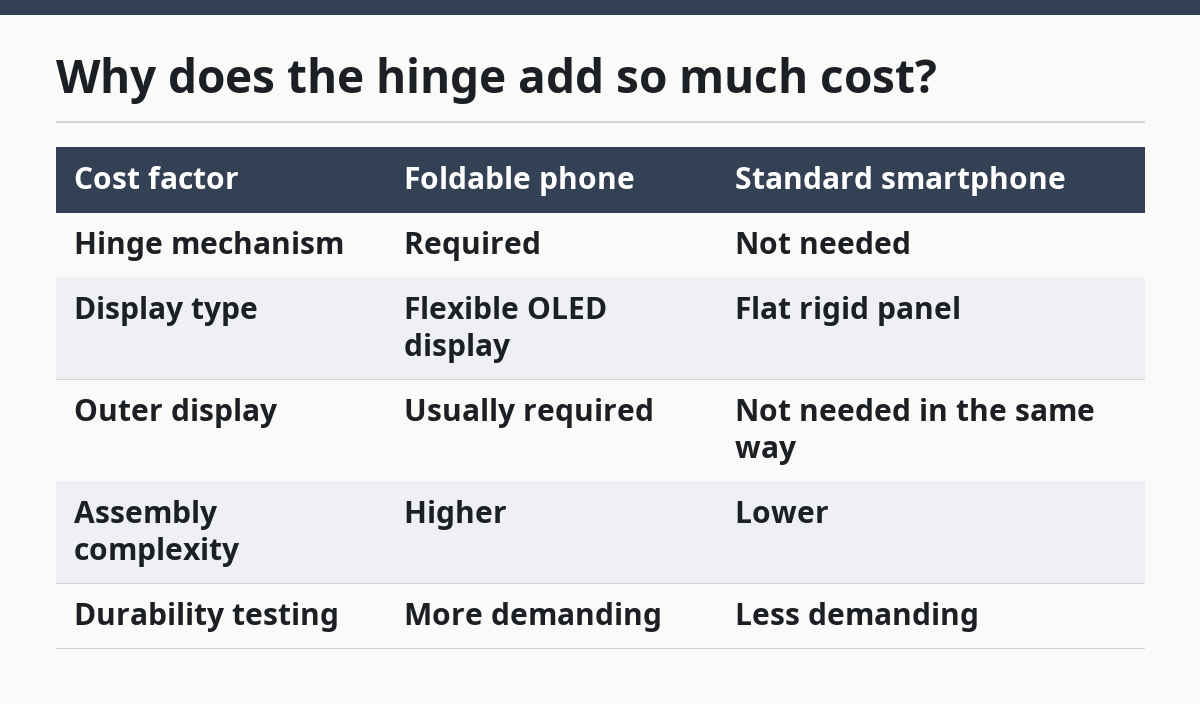
That table shows why foldables cost more even before marketing enters the picture. The hinge is not an accessory. It is one of the core reasons the product exists, and the phone cannot be made without it.
Why is the flexible OLED display pricier?
The flexible OLED display is pricier because it must work as a display and as a bendable component at the same time. A standard smartphone panel sits flat behind glass. A foldable panel has to bend, keep image quality, and stay usable after repeated folding, which makes the manufacturing process more difficult.
That difficulty starts with the materials. A flexible OLED display uses layers that have to remain thin and stable under movement. The cover layer also has to protect the screen while still allowing the phone to fold, and that is a harder balance than placing a flat sheet of glass over a rigid screen.
The display also has to be made with tighter quality control. Tiny flaws can show up more easily when the panel bends, and a panel that would be acceptable in a standard smartphone may fail in a foldable phone because the motion reveals weak spots.
This is one reason foldable phone pricing stays high even when the rest of the phone looks familiar. Two phones may both run the same kind of apps, but one needs a display built for bending, and that is a different product class, not a simple upgrade.
For a closer look at the panel itself, how OLED displays work helps explain why a flexible screen is harder to engineer than a rigid one.
How does production yield push prices up?
Production yield pushes prices up because foldable phones are harder to make without defects, so more finished units are lost during manufacturing. When a factory has a lower success rate for perfect screens, hinges, or full phone assemblies, each good unit has to carry part of the cost of the failed ones.
That matters more for foldables than for standard smartphones. A flat phone design has a simpler path through production, so fewer pieces go wrong and fewer units need to be reworked or discarded. A foldable has more custom parts and more points where alignment matters, which makes small errors expensive.
The term for this is yield, and it matters in any complex product. In a foldable phone, the yield problem can affect the display, the hinge, the frame, and the final assembly all at once. If one step has a weak pass rate, the whole line gets more expensive.
A simple way to think about it is this: a standard smartphone can absorb small mistakes more easily, while a foldable phone often cannot. That is why the same factory discipline that helps a normal phone stay affordable does not save as much money on a foldable.
What durability trade-offs raise the bill?
Durability trade-offs raise the bill because foldable phones need extra protection without becoming too thick or heavy. The inner screen is exposed to motion, the hinge has to keep working for a long time, and the body has to stay rigid enough to prevent damage while still folding.
That creates a design problem standard smartphones do not have. A normal phone can rely on a flat slab design and a protective outer shell. A foldable has to protect the inner display when closed, protect the hinge when moving, and still feel usable in the hand. Each layer of protection adds cost.
Durability work also increases testing and retooling. A phone maker may need more lab cycles for opening and closing tests, frame stress checks, and dust or debris concerns around the hinge area. Those steps do not show up in the box, but they show up in the price.
This is the trade-off that matters most for buyers: the foldable format costs more partly because it is trying to solve a harder physical problem. The product is not overpriced for no reason; it is priced like a complicated machine, not like a plain rectangle of glass and chips.
For a broader buying view, our smartphone buying guide compares the trade-offs that matter before you pay for a premium design.
Which parts raise the price the most?
The parts that raise the price the most are usually the hinge mechanism and the flexible OLED display, because both are custom pieces that standard smartphones do not need. Those two parts shape the rest of the phone, which means they also drive the cost of the frame, assembly, and quality control.
The outer display adds more cost too, even though it may look simple on paper. A foldable phone often needs a smaller second screen on the outside so it can be used when closed, and that means the phone carries two display-related systems instead of one.
The internal layout also becomes more expensive. Battery placement, cable routing, and camera positioning need more planning when the phone has to bend in the middle. A standard smartphone can keep its parts in a flatter, simpler arrangement, which usually lowers manufacturing cost.
For a reader trying to understand foldable phone pricing, the core answer is this: the most expensive pieces are the ones that make folding possible at all. If the phone did not fold, those parts would disappear, and so would a large part of the price premium.
Who is this price premium not for?
The price premium is not for someone who only wants a phone for calls, messaging, photos, and a few apps. A standard smartphone usually does those jobs with less risk, less weight, and a lower purchase price.
It is also not a good fit for a buyer who wants the simplest repair path. More moving parts usually mean more things that can go wrong, and foldables are built with tighter space and more complex internals than a flat phone. That does not make them bad products; it makes them more specialized products.
For readers comparing phone costs across categories, this page fits inside the larger topic of what affects mobile phone prices. The foldable premium comes from design and manufacturing, not from one single spec line on a store page.
Do foldables get cheaper as production improves?
Foldables can get cheaper as production improves, but the price gap does not vanish quickly. Better yields, more mature hinge designs, and larger production runs can lower costs over time, yet the category still needs more expensive parts than a standard smartphone.
That is the key point: efficiency helps, but the foldable format still asks for custom hardware. Even if factories get better at making flexible OLED displays and hinges, the phone still has to support bending, alignment, and durability in a way a flat smartphone does not.
The likely path is gradual, not dramatic. As the parts become easier to make and assemble, the premium can shrink. But as long as the phone folds in the middle, it will keep carrying costs that a regular smartphone never has to pay.
Quick Answer
Foldable phones are usually more expensive, but not always. A lower-priced foldable can still cost more than many flat phones because it adds a hinge and a flexible OLED display, and those two parts raise manufacturing cost.
Are foldable phones always more expensive?
No. They are usually priced above standard smartphones with similar mainstream features, but that is not an absolute rule. A lower-priced foldable can still cost more than many flat phones because the hinge and flexible OLED display add manufacturing cost even when the rest of the phone is not especially premium.
What part of a foldable phone costs the most?
The flexible OLED display and the hinge mechanism are usually the biggest cost drivers. The display has to bend without failing, and the hinge has to stay precise through repeated folding, so both parts require more engineering and tighter production control than standard smartphone parts.
Do foldables get cheaper as production improves?
Yes, they can get cheaper as factories improve yields and production becomes more efficient. The drop is usually gradual, though, because the phone still needs expensive custom parts. Better manufacturing can reduce the premium, but it does not erase the cost of making a device that folds.
For additional context, Samsung Display and Motorola’s foldable product pages both show how much hardware goes into flexible-screen phones.
Drafted with AI; not yet reviewed by a person.