
How Channel Exclusivity Shapes Phone Prices
Last updated: November 28, 2026
Quick Answer: channel exclusivity and retail distribution can hold a phone’s launch price steady for the first 30 to 90 days. In the topic of How channel exclusivity and retail distribution shape phone prices, the distribution channel decides where a phone can be sold, who can promote it, and how long it stays tied to a carrier store, an official retailer, or one exclusive distributor before it reaches a broader market.
Key takeaways
- A phone sold through one channel has fewer places to compete on price, so the launch price often stays fixed for longer.
- Retail partnership terms can change the sticker price, even when the phone itself is the same model and storage size.
- Regional channel restrictions can keep a phone out of a market for weeks or months, which changes how buyers compare it.
- Channel incentives can make one store advertise a lower headline price while another channel bundles extras instead of cutting the price.
- The same phone can cost differently depending on whether it is sold by a carrier store, an official retailer, an exclusive distributor, or a regional reseller.
What does distribution channel mean here?
A distribution channel is the route a phone takes from the maker to the buyer. In this topic, that route matters because a phone sold only through one carrier store or one official retailer faces different pressure than a phone that appears across several retail chains at once.
Therefore, the channel also sets the rules of the sale. An exclusive distributor may control the launch date, the listed price, the colors or storage tiers shown first, and the markets where the phone can be sold. A regional reseller may have stock, but only for a limited country or city, which can keep prices from settling quickly.
This is why “same phone, same box” does not mean “same price.” Distribution reaches the price tag before the buyer does. A phone with a narrow launch path often has fewer competing listings, fewer discount wars, and less chance of a quick drop.
In contrast, broader distribution can widen price spread across stores, but it can also create more visible competition. That is why the distribution channel belongs in the price conversation, not just the marketing conversation.
Why do some phones launch through one channel?
Some phones launch through one channel because exclusivity gives the maker and the retailer more control over the first sale. A carrier may want the phone tied to a contract plan, while an official retailer may want the phone to draw traffic into its own stores and website.
As a result, that setup changes the first 30 to 90 days after launch. If only one channel can sell the phone, buyers have fewer places to compare prices, so the launch price often stays firm. The phone may still appear “on sale” later through a bundle, a trade-in offer, or a plan credit, but the base price is usually harder to move.
Exclusive launches can also protect supply. If the maker has limited stock of a new model, channel control helps keep inventory in one place instead of spreading it thinly across many retailers. That can make the phone easier to find in one market and impossible to find in another.
However, exclusive launches can frustrate buyers who want to pay cash, switch carriers, or buy from a regional reseller with faster shipping. They can also make price tracking harder, because the first visible price may reflect launch control rather than normal market pricing.
How do retail partnership terms change the tag?
Retail partnership terms change the tag because the store and the maker agree on who can discount, when, and in what form. A carrier store may use monthly bill credits, while an official retailer may keep the sticker price fixed and add a gift card or accessory bundle.
Accordingly, those terms shape what the buyer sees first. One channel may show a lower headline price but require a plan commitment. Another may show the full opened price and avoid long-term billing terms. The phone is the same, but the payment path is not.
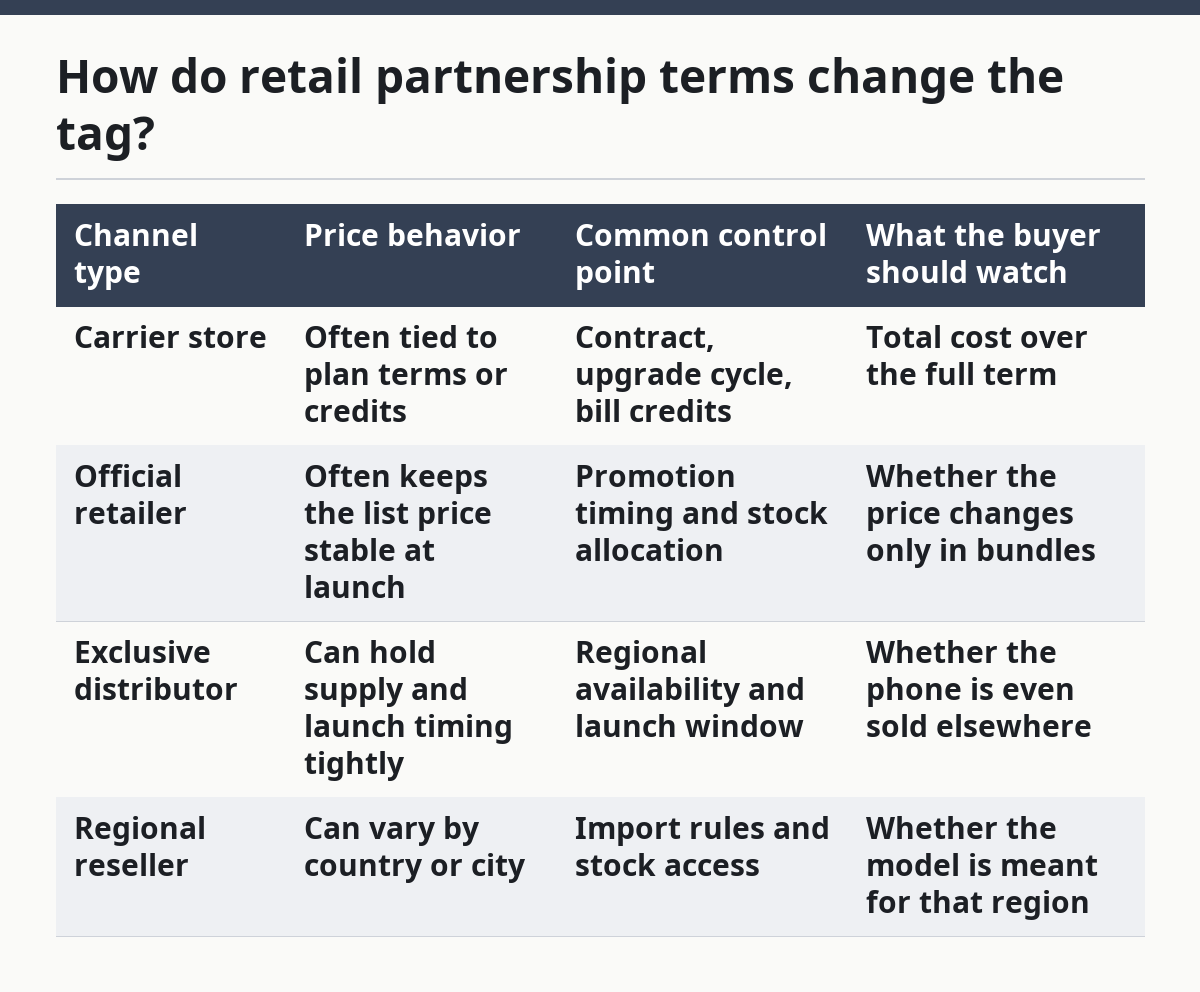
Here is the simplest way to compare the common channel setups:
| Channel type | Price behavior | Common control point | What the buyer should watch |
|---|---|---|---|
| Carrier store | Often tied to plan terms or credits | Contract, upgrade cycle, bill credits | Total cost over the full term |
| Official retailer | Often keeps the list price stable at launch | Promotion timing and stock allocation | Whether the price changes only in bundles |
| Exclusive distributor | Can hold supply and launch timing tightly | Regional availability and launch window | Whether the phone is even sold elsewhere |
| Regional reseller | Can vary by country or city | Import rules and stock access | Whether the model is meant for that region |
The main trap is focusing on the sticker and ignoring the route. A lower-looking price from one channel can be real, but only if the buyer does not pay it back through a longer plan or a tighter lock-in.
A higher-looking price can also be honest if it includes an opened phone with fewer strings attached. For background on phone locks and opening, see the FTC’s consumer guidance on mobile devices and the FCC’s advice on opened phones: https://consumer.ftc.gov/ , https://www.fcc.gov/consumers/guides/unlocked-phones.
What regional restrictions do to price
Regional restrictions change price because they limit who can sell the phone and where it can move next. If a model is meant for one country, an official retailer elsewhere may never stock it, which leaves buyers with fewer direct options and more dependence on a regional reseller.
That can create a split market. In one region, the phone may launch through a single carrier or official retailer. In another, it may not show up at all until a later wave, if it appears there at all. The result is not just a price difference; it is a difference in access.
Regional channel control also affects features that buyers notice only after purchase. A model with the same name can be sold with different band support, warranty handling, or packaging by market. That does not always make the price higher, but it can make a cheaper listing a poor deal if the phone is not meant for local use.
This is where a buyer can save time by checking the channel before comparing prices. If a phone is locked to a region, a low listing from a distant reseller may look attractive and still be the wrong buy. The price matters, but the sales path matters just as much.
How to read a channel-controlled price in 5 steps
A buyer can read a channel-controlled phone price by tracing the sale route before comparing the number on the page. The goal is to tell a real price cut from a channel rule, a bundle, or a launch restriction.
- Identify the seller type. Check whether the listing is from a carrier store, an official retailer, an exclusive distributor, or a regional reseller. The seller type tells you whether the phone is likely tied to a plan, a launch window, or a region.
- Check the launch status. If the model is brand new, ask whether it is in an exclusive launch phase. A phone sold only through one channel for the first few weeks often has less price movement than an older model.
- Read the payment terms. Look for plan credits, trade-in terms, or installment language. A lower monthly payment can hide a higher total cost.
- Compare what is bundled. Some channels lower the headline price by adding accessories or service credits instead of cutting the phone price itself. That can make a “deal” look better than it is.
- Check region and warranty notes. A regional reseller may offer the right model number, but not the right support terms for your market. A price that looks good on paper can become a poor value if the phone is not supported where you live.
For a broader buyer checklist, see the hub page on Mobile Phone Pricing Factors. This process does not need a calculator at first. It needs a clear reading of the channel. Once the route is known, the price usually makes more sense.
Common mistakes that make prices look lower than they are
The most common mistake is treating every channel price as a cash price. That mistake costs buyers because a carrier store or official retailer may present a lower upfront number that depends on a longer payment term, a plan change, or a promotion window. If the terms are unclear, consult a sales professional or review the seller’s disclosure, because FTC guidance on phone offers and billing terms recommends checking the full cost before you buy: https://consumer.ftc.gov/ .
A second mistake is assuming the first launch price is the “real” price. Exclusive launches often hold the price in place longer than buyers expect. If the phone is only in one channel, there is no second store to force a quick cut.
A third mistake is comparing channels without checking region. A regional reseller can make a phone appear available everywhere when it is really meant for one market. That mistake costs time and can lead to a return problem later.
A fourth mistake is ignoring distribution reach. A phone with wider retail reach may show the same price in more places, but that does not mean the seller has less control. The channel can still shape the discount timing, the colors offered, and the stock depth. A buyer who only looks at the number can miss the rules behind it.
Who is this NOT for?
This guide is not for someone trying to compare the cheapest phone price across every seller type, or for someone focused on marketplace fees or retailer margin. Those are separate pricing questions, and mixing them with channel exclusivity muddies the result.
This guide is for a buyer who wants to know why one phone is sold through a carrier store today, an official retailer next month, and a regional reseller somewhere else. That difference can matter more than a small headline discount. If the question is “why is this phone priced the way it is across channels,” this is the right lens.
For a broader view of phone pricing, the next step is the hub page on Mobile Phone Pricing Factors, which puts channel control beside the other forces that shape the final number.
Why distribution channel matters more than a simple discount
Overall, distribution channel matters because it decides the rules before the discount appears. A phone sold through an exclusive distributor may never face the same pressure as a model sold through several retail chains at once.
That is why one phone can seem expensive in one place and ordinary in another. The channel is not just a sales route; it is part of the price itself. A buyer who reads the route first is less likely to mistake a controlled launch for a market-wide price.
Do exclusive stores charge more?
In many cases, exclusive stores can present a higher sticker price, but the total cost depends on credits, bundles, and plan terms. The buyer should check the total cost, not just the first number shown.
Why do some phones launch only through one channel?
A one-channel launch gives the maker or retailer more control over timing, stock, and pricing. It can also protect a new model from getting spread too thin across stores. The trade-off is less price competition and less choice for buyers during the launch window.
How does distribution exclusivity affect pricing?
Distribution exclusivity narrows the number of sellers who can compete on the same model at the same time. That usually keeps prices steadier for longer and can slow down discounting. It also means the first visible price may reflect channel control as much as market demand.
For further reading on how phone offers are structured, the FTC and FCC are useful starting points: https://consumer.ftc.gov/ and https://www.fcc.gov/consumers/guides/unlocked-phones.
Drafted with AI; not yet reviewed by a person.