

How to Compare Mobile Phone Stackable Offers
Last updated: November 20, 2026
Quick Answer: compare mobile phone stackable offers by checking which four things change the final price: sticker price, trade-in credit, rebate, or voucher value. In this guide to How to Compare Mobile Phone Stackable Offers, the safest way is to track the exact line each discount changes, because one offer can cancel another or reduce the amount another discount can touch.
Key takeaways
- Stackability matters more than the size of the first discount you see.
- A coupon, a trade-in credit, a manufacturer rebate, and a retailer voucher do not work the same way.
- The order of discounts can change the final price.
- A deal that sounds large can be weak if one offer wipes out another.
- A careful comparison usually starts by mapping each discount to the exact line it changes.
What makes an offer stackable?

A stackable mobile phone offer is one where two or more discounts can apply to the same phone without one fully canceling the other. The practical test is simple: ask what each offer is allowed to touch. A promo code may reduce the checkout price, a trade-in credit may reduce the bill after appraisal, and a rebate may arrive later as cash back or a statement credit.
The trap is assuming that every discount applies to the same base price. It often does not. A retailer voucher may work only before tax, while a manufacturer rebate may require the full purchase price first. A carrier promo may also require a plan change or a line activation, which means the “discount” is tied to a separate condition, not just the phone price.
A clean comparison starts with four labels:
- Promo code: a code entered at checkout, usually tied to the online cart.
- Trade-in credit: value for your old phone, usually based on model and condition.
- Manufacturer rebate: money returned after the sale, often with a form or claim process.
- Retailer voucher: a store-issued credit or coupon that may have its own limits.
The key question is not “How big is the discount?” It is “Can this offer stack with the others, and if so, in what order?” For a useful outside reference on offer terms, the Federal Trade Commission explains how rebates and discounts can work differently from upfront price cuts, and retailer terms often spell out the same thing in their fine print.
Which offer types stack best?
Different offer types stack in different ways, and some combinations are easier to compare than others. The table below shows common patterns to check first.
| Offer combo | How it usually works | What to check first | Best for | Main drawback |
|---|---|---|---|---|
| Promo code + trade-in credit | Code cuts the checkout price, then trade-in is applied or valued separately | Whether the code lowers the amount used to calculate trade-in | Buyers replacing an old phone | Trade-in value can be based on a lower base if the retailer applies the code first |
| Promo code + manufacturer rebate | Code lowers the upfront price, rebate is claimed later | Whether the rebate is valid after another discount | Buyers who can wait for the rebate | Rebate forms, deadlines, and proof requirements can slow the savings |
| Carrier promo + retailer promo | Two sellers may offer separate savings, but one may depend on plan rules or activation | Whether both promos can be used on the same device | Buyers comparing channel offers | One seller may block the other if the offer terms conflict |
| Manufacturer rebate + retailer voucher | Voucher cuts the purchase price, rebate returns money later | Whether the rebate is calculated from the pre-voucher or post-voucher price | Buyers chasing layered savings | The rebate may be smaller than expected if the voucher changes the base |
| Trade-in credit + carrier promo | Trade-in reduces the bill while carrier promo may come through monthly bill credits | Whether the carrier requires a line term or billing plan | Buyers with an old phone and a carrier change | Long billing credits can hide the real timing of the savings |
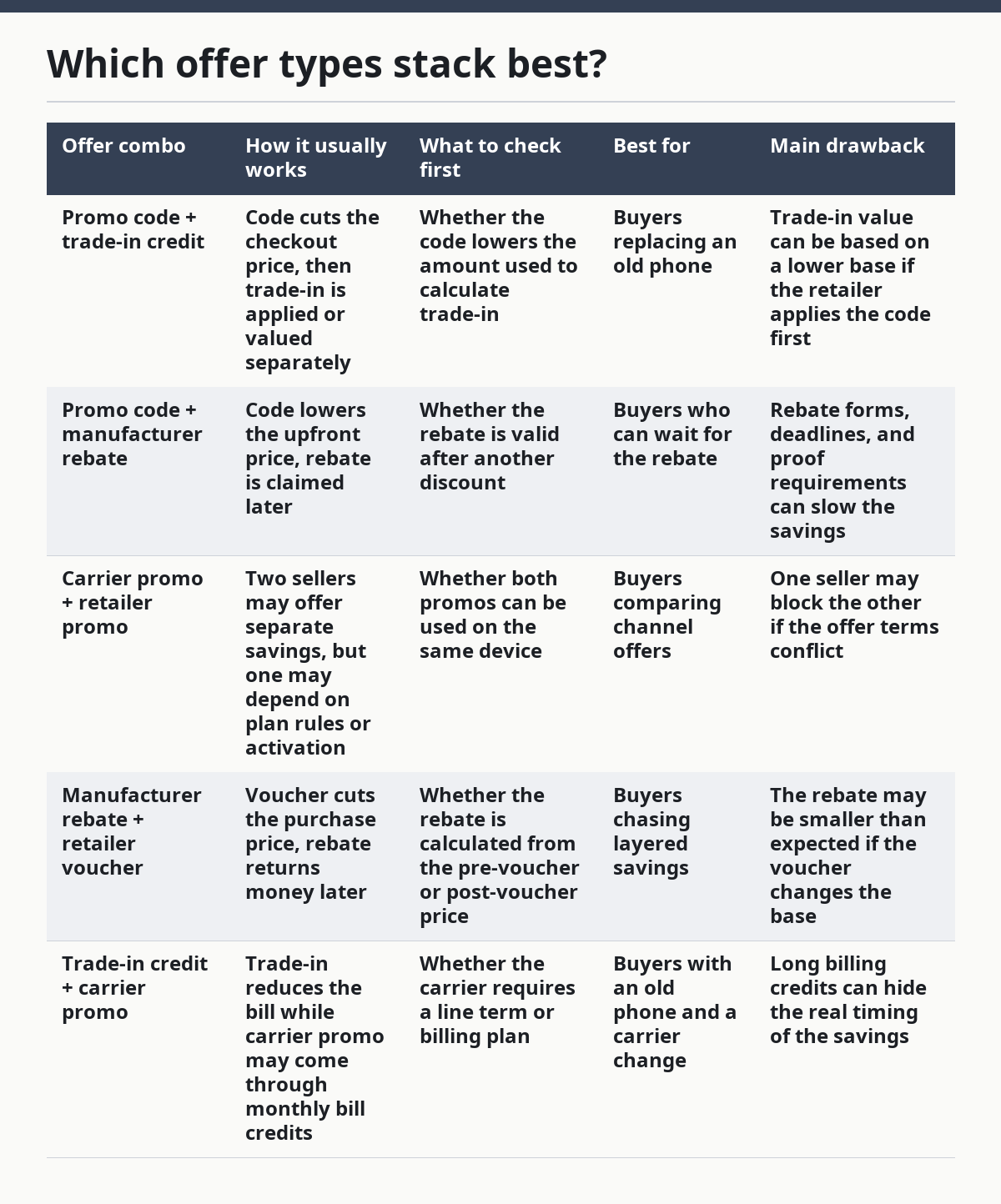
For many buyers, a promo code plus a trade-in credit is easier to compare because the savings are more visible and less dependent on after-sale paperwork. That said, it is not the right choice for everyone. If your trade-in is weak or the promo code only applies to accessories, the combo loses value fast.
A manufacturer rebate can look attractive on paper, but it is weaker for anyone who wants instant savings. A retailer voucher can be more flexible, yet it may expire quickly or exclude premium models. Carrier promos can offer large-looking numbers, but they often bring the most conditions. For a second authoritative reference, the Federal Communications Commission and the FTC both warn shoppers to read service and billing terms carefully when a wireless offer depends on credits or plan changes.
How do you compare phone offers step by step?

You compare mobile phone stackable offers by reducing every deal to the same question: what is the final out-of-pocket cost, and what conditions are attached to it? That means reading the terms in order, not jumping straight to the largest printed discount.
Use this process every time:
- Write down the phone model, storage size, and seller, such as a 128 GB model sold by a carrier or retailer. This gives you the exact price path to compare.
- List each discount separately: promo code, trade-in credit, manufacturer rebate, retailer voucher, or carrier promo. You are looking for the offer names, not a marketing summary.
- Check whether each offer changes the same base price or a different one. If one offer is applied before another, the final total can change.
- Look for exclusions, such as “cannot be combined with other offers,” minimum plan requirements, or limits on refurbished and open-box phones. One sentence in the terms can erase the stack.
- Note when each saving arrives: at checkout, after trade-in processing, after rebate approval, or as monthly bill credit. The timing affects how useful the deal feels.
- Compare the final total you actually pay, not the advertised discount. A smaller upfront reduction can beat a bigger rebate if the rebate is delayed or hard to claim.
- Choose the deal that keeps the lowest real cost with the fewest conditions. If two offers end close together, pick the one with the cleaner terms and the shorter wait.
A good comparison sheet should include at least four columns: offer name, amount or value, when it applies, and what blocks it. If the seller hides one of those pieces, the deal is harder to trust. For a phone priced at a premium level, even a small difference in order can matter more than the size of the rebate.
Therefore, readers should compare apples to apples. A retailer voucher and a trade-in credit are not the same kind of saving, because one is a discount and the other is a payment for your old device. Treating them as equal often makes a deal look better than it is, so if you are unsure, consult a consumer-protection professional or the seller’s support team and check the FTC’s rebate guidance before deciding.
Which stack should you choose?
You should choose the stack that gives you the clearest saving with the least risk of losing part of it. For most buyers, a promo code plus trade-in credit is the easiest to judge, while a carrier promo plus retailer promo is the hardest.
Promo code + trade-in credit
Pros: easy to see at checkout, often simple to compare, and the phone price drops before the trade-in is valued. Cons: the code may apply only to certain models, and the trade-in can be downgraded if the device condition is worse than expected. This option is for someone who wants a direct reduction and has a phone to hand in.
Promo code + manufacturer rebate
Pros: the upfront price is lower, and the rebate can add extra value later. Cons: the rebate may need a form, proof of purchase, or a deadline, and the savings can be delayed. This option is for a patient buyer who is comfortable waiting for the back-end refund.
Carrier promo + retailer promo
Pros: the combined headline savings can look strong, especially around major sales. Cons: the carrier may require a plan change, line activation, or bill-credit schedule, while the retailer may not allow the same device to qualify for both. This option is for buyers already planning a carrier move and willing to read terms carefully.
Manufacturer rebate + retailer voucher
Pros: the voucher can trim the price at once, and the rebate can add a later return. Cons: the rebate may be based on a different base price than expected, and the voucher may have category limits or expiry dates. This option is for buyers who can track two separate savings paths without losing paperwork.
My recommendation is the stack that combines a visible upfront discount with a simple, separate credit, usually a promo code plus trade-in credit. It is not always the largest on paper, but it is often the easiest to verify and the least likely to fall apart in the fine print. It is the wrong choice for anyone who needs the biggest possible headline discount regardless of timing, because rebates and carrier credits can look larger while feeling slower and more conditional.
What do the fine-print rules usually hide?
The fine print usually hides the part that changes the real value of the deal. That is where a 20-word promo description becomes a much narrower offer once the terms are open.
The most common limits are:
- Order rules: one offer must be entered before another, or it stops qualifying.
- Model limits: the offer works on only some phone models or storage sizes.
- Timing rules: a rebate must be submitted within a set window, or the claim fails.
- Channel rules: an offer works online but not in store, or with one seller but not another.
- Payment rules: a carrier promo may require monthly billing credits instead of a one-time cut.
- Combination rules: a retailer voucher may be blocked by another coupon code.
These limits matter because they change the shape of the saving. A buyer who sees “save $X” may not notice that the offer only applies after a trade-in inspection, or that the rebate arrives in a separate step weeks later. That is why stackability should be checked before emotional excitement sets in.
The cleanest habit is to read the offer like a checklist, not a slogan. If the terms mention “may not be combined,” treat that as a stop sign unless another line clearly says otherwise and the seller confirms it in writing; when in doubt, consult a consumer-protection professional and check the FTC’s guidance on rebates and discounts. If the terms mention “eligible devices only,” look up the exact model before comparing anything else. A deal that works only after three extra steps is not the same as a deal that works at checkout.
For consumer guidance on rebates and discounts, the FTC is a useful place to check because it explains how these offers can differ from an immediate price cut. That is the kind of detail that keeps a comparison honest.
How do I compare two deals side by side?
You compare two deals side by side by turning both into the same worksheet, then measuring the total cost and the effort required to get it. A simple side-by-side view is better than reading two sales pages separately.
Use one row per offer and mark these items:
- phone model and storage
- seller
- list price
- promo code value
- trade-in value
- rebate value
- voucher value
- timing of each saving
- conditions that can cancel the offer
Then ask three questions. Which deal gives the lowest final cost? Which deal has the fewest moving parts? Which deal is least likely to fail because of a condition you missed? The right answer is not always the lowest number, because a delayed rebate or a tricky carrier credit can cost time and patience.
If one deal offers a bigger total saving but splits it into a rebate and a bill credit, that deal is harder to compare than an upfront discount with a trade-in. That does not make it bad. It just means the buyer needs to value timing, paperwork, and risk alongside the savings amount.
For readers working through the broader price picture, this page fits under the site’s mobile phone price comparison and value topic. The useful habit is the same there as it is here: compare the price you will actually pay, not the marketing line you saw first.
When should you pass on a stackable offer?
You should pass on a stackable offer when the savings depend on conditions you do not want to accept. A discount is not worth much if it forces a plan change, an unwanted service add-on, or a long wait for money that should have been immediate.
Skip the deal if any of these are true:
- The terms say another offer cannot be combined, and the seller has not confirmed otherwise.
- The rebate is small enough that the claim process is not worth your time.
- The carrier promo requires monthly bill credits and a contract term you do not want.
- The trade-in value looks high but depends on a perfect condition rating you cannot guarantee.
- The retailer voucher excludes the exact phone model you want.
A common mistake is treating every extra discount as free money. It is not free if it changes the way you buy, when you pay, or what you must keep active after the sale. That is especially true with carrier offers, where the real cost can sit in the service rules rather than the phone itself.
The better move is to pick the offer with the cleanest path to ownership. If a smaller discount is easier to receive and easier to keep, it can be the smarter choice. If a larger stack only works after four steps and a deadline, it may be a bad trade for a buyer who wants a simple purchase.
Can you stack phone discounts?
Sometimes, yes, but only when the offer terms allow it. A promo code, trade-in credit, manufacturer rebate, or retailer voucher may stack if each one applies to a different part of the deal or if the seller says they can be combined. If the terms say “cannot be combined with other offers,” assume the stack fails unless the seller confirms otherwise.
Which phone offers can be combined?
The offers most often combined are a promo code with a trade-in credit or a promo code with a manufacturer rebate, but the rules vary by seller. Carrier promos and retailer promos are the trickiest pair because one may depend on plan activation, billing credits, or a single sales channel. The exact combination always comes from the written terms, not the headline ad.
Drafted with AI; not yet reviewed by a person.