

How Component Shortages Affect Mobile Phone Prices
Last updated: November 26, 2026
Component shortages push mobile phone prices up when makers cannot get enough chipsets, display panels, memory chips, or camera modules to build phones at planned volumes. The shortage does not only raise factory costs; it also slows production, trims discounts, and can keep one model expensive for longer than buyers expect.
Key takeaways
- A shortage usually starts inside the supply chain, not at the store shelf.
- One missing part can hold back the whole phone, even if every other part is available.
- Chip shortages often hit the main processor first, but display panels, memory chips, and camera modules can also limit supply.
- Lower production gives sellers less room to cut prices, so launch pricing can stay firm.
- The effect is strongest on models that use parts from a small number of suppliers.
What a component shortage does to price
A component shortage raises mobile phone prices by reducing how many phones can be built on time. When a maker cannot secure enough parts, it has fewer units to sell, so the phone loses the pricing pressure that comes from full shelves and normal competition.
The price effect starts long before a shopper sees a label in a store. A phone needs a matched set of parts: a chipset, display panel, memory chip, camera module, battery, and supporting electronics. If one of those parts is late, the phone can sit half-built in the factory. That is a production constraint, and it often costs more to work around than to wait.
This is why a shortage can lift prices without any change in the phone’s design. The maker may pay more for scarce parts, pay more to reroute assembly, or ship fewer units and protect margin instead of discounting. That is the opposite of a normal sale cycle, where volume gives room for lower prices.
The effect is not the same for every phone. A model that uses common parts from multiple suppliers may absorb a shortage better than a model that depends on one exact display panel or one specific camera module. In a tight supply chain, the phones with the least flexible parts are the first to feel the squeeze.
For a wider view of pricing factors, the hub on what affects mobile phone prices belongs alongside this guide.
Which parts push prices up most?
Component shortages affect prices most when they hit parts that are hard to swap out quickly. The biggest pressure usually comes from the chip shortage, but display supply, memory supply, and camera module supply can each move price in its own way.
| Component | Why it matters | Typical price effect |
|---|---|---|
| Chipset or main processor | Sits at the center of the phone’s core functions | Can slow or cap production across the whole model |
| Display panel | Must match size, resolution, and panel type | Can delay shipment or force a more expensive source |
| Memory chip | Needed for storage and performance tiers | Can make higher-capacity versions harder to stock |
| Camera module | Often tied to a specific lens and sensor setup | Can reduce the number of finished phones available |
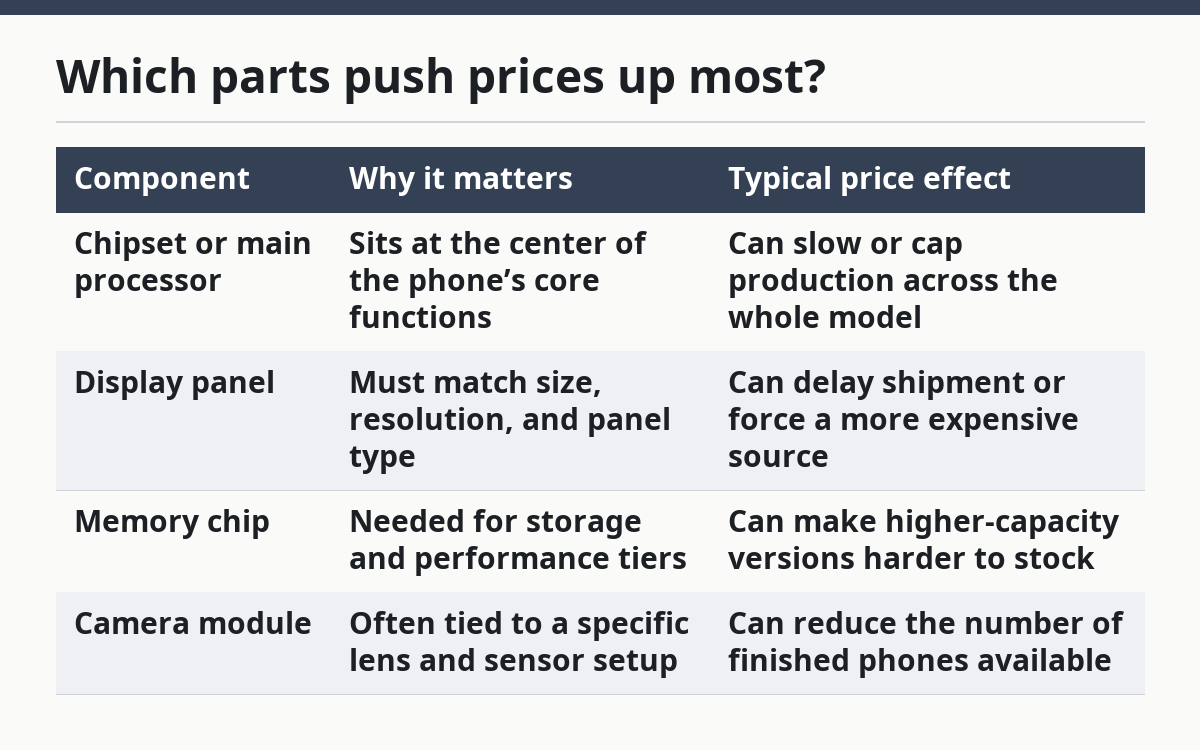
A chipset shortage is the bluntest problem because it can stop the build. If the processor is missing, the phone cannot be completed. That is why chip shortage stories often lead the news during supply crunches.
Display shortages work a little differently. A maker may still build the phone shell, but without the right display panel the units cannot be finished. The phone may launch in a smaller batch, or in fewer color and storage options, which can keep the price firm.
Memory shortages can change the mix of models on sale. If 128 GB or 256 GB parts are tight, the maker may favor higher-margin versions first. That does not always raise the entry price, but it can leave cheaper versions in short supply.
Camera module shortages can matter even on ordinary phones. A camera module is a bundled part, not just one lens, so a single supplier problem can reduce output more than buyers expect. For phones sold on camera quality, that can matter as much as the chipset itself.
Why does a chip shortage hit one phone harder than another?
A chip shortage hits one phone harder than another when that model depends on a narrow set of parts or a single supply line. The more specific the part, the less room the maker has to switch suppliers without changing the phone or delaying it.
This is where production constraint becomes the key idea. A phone maker may have design plans, marketing plans, and a launch date, but those plans only work if the supply chain delivers the exact parts on time. If one chip family is scarce, the maker may have to wait even if the rest of the bill of materials is ready.
Two phones can look similar to a shopper and still face very different supply risks. One may use a standard memory chip and a common display panel. Another may use a less common panel size, a custom camera module, or a processor that is in heavy demand across the industry. The second phone is more likely to face a delay or a higher launch price.
This is also why shortages do not always show up as a neat, visible price jump. Sometimes the listed price stays the same, but discounts disappear. Sometimes the base model stays available while the higher-capacity version becomes hard to find. Sometimes the release spreads across regions over weeks instead of days.
A useful way to think about it is simple: the more custom the part, the more fragile the price. Standard parts can be swapped, sourced, or reallocated more easily. Custom parts lock the phone into a tighter supply chain, and that usually leaves less room for cheap units.
How does the supply chain pass the cost on?
The supply chain passes the cost on by adding pressure at each step between the factory and the retailer. A shortage does not just change the maker’s costs; it changes how many phones can move through each stage, and that affects the final price a shopper pays.
Here is the usual chain, step by step:
-
A component runs short at the supplier level. The missing part might be a chipset, display panel, memory chip, or camera module. The result is a slower flow of parts into assembly plants.
-
The phone maker gets fewer complete sets. Fewer parts mean fewer finished phones, often with a focus on the models or regions that matter most. The result is a smaller shipment than planned.
-
Factory costs rise per phone. Fixed costs such as labor, testing, and logistics get spread across fewer units. The result is a higher cost for each finished phone.
-
Discounting gets cut back. If stock is thin, sellers do not need to mark down prices to move inventory. The result is firmer launch prices and fewer early deals.
-
The market resets around scarcity. A shortage can make a phone feel rare for a while, which keeps prices raised until supply catches up. The result is slower price softening than buyers expect.
The important part is that the final sticker price reflects more than the part itself. It reflects delays, smaller batches, and the loss of normal volume pricing. That is why a shortage can affect prices even when the phone’s design stays the same.
What changes at launch and after launch?
A shortage can change launch pricing by making a phone arrive in a smaller batch, with less room for early discounts. That often means the first price looks firmer than expected, and the phone stays that way until supply improves.
At launch, makers want enough stock to support press coverage, carrier orders, and store demand. If supply is tight, the launch may still happen, but the number of units behind it is smaller. That can keep the price from dropping quickly because there is no surplus to clear.
After launch, the pattern depends on how long the shortage lasts. If the missing part returns to normal supply in a short period, prices may settle once stock improves. If the shortage keeps going, the phone can remain expensive longer than a buyer would expect from a typical cycle.
This is one reason shortages are frustrating for shoppers who wait for a normal price dip. A phone can sit at its launch price for months if the factory cannot build enough units. The delay is not always obvious from the outside, because the phone may still be listed and advertised. The real problem is that the supply chain has not filled the channel.
A shortage can also distort the model mix. Base versions may disappear first, leaving higher-storage variants as the easiest ones to buy. That makes the average selling price look higher even if the official launch price has not changed. For a buyer, the result is simple: fewer choices and fewer chances to save.
What should a buyer watch for during a shortage?
A buyer should watch for signs that the shortage is affecting supply, not just the headline price. The most useful signals are limited stock across storage tiers, delayed ship dates, and fewer retailer discounts on the same model.
That matters because the sticker price alone can hide the real effect. A phone may look “stable” at launch price, but if the cheapest version is out of stock, the usable price has risen. If a buyer has to move up to a higher-capacity version, the real cost goes up even when the base model number stays the same.
The safest move is to compare the part of the market that is still in stock, not the broad advertised price only. A shortage often affects one model, one capacity, or one color first. That means a buyer may need to decide whether waiting is worth the chance that supply improves later.
This page is not for someone trying to compare the first month after release or track short-term price drops across retailers. It is for the buyer who wants to understand why a normal phone can stay expensive when one part of the supply chain goes tight.
For background on the supply side, the Semiconductor Industry Association and OECD supply chain work are useful starting points. Their materials help explain why chip availability and transport bottlenecks can ripple into consumer prices.
Why do phone prices rise when parts are scarce?
Phone prices rise when parts are scarce because the maker can build fewer units and loses the pricing pressure that comes with normal supply. A shortage can also raise the maker’s own cost per phone, especially when it must source a part from a more expensive supplier or run a smaller production batch. The result is often a firmer retail price and fewer discounts.
Which components can affect smartphone pricing?
The parts that most often affect smartphone pricing are the chipset, display panel, memory chip, and camera module. A shortage in any one of these can slow production or reduce the number of finished phones. The effect is strongest when the part has few substitutes or must match a very specific phone design.
How do shortages change launch pricing?
Shortages can change launch pricing by limiting the number of units available when the phone first goes on sale. A small launch batch gives retailers less reason to discount, and it can leave only certain storage versions in stock. That is why a phone may debut at its full price and stay there longer than expected.
Can supply issues keep a phone expensive for longer?
Yes, supply issues can keep a phone expensive for longer if the shortage lasts beyond the launch window. When production stays tight, retailers have little excess stock to clear, so prices soften slowly. If the missing part is a critical one, the phone may remain hard to find at the lower end of its price range for an extended period.
Drafted with AI; not yet reviewed by a person.