

How retailer margin affects phone price
Last updated: November 27, 2026
Quick Answer: retailer margin and channel markup can add 10% or more to a phone’s final shelf price, depending on the seller and channel. If you want the real shelf price, start with the base cost from the distributor, then add the wholesaler’s cut, the retailer’s margin, and the store overhead that has to be paid from each sale. This page explains how retailer margin and channel markup affect the final phone price.
Key takeaways
- The price you pay is not just the phone’s cost; it also covers the seller’s share and the costs of keeping the store open.
- The same model can cost more at one shop because that shop needs to recover rent, staff pay, display stock, and payment fees.
- Authorized retail pricing usually leaves less room for surprise discounts, while third-party pricing can move faster.
- Online stores often have a different markup structure from physical stores, but lower prices are not automatic.
- If a phone looks cheap, check whether the lower price comes from lower margin, fewer included services, or a different channel.
What is retailer margin on a phone?
Retailer margin on a phone is the amount a store keeps above its own cost when it sells the device. That margin is what pays the business and helps cover the risk of stocking phones that may sit for weeks or months.
In plain terms, if a retailer buys a phone through a wholesaler or distributor, the store does not sell it at the same number it paid. The gap between the store’s cost and the shelf price is the retailer margin. A bigger margin usually means a higher final price, unless the store is using the phone as a traffic item and pricing it very tightly to bring in buyers.
This is where people get tripped up. The margin is not the same thing as profit after every expense. A shop may have a visible markup on a phone, then use part of that to pay store overhead such as rent, wages, card fees, stock loss, and returns. That means a phone sold with a thin margin can still be expensive if the store has high operating costs.
A simple way to think about it is this:
- Distributor cost: what the seller pays into the channel
- Retailer margin: the added amount the store wants to keep
- Store overhead: the fixed costs the store must recover
- Final phone price: what the buyer sees at checkout
That last number can change even when the phone model, storage size, and color stay the same. A 128GB model and a 256GB model are not the same product, and the markup can be different on each one. If you are comparing prices, compare the exact model number first, and do not rely on the brand name alone.
Why do different stores list the same phone at different prices?
Different stores list the same phone at different prices because their channel markup and overhead are not the same. One seller may buy through a wholesaler, another through a distributor, and a third may work under an authorized retail pricing rule that limits how far the price can move.
Channel markup is the extra cost added as a phone moves through the chain. A phone can pass from distributor to wholesaler to retailer, and each step may add its own margin before the buyer ever sees it. That is why two stores can carry the same phone and still end up with different shelf prices.
Store overhead matters too. A shop with a prime retail location, staffed counters, and full display inventory has more costs to recover than a seller operating from a small back room or a warehouse. Those costs often show up in the final phone price even when the base device is identical.
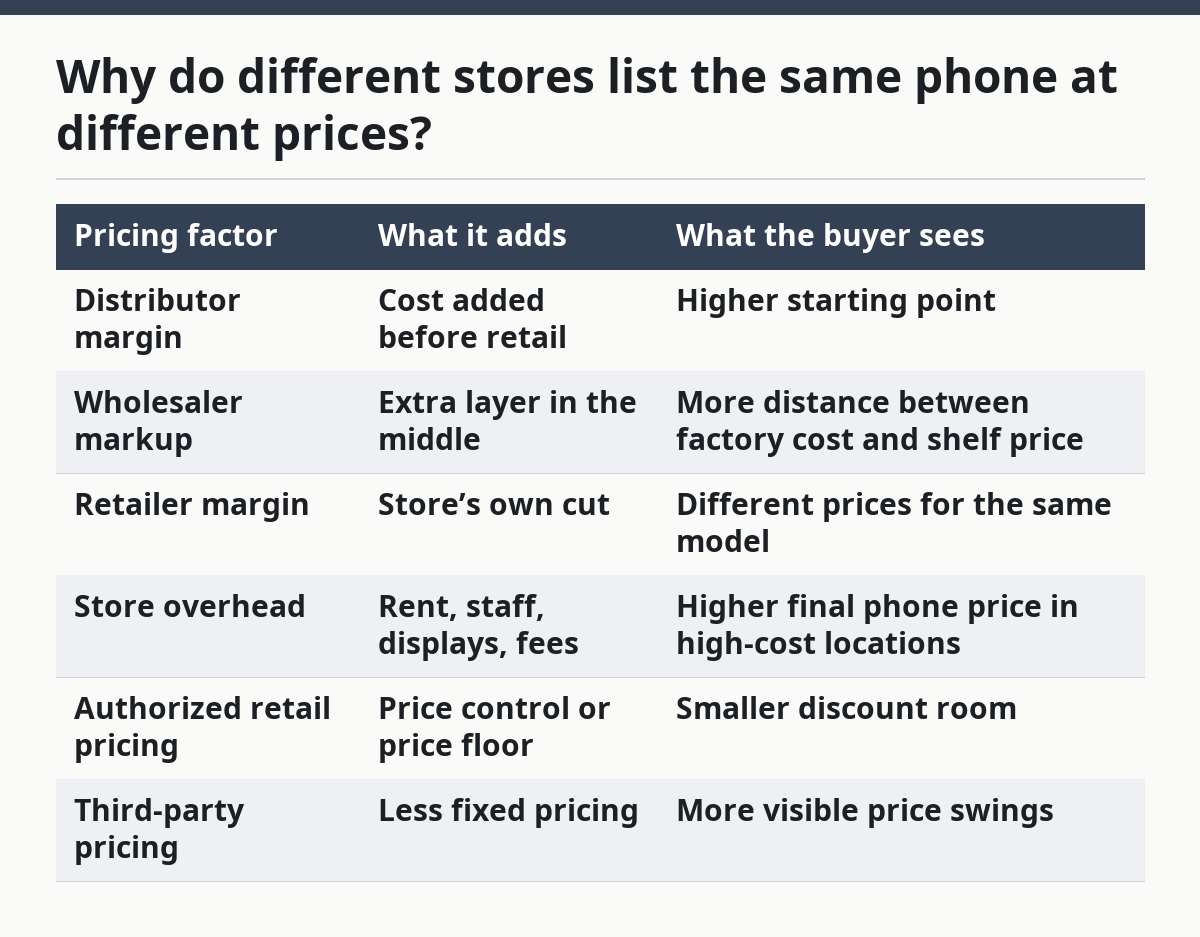
Here is the comparison in one view:
| Pricing factor | What it adds | What the buyer sees |
|---|---|---|
| Distributor margin | Cost added before retail | Higher starting point |
| Wholesaler markup | Extra layer in the middle | More distance between factory cost and shelf price |
| Retailer margin | Store’s own cut | Different prices for the same model |
| Store overhead | Rent, staff, displays, fees | Higher final phone price in high-cost locations |
| Authorized retail pricing | Price control or price floor | Smaller discount room |
| Third-party pricing | Less fixed pricing | More visible price swings |
The same phone can also be priced differently because of stock timing. A store with older stock may drop the price to clear shelf space, while a store with newer stock may hold the price steady. That is common with models that have been on sale for 3 or 4 product cycles and are still moving through the channel.
This part matters most if you are trying to decide whether a price gap is real savings or just a different pricing setup. A lower sticker price is not always a better deal if the seller is cutting support, limiting returns, or changing the bundle.
For a quick check, compare the same model at two sellers and note whether the gap is tied to channel, stock age, or included service. If the difference is only a few dollars, the seller may simply be running a tighter margin.
How do I estimate the final phone price?
The final phone price is the base cost plus every layer added on the way to the shelf. A quick estimate starts with the distributor or wholesale price, then adds the retailer margin, then checks whether store overhead is already baked into the shelf tag.
Use this 5-step check when you compare a phone price:
- Identify the exact model. Match the brand, storage size, and version so a 128GB model is not compared with a 256GB model.
- Ask which channel the phone came through. Direct retail, wholesaler supply, and authorized retail pricing do not behave the same way.
- Look for the retail margin signal. A high shelf price with no bundle often means the seller is keeping a wider spread.
- Check what the price includes. Some sellers build support, setup, or warranty handling into the price, while others keep the tag bare.
- Compare the final checkout total, not just the sticker. A low shelf price can rise once fees, delivery, or add-ons appear.
This matters because a phone’s final price is often shaped more by the channel than by the hardware. A seller with low overhead can live on a smaller margin. A seller with a costly storefront may need a wider markup just to stay open.
Do not expect every price difference to mean overcharging. Some gaps are normal. A store that carries stock, offers immediate pickup, and keeps trained staff on hand has real costs. The point is not to hunt for the lowest number on paper. The point is to understand which part of the number comes from the device and which part comes from the path it took to reach you.
A practical habit helps here: compare two or three offers from the same exact model, then look at the listed extras. If one seller is higher by a small amount but includes a service you would have paid for anyway, the larger sticker price may not be the worse deal.
Are online and offline prices built the same way?
Online and offline prices are built from the same basic pieces, but the mix of retailer margin and store overhead is usually different. A physical store often carries more overhead, while an online seller may trade lower display costs for shipping, warehousing, and return handling.
That difference changes how the final phone price is set. An offline store may need a wider markup to cover rent, floor staff, and in-person service. An online seller may have less showroom cost, but the price still needs to cover fulfilment, payment processing, and returns. Lower overhead does not automatically mean lower prices, because the seller can choose to keep more of the savings or use them to stay competitive.
Authorized retail pricing can also shape both channels. In some cases, the same phone carries a more rigid price pattern through authorized sellers, while third-party pricing moves more quickly as sellers react to stock levels and demand. That is why two listings can look close at first glance but end up different once you check the source and the sales channel.
This is where buyers make the most common mistake. They assume online is always cheaper, then compare only the sticker price. That can miss delivery charges, limited warranty handling, or a return process that is less convenient than a nearby shop. The reverse mistake also happens: buyers assume a store price is higher because of greed, when the gap may be paying for same-day pickup, live help, or easier exchanges.
A cleaner rule is this: compare total cost and service together. If the online seller is lower by a clear amount and the return terms are fine, the lower margin may be real savings. If the physical store is slightly higher but includes better handoff or setup, the gap may be small enough to accept.
For a broader comparison, see the guide to the factors that affect mobile phone prices and the phone buying checklist before you decide.
What kind of markup is normal, and what is not?
A normal markup is one that fits the seller’s channel, costs, and service level; a bad markup is one that hides extra charges without a clear reason. The number itself can vary a lot, so the better question is whether the price makes sense for that type of seller.
A retailer with a busy storefront has to recover more than a phone seller working from a warehouse or a marketplace page. That means the same model can carry different margins without either seller being unusual. A higher price is easier to justify when the seller is paying for display stock, staff time, local advertising, and in-person support.
What looks off is a price gap that does not match the channel. If an authorized retail listing is far above nearby offers with no added service, the margin may be doing more work than the buyer needs. If a third-party listing is far below the rest, the lower price may reflect a thinner margin, but it may also reflect a stripped-back package or less flexibility after purchase.
This section is not a warning to avoid lower prices. It is a reminder to ask what is being left out. A phone sold with a narrow margin can still be a good buy if the model is right and the terms are clear. A phone sold with a wide margin can still be acceptable if the seller offers faster delivery, easier returns, or a service package you would have paid for anyway.
For the reader who wants the shortest possible answer: the final phone price is not just the phone plus tax. It is the phone plus every layer added by the channel, plus the cost of the seller doing business.
What should I check before I pay?
You should check the exact model, the seller’s channel, and the checkout total before you pay. Those three items tell you far more about the final phone price than the headline discount does.
Start with the model code and storage size. Then look at whether the seller is an authorized retailer, a third-party seller, or an online storefront with its own pricing rules. After that, compare the total price after shipping and any listed fees. If the seller offers a bundle, check whether the extra item is something you actually need or just a way to make the price look lower.
A few mistakes cost buyers the most:
- Comparing the wrong model. That can make a more expensive phone look cheap.
- Ignoring the channel. A different channel can explain a large price gap without any hidden problem.
- Focusing only on the sticker price. Fees and service terms can change the real cost.
- Assuming low price means low margin. Sometimes the seller makes the money back in add-ons or a tighter return policy.
If you want one rule to keep, use this: compare the full final price, then compare what is included. That is the cleanest way to read retailer margin and channel markup without getting distracted by the first number you see.
For a broader view of the pricing chain, the hub on what affects mobile phone prices sits above this page and covers the rest of the pricing stack.
For pricing basics and consumer guidance, see the FTC’s consumer advice on shopping and the FCC’s guidance on buying phones and checking terms before you buy.
Drafted with AI; not yet reviewed by a person.