

How Financing Costs and Interest Rates Affect Phone Prices
Last updated: November 28, 2026
Quick answer: on a 24-month plan, phone financing can make the total due higher than the sticker price once APR and fees are included. Phone financing changes the price by adding borrowing costs on top of the handset’s sticker price, so the phone can end up costing more than the advertised monthly payment suggests. This article is about how financing costs and interest rates affect phone prices, and a qualified adviser should be consulted for your own situation because APR, fees, and repayment rules vary by country and lender.
Key takeaways
- The monthly payment is only part of the price; the borrowing charge can change the total you pay over 12, 24, or 36 months.
- A low or 0% APR plan can still cost more if there is an upfront fee, a higher handset price, or a penalty for late payment.
- Credit checks matter because lenders price risk into the deal; a weaker credit profile can mean a higher APR or a tighter approval.
- Carrier financing and retailer financing can look similar at checkout but may have different fees, terms, and payoff rules.
- A practical way to judge a phone finance offer is to compare the total amount due, not just the monthly instalment.
Who does phone financing affect?
Phone financing affects anyone paying for a handset in instalments instead of all at once, including carrier financing, retailer financing, and most payment plans tied to a credit agreement. It applies most clearly when the contract shows an APR, a financing fee, or a fixed monthly amount over 12 months or longer.
This matters if you are deciding whether a quoted monthly payment is really cheap or just spread out. It also matters if you expect to pay off the phone early, because some plans charge the finance cost up front while others spread it into each payment. If the agreement uses an instalment plan, ask what happens to the total if you miss one payment, make an early payment, or clear the balance before the final month.
A person who only wants the handset price and nothing else should stop here and read the full credit terms first. If the offer is unclear, if the APR is variable, or if the agreement bundles insurance, accessories, or a service plan into the monthly figure, a qualified adviser or the lender’s own written disclosure should answer the question before any signature. For a related checklist, see the section on what to check before agreeing to a plan.
How does phone financing change the sticker price?
Phone financing changes the sticker price by turning part of the purchase into borrowing, and borrowing can add interest, fees, or both. A phone listed at one price may cost more once the APR, finance charge, and any admin fee are included in the repayment schedule.
The most important term is APR, which means annual percentage rate. APR is the yearly cost of borrowing, expressed as a percentage, and it can include interest plus some fees. A 0% APR plan means no stated interest charge, but it does not guarantee the phone is cheapest, because the seller may recover costs in the handset price or in another fee.
The cleanest way to think about it is this: the monthly payment shows cash flow, while the total amount due shows price. If the total due is higher than the cash price, the difference is the financing cost. If the total due is the same as the cash price, the lender or seller may still be earning from the deal elsewhere, such as through a higher retail price, a service bundle, or a fee taken at signup. The Consumer Financial Protection Bureau explains APR and finance charges in consumer-credit disclosures, and the UK Financial Conduct Authority also explains credit-cost disclosure in plain language.
What costs get added to a phone purchase?
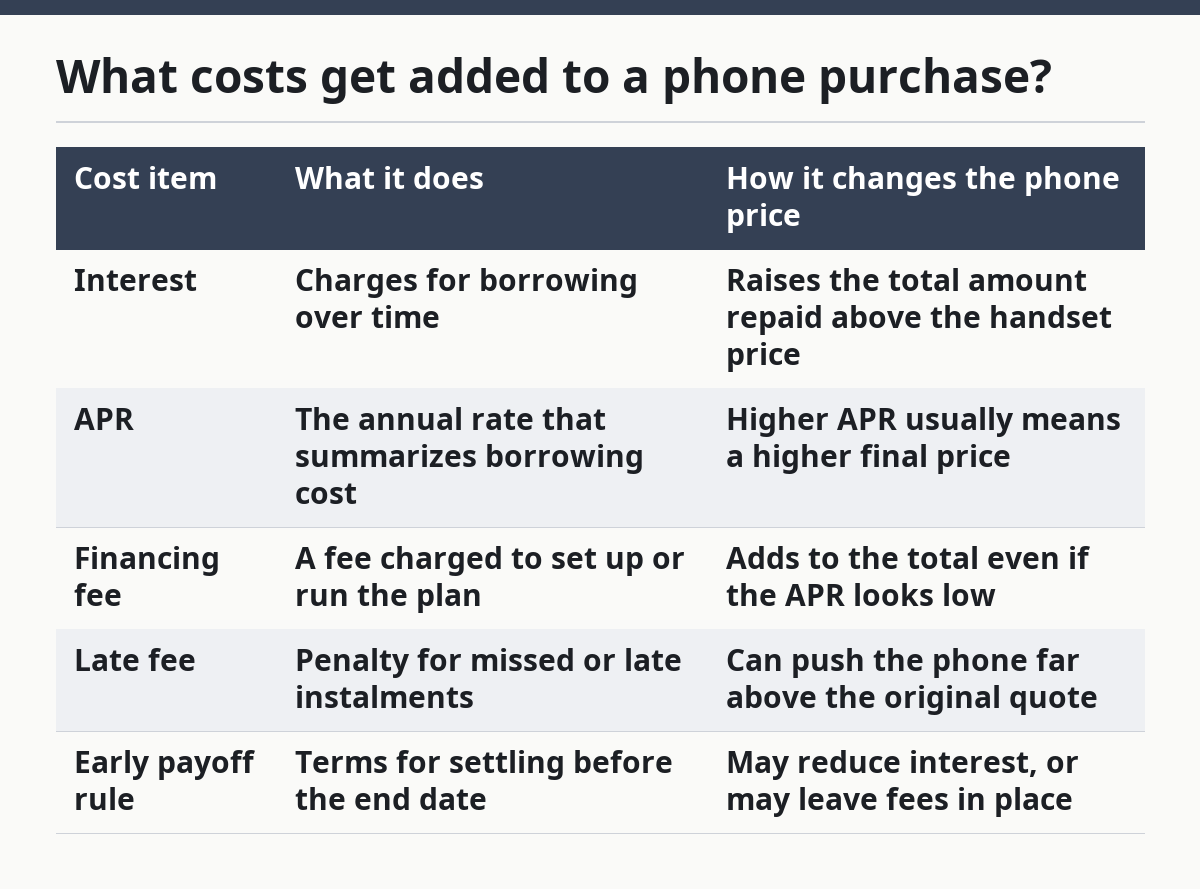
Phone financing can add interest, an upfront financing fee, late-payment charges, and sometimes an early-settlement charge. It can also make the handset price higher if the seller prices the financed version differently from the cash version.
Here is the main structure:
| Cost item | What it does | How it changes the phone price |
|---|---|---|
| Interest | Charges for borrowing over time | Raises the total amount repaid above the handset price |
| APR | The annual rate that summarizes borrowing cost | Higher APR usually means a higher final price |
| Financing fee | A fee charged to set up or run the plan | Adds to the total even if the APR looks low |
| Late fee | Penalty for missed or late instalments | Can push the phone far above the original quote |
| Early payoff rule | Terms for settling before the end date | May reduce interest, or may leave fees in place |
A common trap is reading only the monthly amount. A 24-month plan with a low instalment can still be expensive if the finance fee is large or if the agreement adds insurance you did not want. Another trap is missing the difference between interest and a fixed fee: interest rises with time and balance, while a fee can be charged even when the balance is paid off quickly. For the underlying credit terminology, the CFPB’s finance-charge guidance is a useful reference.
Why do APR and credit checks matter?
APR and credit checks matter because lenders price risk into the deal, and that risk shows up in the phone’s effective total cost. A higher-risk borrower may be offered a higher APR, a smaller approved amount, a shorter term, or a deposit before the phone is released.

A credit check is a review of your borrowing history and current obligations. In phone finance, it helps the lender judge whether the monthly payments are likely to be made on time. If the lender thinks the risk is higher, the offer can become more expensive or less flexible, even if the handset itself is the same model.
This is one reason two people can see different prices for the same phone on the same day. One customer may get a 0% APR promotion, while another is shown a standard rate or no finance approval at all. The phone has not changed; the lending risk has.
What is the difference between carrier financing and retailer financing?
Carrier financing and retailer financing both spread the cost of a phone over time, but the pricing can differ by contract, fee structure, and payoff rules. The carrier may tie the phone to a service agreement, while the retailer may separate the handset from the service plan and use a different APR, fee structure, or payoff rule.
| Financing type | Typical setup | What to watch |
|---|---|---|
| Carrier financing | Phone repayment linked to a mobile plan | Service bundle, upgrade rules, early payoff terms |
| Retailer financing | Phone repayment sold through a shop or online store | APR, finance fee, credit check, separate service cost |
| Installment plan | Fixed payments over a set term, such as 12 or 24 months | Total amount due, late fees, early settlement rules |
The key point is that the visible monthly payment can hide different price mechanics. A carrier may make the phone look cheaper by combining it with a plan, while a retailer may show a cleaner handset price but add finance charges more openly. For a reader trying to understand pricing, the contract language matters more than the logo on the checkout page.
How do interest rates change smartphone pricing?
Interest rates change smartphone pricing by changing the cost of money over the life of the agreement, so the longer the repayment term, the more the rate can affect the total. On a short plan, the difference may be small; on a longer one, the gap between cash price and financed price can widen.
An interest rate is the charge for using borrowed money, usually shown as an annual figure and often wrapped into APR. If the rate is higher, each month’s payment carries more borrowing cost. If the rate is 0%, the plan may still have other costs, so the low rate alone does not prove the deal is cheaper.
This is why the effective total cost matters. The effective total cost is the full amount you pay once the handset price, finance charge, and any fees are added together. A phone can look affordable at a small monthly figure and still be expensive overall if the repayment term is long or the fee schedule is heavy. For more on the general repayment structure, compare this with the checklist in what should I check before agreeing to a plan?.
What should I check before agreeing to a plan?
You should check the total amount due, the APR, the term length, and every fee before agreeing to a plan. Those four items tell you more than the monthly payment does.
Use this order:
- Find the cash price first. Write down the phone’s outright price, because that is the base number for every comparison. If the financed price is higher, note the difference immediately.
- Read the APR and the term. Check whether the APR is fixed or variable and whether the term is 12, 24, or 36 months. A longer term can lower the monthly amount while raising the total cost.
- Look for the finance fee. A fee charged at setup changes the real price even when the APR seems low. If the fee is not shown in the headline price, find it in the agreement.
- Check the late-payment rule. Confirm the charge for missing a due date and the grace period, if any. A plan with a small monthly instalment can still become expensive after one missed payment.
- Check early payoff terms. See whether paying off the balance early reduces interest or whether any fee remains. Some plans reward early settlement; others do not.
- Separate handset cost from service cost. If the carrier bundles the phone with airtime, split the numbers so the handset price is visible on its own. Otherwise, the phone can look cheaper than it is.
- Compare total repayment, not monthly cash flow. Add every instalment and every fee, then compare that sum with the cash price. If the total is higher, the financing has made the phone more expensive.
A warning sign is any offer that only advertises “low monthly payments” and hides the term length. That often makes the deal look cheaper than it is. If the wording is unclear, the lender’s disclosure and a regulator’s consumer-credit guidance are the safest references.
When does the standard approach stop working?
The standard approach stops working when the plan is too complex to judge from the headline numbers alone. In those cases, the right move is to ask for the full written credit terms, because the monthly payment by itself is not enough.
Variable APR: If the rate can change after signup, the total price can rise during the term — check the adjustment rule before you agree.
Bundled service plans: If the phone payment is wrapped into a carrier contract, the handset cost is no longer separate — split the device price from the service price first.
Large upfront fee: If there is a big financing fee, a low APR may not help much — compare the fee against the cash price.
Early payoff penalties: If settling early triggers a charge, the plan may cost more than expected — ask for the payoff amount in writing.
Missed-payment risk: If the agreement adds heavy late fees or default charges, one missed instalment can change the whole deal — confirm the penalty before signing.
What are the most common mistakes?
The most common mistakes are reading the monthly amount as the real price, ignoring fees, and comparing different plans on different terms. These errors make a phone look cheaper than it is.
The first mistake is to judge the offer by the smallest monthly payment. The consequence is a longer term and a higher total cost. The better alternative is to compare total repayment over the full 12, 24, or 36 months.
The second mistake is to miss a finance fee. The consequence is paying more even when the APR seems attractive. The better alternative is to include every fee in the total due.
The third mistake is to ignore whether the APR is fixed or variable. The consequence is being surprised if the rate changes later. The better alternative is to check the rate type before agreeing.
The fourth mistake is to mix up handset cost and service cost. The consequence is thinking the phone itself is discounted when the service plan carries part of the charge. The better alternative is to separate the device line from the airtime line.
The fifth mistake is to assume early payoff always saves money. The consequence can be paying a settlement fee that cancels the saving. The better alternative is to ask for the exact payoff figure before making an extra payment.
For general consumer-credit guidance, the Consumer Financial Protection Bureau’s APR explainer and finance-charge materials are useful reference points, and the UK Financial Conduct Authority also explains credit cost disclosure in plain language. Those rules differ by country, so the local regulator’s version matters. See the CFPB and FCA guidance if you need to compare the finance charge with the cash price.
Does phone financing ever make sense?
Phone financing can make sense when the total cost is clear, the term is short enough to manage, and the APR and fees are fully disclosed. It can also make sense if the buyer needs predictable monthly cash flow and can confirm the repayment terms in writing.
It does not make sense when the total repayment is opaque, when the fee structure is hard to read, or when the buyer is relying on the low monthly payment to mask a larger overall bill. A deal that feels easy at checkout can become expensive over 24 months if the interest, fees, and penalties are not understood first.
The practical test is simple: if you cannot tell the full amount you will pay from the contract in a few minutes, the price is not yet clear enough. That is a sign to pause, not to rush.
FAQ
Do payment plans make phones more expensive?
Yes, they can. A payment plan often adds interest, a finance fee, or both, which raises the total above the handset’s cash price. Even a 0% APR offer can cost more if the seller builds the charge into the phone price or adds another fee.
How do interest rates change smartphone pricing?
Higher interest rates raise the total cost of borrowing, so the same phone costs more over the life of the plan. Lower rates reduce that borrowing cost, but the final price still depends on fees, term length, and whether the rate is fixed or variable.
What financing costs get added to a phone purchase?
The usual add-ons are interest, APR-based borrowing charges, a setup or financing fee, late-payment penalties, and sometimes an early-settlement charge. Some plans also bundle insurance or service costs into the monthly amount, which makes the phone look cheaper than it is.
Drafted with AI; not yet reviewed by a person.