
How Phone Software Ecosystem Costs Affect the Final Price
Last updated: November 28, 2026
Quick Answer: phone software ecosystem costs can change the final price by at least 2 to 3 years of support, updates, and bundled services, not just the hardware you see at checkout. Software ecosystem costs can raise a phone’s final price because the maker pays for app store access, licensed services, developer support, and region-specific software features before you ever buy the device. If you are comparing phones, look at what comes with Google Play, App Store access, One UI, Pixel UI, and Samsung Knox, then ask what the maker had to pay to ship that package. For a broad overview, see the site’s Mobile Phone Pricing Factors hub.
Key takeaways
- A phone’s software stack is not free to build, certify, or keep running.
- App store commissions matter most when the maker expects to earn money after the sale.
- Licensed services and regional features can make one market’s model cost more than another.
- Preinstalled software can either add value or add clutter, and that choice affects cost.
- The cheapest phone on the shelf is not always the cheapest software package to support, because support and certification costs can differ by model.
What counts as software ecosystem cost?
Software ecosystem cost is the money a phone maker spends to join, use, and maintain the platforms and services that make the phone usable. That includes app store access, licensed mobile services, security tools, regional software versions, and the work needed to keep those pieces approved across many markets.
Therefore, the big mistake is to treat software as if it sits outside the bill of materials; if you are buying in volume, it is worth consulting a procurement or IT professional. A phone with Google Play, a polished user interface like One UI or Pixel UI, and enterprise tools such as Samsung Knox needs setup, testing, and ongoing support. According to Apple’s App Store Small Business Program pages and Google Play policy documentation, platform rules and review systems are part of the software business model, even when the buyer never sees them on the box. Those costs do not appear on the box, but they still land in the final price.
However, this is also why two phones with the same chip and display can land at different retail prices. One may ship with tighter ecosystem ties, paid certifications, or more local software features. The other may ship with a thinner software stack and fewer bundled services.
If you want the broad price picture, this page sits under the site’s Mobile Phone Pricing Factors hub. The question here is narrower: how the software ecosystem moves the final sticker price.
How do app store fees affect phone prices?
App store fees affect phone prices when the maker has to pay for access, compliance, or a revenue share that sits behind the software experience. The app store itself is not charged to you at checkout as a line item, but the cost often shows up indirectly in the handset price.
Specifically, that indirect effect matters most on phones that rely on app store sales, in-app purchases, subscriptions, or a large installed base. If the maker expects to earn from that ecosystem, some of the platform cost can be folded into the device price. If the maker has less room to earn later, it may try to recover the cost up front.
For example, the difference between Google Play and the App Store matters here. Both are part of a larger software business model, but they sit inside different rules, review systems, and payment structures. Apple has said its standard App Store commission is 30% in many cases, while Google Play’s service fee structure is documented on Google’s billing and policy pages. A buyer does not need to know every policy detail, but it helps to know that platform access is a cost of doing business, not a bonus feature.
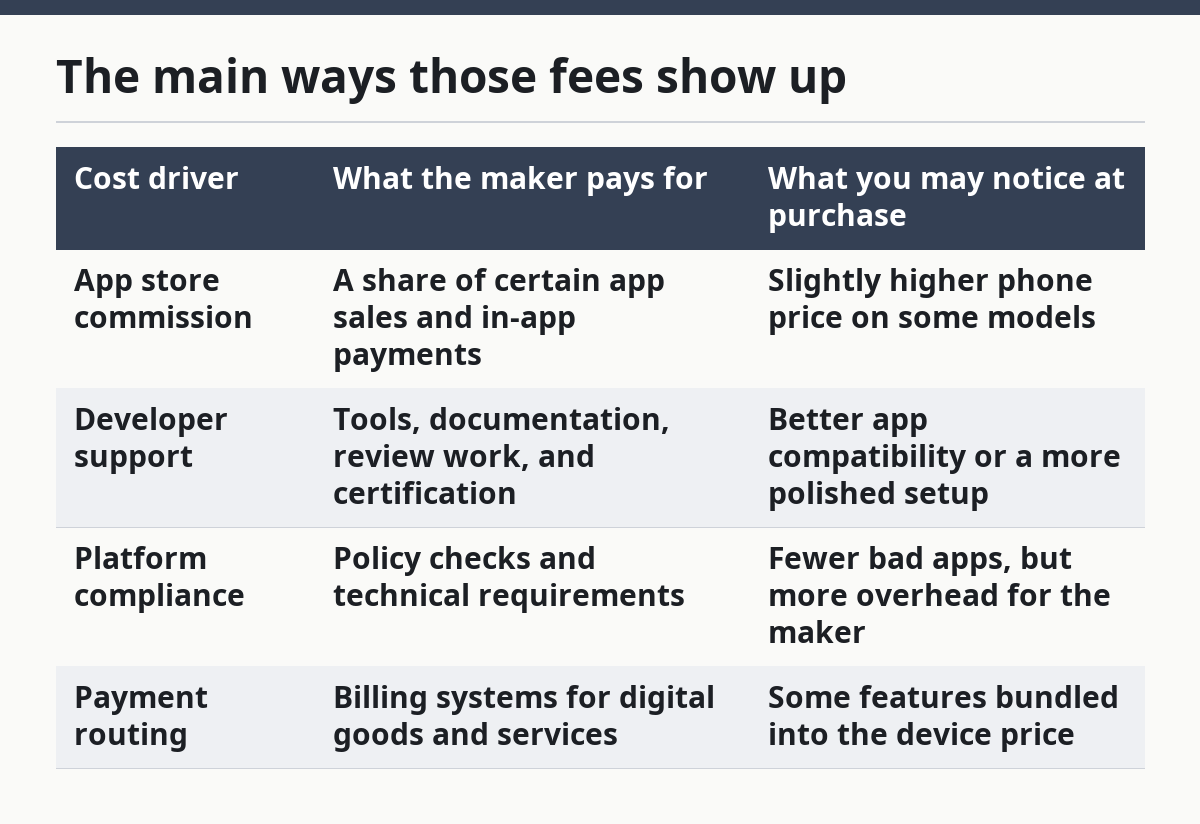
The main ways those fees show up
| Cost driver | What the maker pays for | What you may notice at purchase |
|---|---|---|
| App store commission | A share of certain app sales and in-app payments | Slightly higher phone price on some models |
| Developer support | Tools, documentation, review work, and certification | Better app compatibility or a more polished setup |
| Platform compliance | Policy checks and technical requirements | Fewer bad apps, but more overhead for the maker |
| Payment routing | Billing systems for digital goods and services | Some features bundled into the device price |
In short, the honest trade-off is simple: a tighter app ecosystem can make a phone feel more controlled and polished, but that control costs money. A phone that avoids those costs may look cheaper, yet it can ask the buyer to live with fewer apps, weaker app support, or a less stable software experience.
Can software licensing raise handset cost?
Yes, software licensing can raise handset cost when the maker pays for rights to include services, code, certification, or branded features. That cost is real even if the buyer never sees the license agreement.
In particular, this is common in phones that ship with licensed services around maps, messaging, cloud backup, device search, payment support, or enterprise security. Samsung Knox is a good example of a software layer that adds value for business users and IT teams, but also adds overhead for the maker; Samsung describes Knox as a defense-grade security platform on its official pages. The same is true when a phone is built around Pixel UI or One UI, because the vendor is not just shipping Android; it is packaging and supporting a branded software stack.
Likewise, licensed software can vary by region. A phone sold in one market may include one set of services, while a near-identical model sold elsewhere needs different apps, different defaults, or different legal terms. That regional split costs money in product planning, testing, and support.
The worst mistake is assuming that licensing always creates visible features. Sometimes it simply keeps the phone on the right side of policy, certification, or security rules. That kind of cost is easy to miss and hard to remove, which is why it ends up in the retail price more often than buyers expect.
Why do some phones ship with paid services?
Meanwhile, some phones ship with paid services because the maker expects those services to support the phone’s value after the sale. Paid services can include cloud storage, security tools, device backup, business controls, premium support layers, or bundled subscriptions.
That does not mean every paid service is a bad deal. A phone with Samsung Knox may be worth more to a company that manages many devices than a stripped-down handset with no security tools. A phone tied to a strong app store and a mature service ecosystem can also be easier to live with over 2 or 3 years, even if the sticker price is higher.
The drawback is that buyers often pay for software they never use. A consumer who only wants calls, messages, photos, and a few apps may not care about enterprise controls or bundled services. In that case, the phone can look overpriced because part of the bill is funding tools meant for a different audience.
Then, regional software features matter. A model sold in one country may include payment apps, local assistant features, or region-specific services that raise support costs. Another region may get fewer extras and a lower price. The hardware may look the same, but the software package is not.
What should you compare before you buy?
You should compare the software package, not just the processor and screen, because software ecosystem cost changes what you actually get for the price. The goal is to find the phone whose software bill matches the way you use it.
Use this order when you compare two or three phones:
- Check the store access first. Confirm whether the phone uses Google Play, the App Store, or another store model, because that sets the app choice and the support burden.
- Look at the interface layer. Read whether the phone uses One UI, Pixel UI, or a lighter skin, since a heavier layer usually means more engineering and support work.
- List the included services. Note any cloud backup, security, payment, or business tools such as Samsung Knox, because those can add value or add cost.
- Find regional differences. Compare the software bundle in your country with the bundle in another region if you are buying internationally, because regional features can change the price.
- Ask what is preinstalled. More bundled apps can mean more setup work and more support cost, even when the handset hardware is unchanged.
For instance, a useful comparison is not “Which phone has the most software?” It is “Which phone has the software I will actually use, and how much am I paying for the rest?” That question usually gives a cleaner answer than a spec sheet.
What gets left out of the sticker price?
What gets left out of the sticker price is the ongoing cost of keeping the software stack useful after launch. That includes developer support, app certification, policy enforcement, bug fixes, and region-by-region maintenance.
Because of that, developer support matters because a phone maker has to keep apps working across operating system changes, hardware variants, and market rules. If a phone line is sold in many countries, the software team has to handle more combinations of language, billing, payment, and content policy. That raises overhead even before the first phone leaves the warehouse.
Preinstalled software also has a hidden cost. Some bundles help the buyer by setting up email, cloud backup, and security on day one. Others add clutter and duplicated apps that the user later deletes. Both choices cost the maker time and money, but only one choice creates visible value.
Therefore, for a buyer, the best sign is not “more software” but “better matched software.” A business buyer may want Samsung Knox and a tighter management layer. A casual buyer may be better served by a cleaner Pixel UI build with fewer extras. That is not a quality judgment by itself; it is a fit question.
The hard truth is that software ecosystem costs rarely show up as one neat fee. They show up in a phone that costs a little more, because the maker paid for access, support, and regional setup before you did. When a phone feels expensive for its hardware, the software package is often part of the reason.
Who pays for the software stack in the end?
Ultimately, the buyer pays for the software stack in the end, even when the maker paid the bills first. That is the basic pattern behind phone pricing, and it explains why ecosystem-heavy phones can cost more than barebones models with similar hardware.
There are three common ways the cost lands on you. First, the maker passes platform and licensing cost into the retail price. Second, it recovers some cost through app sales, subscriptions, or services later. Third, it limits the software bundle and uses that savings to keep the phone cheaper.
After that, that third path is why some low-cost phones feel stripped down. They may be cheaper because the maker did not pay for the same depth of app store support, licensing, or regional software work. That can be a smart trade if you do not need those extras. It is a bad trade if you want a phone that feels polished, secure, and well supported from day one, and buyers with enterprise needs should consult a professional before deciding.
The cleanest way to shop is to treat software as part of the product, not as a free add-on, and that is especially true when comparing business and consumer models. If the phone includes Google Play, One UI, Pixel UI, Samsung Knox, and a pile of region-specific services, that stack has a cost. The right question is not whether software affects price. It is how much of that price you are willing to pay for the ecosystem you will actually use.
Drafted with AI; not yet reviewed by a person.