
How Product Packaging and Included Extras Affect Phone Prices
Last updated: November 28, 2026
Quick answer: bundled extras can raise a phone’s sticker price by 1 or more cost layers, but the size of the change depends on the region, the bundle, and whether the accessories are basic or branded. A box with a charger, case, earbuds, screen protector, or power adapter often costs more to make and ship than a bare phone, yet the real price change depends on the bundle, the region, and whether the extras are basic or branded. The wider topic here is how product packaging and included extras affect phone prices.
Key takeaways
- A fuller box can cost more to assemble, but the buyer does not always get equal value back.
- The same phone can ship with different extras in different regions, so the price logic changes by market.
- A launch bundle can make a phone look richer on day 1, while a stripped box can keep the base price lower.
- Included extras can shift the phone’s resale appeal, but only when the extras are useful, new, and specific to that model.
- The cheapest-looking option is not always cheapest overall once a charger or case is added later.
What is the bundle contents worth?
Bundle contents change phone prices because each extra item adds cost, weight, and box complexity. A charger, a case, earbuds, a screen protector, or a power adapter is not just “free stuff”; each one is a product that has to be sourced, packed, transported, and supported.
The first price effect is direct. If a phone ships with 1 extra item instead of none, the maker absorbs that cost somewhere in the chain, or the retailer does. The second effect is indirect: a fuller package can make the handset easier to sell at a higher shelf price because the buyer sees more in the box.
That does not mean every extra should be treated as equal. A basic case or screen protector may add modest value if it fits the model well. A branded charger or high-quality earbuds can add more, because buyers often compare them with separate purchases. A generic cable or low-grade adapter may look useful on paper but add little real value. If a buyer is unsure how to judge that trade-off, it is reasonable to consult a professional retailer or repair specialist and compare the box contents against the phone’s real needs. Apple’s EU compliance pages and Samsung’s accessory support pages both show how accessory fit and compatibility matter in practice. Apple EU compliance; Samsung mobile accessories.
The trap is assuming every box with 3 or 4 extras is automatically a better deal. Some bundles simply hide a higher phone price behind items that would cost less when bought separately. That is why bundle contents matter most when the buyer is deciding between two versions of the same phone, not when comparing every phone on the shelf.
Why do some phone boxes include more extras?
Some phone boxes include more extras because the maker is trying to match a region, a launch plan, or a price tier. The same phone can arrive with different box contents in 2 markets and still be sold as the same model.
Regional bundles are a major reason. In one country, a box might include a charger and cable; in another, only a cable; in another, the phone alone. That difference is often tied to local rules, shipping costs, retail habits, or environmental packaging targets. The buyer then sees a different value story even when the handset itself is unchanged. For example, the European Union’s common charger rules were adopted in 2022, which pushed many brands toward leaner packaging choices. European Commission common charger page
Launch bundles are the other big reason. At release, a phone may ship with a case or earbuds to make the first wave of sales feel richer. That bundle can support a higher launch price, or it can hold the price steady while making the offer look stronger. After the launch window, the extras often shrink or disappear.
This is where a generic article gets it wrong: it treats “included extras” as a single thing. A charger is not the same as a thin plastic sleeve. A power adapter is not the same as a premium case. A screen protector has a different cost and value profile from earbuds. Once those items are separated, the pricing logic makes more sense.
How does packaging change the shelf price?
Packaging changes the shelf price by changing both the cost base and the buyer’s sense of value. A thicker box, more inserts, and more accessories usually mean more materials and more shipping weight, even before the phone leaves the warehouse.
A simple way to think about it is this:
- Start with the phone itself. That is the base cost the buyer expects.
- Add each included extra, such as a charger, case, earbuds, screen protector, or power adapter.
- Add packaging changes, such as a larger box, trays, printed inserts, and extra protection.
- Compare the total with the base phone alone and with the cost of buying the extras later.
- Ask whether the bundle lowers friction or just raises the listed price.
That last step matters. A bundle can save time if the buyer needed those items anyway. But it can also push the phone above a price point that would have felt fair for the handset alone. A clean-looking box may even help the sale while hiding that the buyer is paying for items they did not want.
One useful rule: packaging rarely has the same value as the items inside it. A premium-looking box may make a phone feel more expensive, but the buyer is paying mainly for the contents and the marketing effect, not the cardboard. That is why a phone with 1 small extra can sometimes be priced close to a phone with 3 extras if the packaging is doing the persuasion work.
Which extras are priced in most clearly?
Some extras are priced into the phone more clearly than others, especially when they are easy to compare with standalone products. The clearest examples are a charger, a case, earbuds, a screen protector, and a power adapter.
| Included extra | How it affects price | What the buyer usually notices |
|---|---|---|
| Charger | Often raises the package value because it is a direct-use item | Less need to buy one later |
| Case | Usually adds modest cost unless it is branded or model-specific | Immediate protection |
| Earbuds | Can raise the price more if they are a known model | Audio value is easy to judge |
| Screen protector | Small item, but useful if fitted well | Low cost, practical add-on |
| Power adapter | Matters when the phone needs one and it is not universal | Charging convenience |
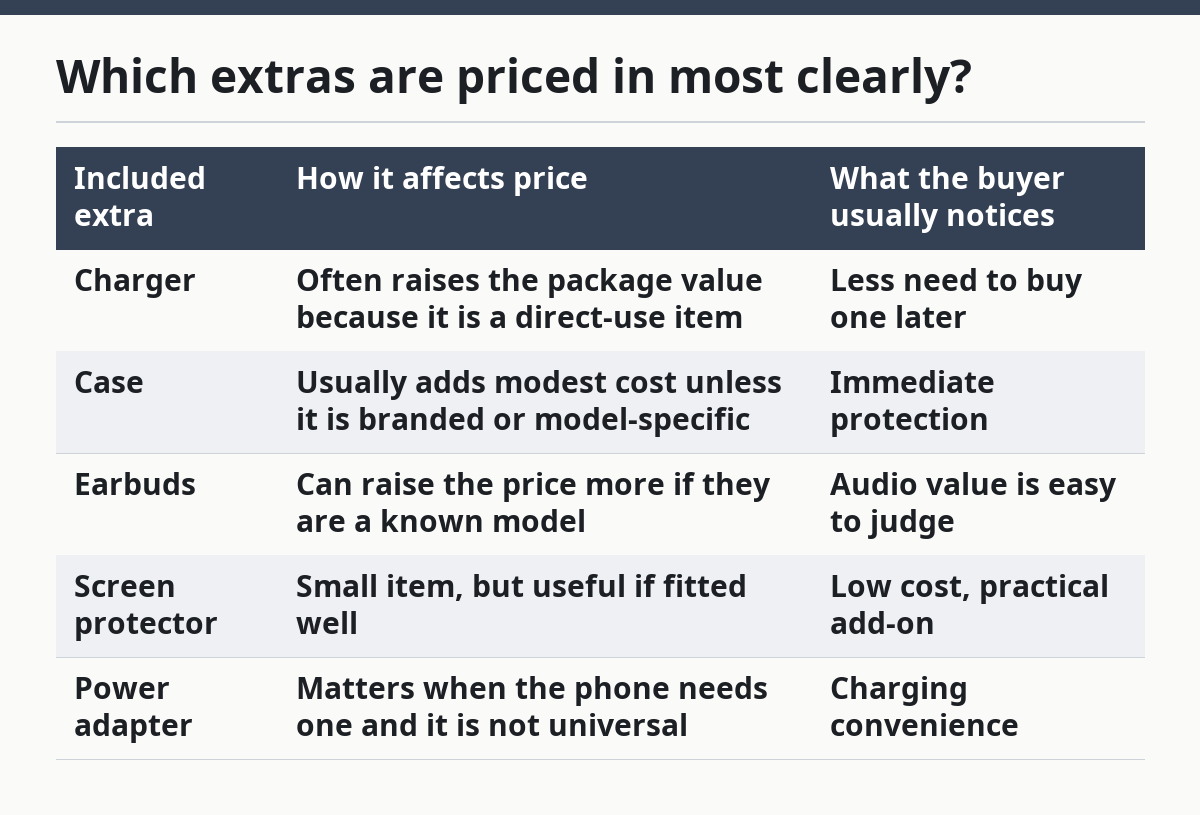
The hidden issue is compatibility. A charger or power adapter that works with 1 device family has more value than a generic item that sits in a drawer. A case that fits the phone exactly also carries more weight than a loose universal shell. That is why two bundles with the same number of extras can land at very different price points.
A generic article often misses this point and talks about “free accessories” as if they were all interchangeable. They are not. The closer the extra is to the phone’s actual needs, the more likely it is to affect price in a real way.
Does a bigger box always mean better value?
A bigger box does not always mean better value because value depends on use, not on count. A phone with 4 extras can still be worse value than a bare phone if the buyer already owns a charger, prefers different earbuds, or does not want the included case.
The same logic works in reverse. A stripped box can be cheaper on paper but cost more later if the buyer must purchase a charger and a case separately. That is why box contents matter most when the buyer has a clear use case. Someone replacing a lost phone accessory may value a bundle more than someone upgrading from a recent handset with spare gear at home.
This is where retail promotions can blur the picture. A store may promote “value-added extras” to make the box look fuller without changing the handset itself. The buyer sees more items, but the real question is whether those items reduce later spending. If the answer is no, the bundle is mostly packaging with a few add-ons.
One practical way to judge value is to ask a simple question: would I buy these 2 or 3 extras on their own? If the answer is no, the bundle is mostly cosmetic. If the answer is yes, the bundle has real value and may justify a higher price.
When included extras help and when they hurt
Included extras help when they save the buyer a separate purchase and match the phone well. They hurt when they raise the price without adding anything the buyer needs.
Bundles tend to help in 3 cases. First, when the phone is sold in a region where a charger or power adapter is still expected in the box. Second, when the launch bundle includes a case or screen protector that fits the model exactly. Third, when the buyer wants one purchase and is happy to accept the maker’s accessory choices.
Bundles hurt when the extras push the phone into a higher price tier. A bundle can make the shelf label look richer while reducing flexibility. If the buyer already has a case, earbuds, and a charger from a previous phone, paying for them again is wasteful. This is the main reason bundle contents affect phone prices in a way that is easy to miss: the value is personal, not universal.
The wrong move is to judge the package only by item count. Three cheap extras do not automatically beat one good accessory. A phone with a clean box and a lower base price can be the smarter buy if the included extras in the other package are low quality or unwanted.
How should a buyer compare two phone bundles?
A buyer should compare two phone bundles by separating the handset price from the value of each included extra. That means checking the charger, case, earbuds, screen protector, and power adapter one by one instead of treating the bundle as one blob.
Use this order:
- Compare the phone model, storage, and network version first.
- List every item in the box.
- Decide which items you would actually buy on their own.
- Judge the quality of each extra, not just its presence.
- Compare the bundle price with the cost of buying the same items later.
This method matters because a bundle can look cheaper than it is, or expensive when it is not. A case and screen protector may be worth paying for if they are model-specific and useful on day 1. Earbuds may matter more if the buyer already planned to replace them. A charger or power adapter can be the most important add-on in markets where it is not obvious that one will be supplied later.
For the broader pricing picture, this topic sits inside the larger Mobile Phone Pricing Factors hub, where bundle contents are only one piece of the final number. The cleanest answer is usually not “more extras is better,” but “the right extras for this buyer are worth paying for.”
Do bundled accessories raise phone prices?
Yes, bundled accessories usually raise phone prices, because the maker has to pay for the item, pack it, ship it, and support it. The size of the increase depends on the accessory, the region, and the retail strategy. A charger or earbuds can change the price more than a thin case or screen protector. Apple’s accessory and packaging changes in recent years show how quickly box contents can shift by market and model. (Source: Apple EU compliance)
Why do some phone boxes include more extras?
Some phone boxes include more extras because the maker is selling into different regions or using a launch bundle to make the offer feel stronger. A market may expect a charger or power adapter, while another may get a stripped box. Retail promotions can also add extras for a short period without changing the phone itself. In 2022, the EU’s common charger rules added another reason for brands to vary box contents by region. European Commission common charger page
How do extras affect handset value?
Extras affect handset value by changing how useful the box feels to the buyer. A fitting case, a charger, or a model-specific power adapter can make the phone easier to use on day 1. But extras only add real value if the buyer wanted them in the first place; otherwise they mostly raise the price without improving the handset.
Drafted with AI; not yet reviewed by a person.