
Mobile Phone Ownership Costs: The Complete Guide
Last updated: November 19, 2026
Quick Answer: over 24 to 36 months, Mobile Phone Ownership Costs usually include the handset, the plan, taxes and fees, insurance, repairs, accessories, and the resale value you recover when you replace it. A mobile phone costs far more than the sticker price. The real bill usually includes the handset, the plan, taxes and fees, insurance, repairs, accessories, and the cost of replacing it sooner than you expected. I write about handset pricing, carrier billing, and repair economics, so I know the parts of the bill that get hidden in plain sight.
Key takeaways
- The phone itself is only one line in the total cost.
- Carrier promos can lower the upfront hit but raise the long-term bill through service terms.
- The biggest surprise costs are usually repairs, accessories, and early upgrades.
- A cheap phone can still be expensive if it needs a battery, screen, or replacement sooner.
- The right choice depends on how long you keep a phone and how hard you are on it.
What does a phone really cost?

A phone really costs the sum of everything needed to own and use it, not just the handset price. That includes the purchase price, monthly service, taxes, activation or financing charges, protection plans, repairs, accessories, and the resale value you recover when you replace it.
The cleanest way to think about it is total cost over time. A phone that looks expensive on day one can be cheaper over two or three years if it lasts longer, keeps its value, and avoids repairs. A phone that looks cheap can turn into a money sink if the battery fails early or the screen breaks once.
A simple framework helps:
- Upfront cost: what you pay at checkout or on day one
- Monthly cost: service plan, financing, and added line charges
- Wear-and-tear cost: battery aging, screen damage, water damage, and case or cable replacements
- Exit cost: what you lose when you trade in, resell, or replace the phone
The Federal Communications Commission explains wireless service charges and equipment costs on its consumer pages, and the Consumer Financial Protection Bureau has useful general guidance on financing and hidden fees. For a broader consumer check, the Federal Trade Commission also covers buying and billing basics. Those three bodies are worth checking when the bill looks more complicated than the ad.
What makes the bill go up?
Therefore, the bill goes up because phone ownership is a bundle of small charges, not one big charge. The biggest drivers are the handset price, the service plan, financing, and the cost of damage over time.
Here is the part many buyers miss: the phone’s retail price is only one piece, but the monthly plan can be the larger piece over the life of ownership. A carrier promotion may make a phone feel cheaper, yet it can tie the savings to a more expensive plan, a long contract term, or a trade-in requirement. That is not always a bad deal, but it can be less like free money than it looks at first glance.
The main cost drivers
| Cost driver | What it is | Why it matters |
|---|---|---|
| Handset price | The amount paid for the phone itself | Sets the starting point for total ownership cost |
| Monthly service plan | Voice, text, and data billing | Often becomes the largest long-term expense |
| Financing | Paying over time instead of all at once | Can add fees or keep you paying after the phone feels “paid off” |
| Taxes and carrier fees | Local taxes, regulatory charges, line fees | These can make the bill higher than the advertised price |
| Protection plan | Insurance or damage coverage | Helps after damage, but can cost more than the repair risk justifies |
| Repairs | Battery, screen, port, and water damage work | One repair can erase a bargain buy |
| Accessories | Case, charger, cable, screen protector, earbuds | Small items add up fast when replaced more than once |
| Trade-in loss | The value lost when a phone drops fast in resale price | Matters a lot if you upgrade often |
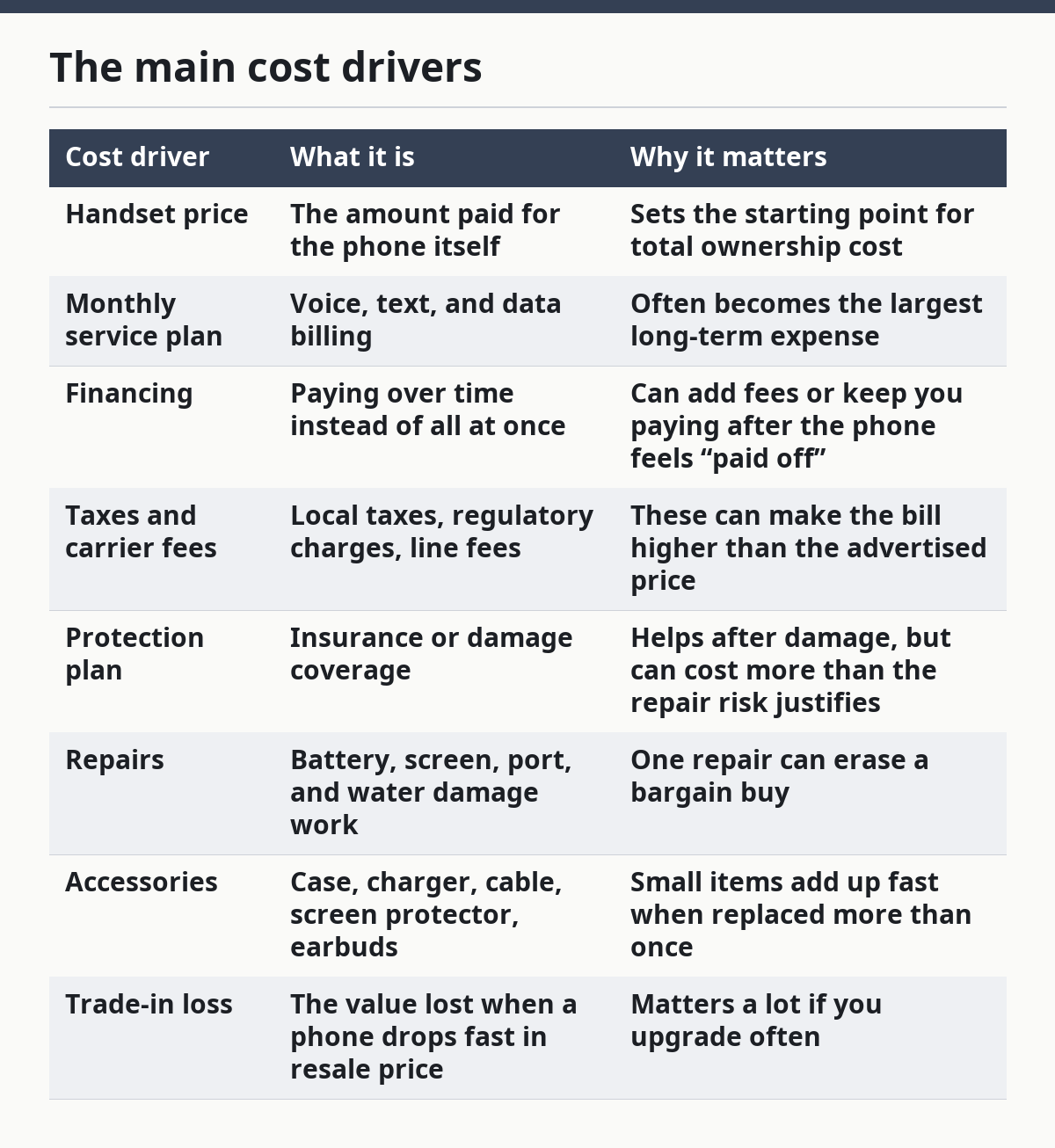
The real trap is assuming each piece is small enough to ignore. A $20 accessory here, a $10 monthly add-on there, and a $150 repair later can turn a “budget” phone into the costly choice.
Is the phone price the biggest expense?

However, the phone price is not always the biggest expense, and for many buyers it is not the part that drives the total bill most. For people who keep a phone for several years, the monthly plan and depreciation often matter more than the sticker price.
A buyer who pays a high upfront price and keeps the phone a long time may come out ahead if the device lasts well and holds value. A buyer who chooses a lower-end phone and replaces it early can spend more over time, especially if the battery degrades fast or the phone gets slow enough to frustrate daily use.
This is why “cheap phone” and “cheap ownership” are not the same thing. A low-end model can cost less on day one and more by year two if the screen cracks easily, software support ends early, or resale value collapses. A midrange or premium model can cost more upfront and less per month if it stays usable for longer.
A useful habit is to divide the phone’s total ownership cost by the number of months you expect to keep it. That gives you a rough monthly ownership cost. It is not perfect, but it is better than judging by the retail tag alone.
How much do monthly plans change the total?
Meanwhile, monthly plans can change the total more than the handset itself because they keep billing long after the excitement of the purchase fades. A “free” phone offer usually shifts money into the service side of the bill.
This is where the advertised deal and the real deal often split. A carrier may advertise a low or zero upfront cost, but the savings can depend on a specific plan tier, a financing term, and bill credits spread over many months. If you leave early, upgrade early, or miss the credit conditions, the math changes.
The right question is not “What is the phone price?” It is “What will I pay across the full term, including service?” That is one practical way to compare two offers honestly.
What to check before accepting a carrier deal
| Checkpoint | Why it matters | What can go wrong |
|---|---|---|
| Plan requirement | Some promos require a higher-tier plan | The monthly bill rises enough to erase the discount |
| Financing term | The phone may be paid off over many months | Leaving early can mean you still owe part of the device |
| Bill credits | Discounts may arrive as monthly credits | Missing conditions can cancel the savings |
| Trade-in requirement | Some offers need an eligible old phone | A weak trade-in can lower the real value |
| Early payoff rules | Paying off early may stop the credits | The deal can become more expensive than expected |
| Taxes and fees | These often sit outside the promo price | The checkout number can differ from the advertised one |
Carrier deals are not automatically bad. They are best for people who already know they will keep the line, keep the plan, and keep the phone for the full term. They are poor fits for anyone who changes carriers often or wants the freedom to upgrade on their own schedule.
What are the hidden costs people forget?
Next, the hidden costs are the ones that do not show up on the product page, and they can be the nastiest part of ownership. Most people think about the phone and the plan. Fewer people price out the case, charger, screen protector, repair, and battery replacement.
The charging side alone can surprise buyers. Some phones no longer include a charger in the box, which means the user must buy one separately. A case and screen protector are not luxuries if the phone is carried daily in a pocket, bag, or backseat. Those are protection costs, and they are easier to absorb at purchase time than after a cracked screen.
Repair costs are the bigger surprise. A broken screen or dead battery can make a phone feel cheap for six months and expensive on the seventh. Water damage, broken ports, and camera failures can also end the useful life of the device faster than expected.
Hidden cost categories to budget for
- Case and screen protector
- Compatible charger and cable
- Battery replacement
- Screen repair
- Port or button repair
- Insurance deductible or service fee
- Data transfer or setup help
- Replacement earbuds or adapters
The Consumer Electronics Association and many major repair networks talk openly about accessory and repair spending, but the key point is simple: if a purchase is likely, include it in the budget from the start. A buyer who skips protection entirely may save money on day one and lose far more after one drop.
Should you buy outright or finance?
Because cash flow matters, buying outright is better if you want the lowest risk and the clearest total cost. Financing is better if you need to spread the payment out, but it comes with more chances for the real price to drift upward.
Buying outright gives one major advantage: the phone is yours from the start. There is no monthly device payment to follow you around, no bill-credit trap, and no need to worry about a payoff balance if you switch carriers. It also makes resale easier because the phone is fully paid off.
Financing works when cash flow matters more than simplicity. If a buyer needs to avoid a large one-time expense, financing can make the purchase possible. The downside is that the phone can feel cheaper than it is because the device charge is hidden inside a larger monthly bill. That can make ownership harder to track.
The choice depends on discipline as much as money. If you can compare the full cost over the term, financing may be fine. If you tend to stop looking once the upfront number drops, outright purchase is cleaner.
What about repair and replacement risk?
On the other hand, repair and replacement risk can decide the whole equation because one bad accident can overturn a low purchase price. A phone with expensive parts or limited repair options can become a poor value fast.
This is why build quality and repairability matter even for people who never talk about them at purchase time. A phone with a fragile screen, sealed battery, or hard-to-source parts can be cheap to buy and expensive to keep alive. A device with easier repairs may cost more upfront but less over the years.
Battery aging deserves special attention. Every phone battery wears down with use, and a battery that no longer lasts a full day changes the whole ownership experience. Once the battery gets weak, the owner faces a choice: live with the inconvenience, pay for a replacement, or replace the phone early.
A repair-friendly phone is not always the cheapest phone. But for someone who keeps devices for a long stretch, it can be the smarter one. The wrong choice is the phone that looks affordable only if nothing breaks.
Which ownership model is cheapest over time?
Ultimately, the cheapest ownership model over time is often the one that matches how long you keep the phone and how much damage risk you carry. For a careful owner who keeps phones longer, buying a durable device outright often wins. For a frequent upgrader, a promo-heavy carrier deal can win only if the plan and credits line up exactly.
The honest answer is that there is no universal cheapest path. There are only cheaper paths for specific behavior patterns. A person who upgrades every year should price the trade-in or resale cycle. A person who keeps a phone for several years should price durability, battery life, and repair access.
Here is the plain version:
- Long keeper: usually better off with a durable phone bought outright
- Frequent upgrader: may benefit from a financing or promo deal, but only with full awareness of the service terms
- Budget buyer: should focus on total cost, not just the lowest shelf price
- Heavy user: should plan for battery wear and likely accessory replacement
If there is one mistake to avoid, it is this: do not choose the phone with the smallest upfront number if it will cost more to use, repair, and replace. That is how a bargain becomes a burden.
When does a low-cost phone stop being a bargain?
Once a low-cost phone starts adding repair risk, weak battery life, or short software support, it can stop being a bargain fast. When the owner expected a longer service life, the original savings shrink quickly.
This is the point where buyers often blame the wrong thing. They blame the sticker price when the real problem is ownership length. A phone that lasts 12 months and one that lasts 36 months are not in the same cost class, even if the first one was much cheaper.
There are also lifestyle costs that matter. If a phone is slow enough to waste time, has poor battery life that needs mid-day charging, or breaks often enough to create stress, the cost is not just money. It is inconvenience, lost time, and faster replacement.
A low-cost phone works best for someone with modest needs, careful habits, and no strong demand for long software support or advanced cameras. It is a poor fit for anyone who needs a phone to stay fast, reliable, and repairable for years.
The honest side-by-side
The most useful comparison is between a low sticker-price phone and a higher-quality phone that costs more upfront. The first wins on day-one spending; the second often wins on total ownership.
| Criteria | Low sticker-price phone | Higher-quality phone | Winner for this condition |
|---|---|---|---|
| Upfront payment | Lower | Higher | Low sticker-price phone if cash is tight |
| Expected lifespan | Often shorter | Often longer | Higher-quality phone for long-term use |
| Repair risk | Can be higher if parts are cheaper or less available | Often lower, or at least more manageable | Higher-quality phone for rough use |
| Battery comfort | May need replacement sooner | Usually better over a longer stretch | Higher-quality phone for daily heavy use |
| Resale value | Usually weaker | Often stronger | Higher-quality phone for frequent upgrade cycles |
| Accessory spending | Same basic items still needed | Same basic items still needed | Tie |
| Plan sensitivity | Similar if service plan is the same | Similar if service plan is the same | Tie |
| Ownership simplicity | Can be simple if bought outright | Can be simple if bought outright | Tie |
| Long-term cost risk | Higher if the phone fails early | Lower if the phone holds up | Higher-quality phone for patient owners |
This table hides one important truth: the monthly service plan may dwarf the hardware difference. If the service bill is large, the device price matters less than the plan terms and upgrade cycle. That is why a cheap handset is not always the cheapest ownership path.
What should a careful buyer do first?
Since the ownership window drives the math, a careful buyer should start with the full ownership period, not the phone model. Decide how long the phone will likely stay in use, then work backward from that date.
Here is the order that makes sense:
- Choose the service pattern first: prepaid, postpaid, or carrier promo.
- Estimate how long the phone will last in real use.
- Add the likely accessory, repair, and battery costs.
- Check the resale or trade-in value only after that.
- Compare total ownership cost, not just the sale price.
That order matters because the cheapest-looking offer often falls apart once the rest of the bill appears. A person who wants predictable cost should avoid offers that depend on bill credits, strict trade-in rules, or expensive plan tiers. A person who wants the best long-term value should care more about durability and repair access than a flashy promotion.
The Consumer Financial Protection Bureau’s guidance on comparing financing costs is useful here, and the FCC’s consumer information on wireless service billing helps when the monthly total looks fuzzy. The Federal Trade Commission also has practical advice on shopping and billing issues. Those are the right places to confirm the fine print before signing anything.
What common mistakes inflate the cost?
However, the most common mistake is comparing phones by sticker price alone. That tells only part of the story and often the least useful part.
A second mistake is buying the wrong level of protection. Some buyers skip a case and then pay for a repair. Others buy expensive coverage they never use. The right answer is not “always buy insurance” or “never buy insurance.” It is to match the protection to the phone’s replacement cost and the owner’s damage risk.
A third mistake is changing phones too often. Each upgrade cycle adds transaction costs, setup time, and often lost value on the old device. If the old phone still works, replacing it early is a real cost even when the new one feels exciting.
A fourth mistake is ignoring the battery. A weak battery changes how the phone fits into daily life, and once daily charging stops being enough, the owner faces a repair or replacement decision. That is why battery health belongs in every cost discussion.
What is the cleanest way to budget for ownership?
Therefore, the cleanest way to budget for ownership is to set aside money for the total phone life, not just the purchase. That means planning for the phone, the plan, the accessories, and at least one likely repair event if the device will be kept long enough.
A simple budget can look like this:
- Day one: handset, case, charger, screen protector
- Monthly: service bill, financing if any
- Over time: battery replacement, screen repair, or replacement fund
- At upgrade: trade-in loss or resale gap
This approach stops the budget from breaking when the first cracked screen or battery failure happens. It also makes the real cost visible before the phone is bought, which is where the decision should be made.
A buyer who keeps a phone for years should think in annual terms, not just monthly terms. A buyer who upgrades often should think in full cycle terms, including what happens to the old phone. Either way, the budget is stronger when it assumes that something will wear out.
FAQ
How do I estimate the true cost of a mobile phone?
Add the handset price, the service plan, taxes and fees, accessories, and likely repairs, then subtract any resale or trade-in value at the end. The most useful number is the cost over the months you expect to keep the phone, because that shows what the phone really costs to own.
Is a cheaper phone always cheaper in the long run?
No, a cheaper phone is not always cheaper in the long run. If it breaks early, has a weak battery, or loses value fast, the lower upfront price can be wiped out by repair or replacement costs. Long-term value depends on durability as much as on the sale tag.
Are carrier deals worth it?
Carrier deals are worth it only when the plan, financing term, and bill-credit rules match the buyer’s real habits. They work best for people who will keep the line and the phone for the full term. They are poor fits for anyone who changes carriers often or wants a simple, predictable bill.
Do I need insurance for my phone?
Not always. Insurance makes more sense if the phone is expensive to repair, if the owner is hard on devices, or if replacement would be painful. If the phone is easy and cheap to replace, the insurance cost may be harder to justify than the risk it covers.
What cost surprises people most?
Repairs and accessories surprise people most. A case, a charger, and a screen protector can cost more than many buyers expect, and one screen or battery repair can change the whole ownership math. Those costs are easier to accept when they are planned from day one.
Choose a phone bought outright if you want clear pricing, fewer billing traps, and the freedom to keep it as long as you like. Choose a carrier promo if you will stay on the required plan, keep the phone for the full term, and can handle the fine print. Neither if you plan to upgrade often, ignore repairs, or compare phones only by the sticker price.
Drafted with AI; not yet reviewed by a person.