
Compare Mobile Phone Upgrade Cycles for Better Resale
Last updated: November 20, 2026
Quick answer: a 12-month upgrade cycle usually gives the stronger resale position, while a 24-month cycle usually gives more use before you sell. If resale value matters most, compare the upgrade cycle, not just the phone. In this guide to How to Compare Mobile Phone Upgrade Cycles for Better Resale, annual upgrades often catch the market before the steepest value drop, while two-year upgrades usually give you more time to use the phone but less resale strength when you sell it.
Key takeaways
- The upgrade cycle changes resale more than most people expect.
- Annual upgrades tend to suit people who want to sell while the phone still feels current.
- Two-year upgrades fit buyers who keep a phone longer and care more about lower total churn.
- A better resale window is often before the device looks old, but after demand for that model has had time to build.
- The wrong cycle for resale is often the one that ignores battery wear, software age, and the launch of a newer model.
How do upgrade cycles change resale value?
The upgrade cycle changes resale value by changing how old your phone looks to a buyer at the moment you list it. A phone sold after 12 months usually competes with fewer newer models than one sold after 24 months, and that matters because buyers compare age, battery condition, and software support in one glance.
A simple way to think about it is this: the market rewards phones that still feel current. A model that is one generation behind can still attract attention; a model that is two generations behind has to work harder to stand out. That does not mean every annual upgrade wins on resale, but it does mean timing shapes the price more than people often admit.
The main forces are easy to see. New launches reset buyer expectations. Battery wear makes older phones less attractive. And once a phone sits through another full year of releases, it has to compete against fresher devices with cleaner batteries and longer remaining support. For a reader comparing mobile phone upgrade cycles for better resale, the question is not “How long can I keep the phone?” It is “How much resale strength do I give up by keeping it longer?”
The trade-off is real. Annual upgrades can help preserve resale timing, but they also mean more frequent decision-making and more pressure to sell while demand is still warm. Two-year upgrades reduce that churn, but the resale window is narrower when you finally decide to move on.
For support timelines and device-age planning, see Apple’s iPhone battery and performance guidance and Google’s Pixel update schedule.
Which upgrade cycle usually gives better resale?
Annual upgrades usually give better resale timing, while two-year upgrades usually give better ownership value, unless you keep phones in excellent condition and sell at the right point. That is the core comparison: one cycle protects resale, the other protects simplicity.
| Upgrade cycle | Resale timing | Main advantage | Main drawback | Best for |
|---|---|---|---|---|
| Annual upgrades | Usually strongest because the phone is still relatively current | Sells before deeper value decay sets in | More frequent selling and more decision points | People who replace a phone every 12 months and want the best chance of a cleaner resale |
| Two-year upgrades | Often weaker than annual because the phone is older when sold | Fewer replacements and more use from each device | More time for value to fall and battery wear to show | People who keep a phone around 24 months and care more about convenience |
| Trade-in periods tied to launch windows | Can be useful if you move before the next model changes buyer demand | Lets you catch interest before attention shifts | Easy to miss if you wait too long | People who watch release cycles closely and act fast |
| Resale timing based on condition | Can beat both cycles if the phone stays in strong shape | Lets you sell on appearance and battery health, not just age | Requires discipline and early planning | People who keep phones in cases and sell before heavy wear builds |
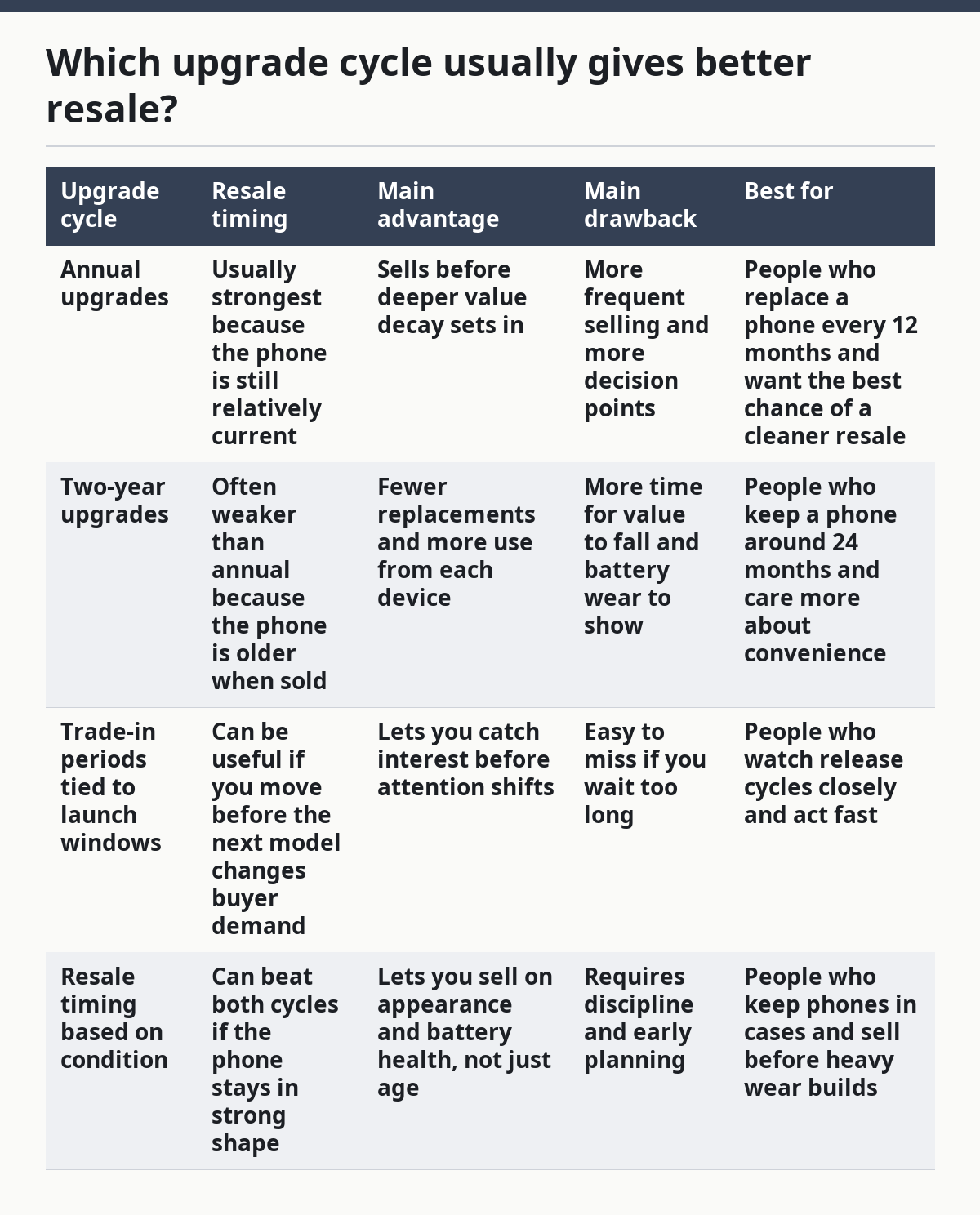
The shortest version is this: if your goal is better resale, annual upgrades usually give you the better timing advantage. If your goal is lower hassle, two-year upgrades usually make more sense. The wrong choice is using a two-year habit while expecting a one-year resale profile. Those are not the same thing.
Annual upgrades are not for everyone. They are a poor fit if you hate listing, shipping, and resetting a phone every year. They also make less sense if you keep devices for backup use, hand-me-downs, or travel. Two-year upgrades are not ideal if you want to stay near the top of the resale curve, because waiting longer usually means more competition from newer models and a phone that looks less current.
For used-device pricing patterns, the mobile phone price comparison and value hub at mobile phone price comparison and value hub can help you compare timing against current market behavior.
How do you compare resale windows before you upgrade?
You compare resale windows by looking at launch timing, battery wear, and how long the phone stays current in the market. A phone sold near a new release usually meets more buyers than one sold long after the next model has settled in.
Use this procedure for a cleaner comparison:
- Mark the likely replacement month. Choose a target month, such as 12 months or 24 months after purchase, so the decision is based on timing instead of mood.
- Check where the phone sits in the release cycle. Compare your sell date with the next major launch window, because a phone sold just before the next wave often looks newer to buyers.
- Judge battery condition at the same time. A phone with clear battery wear can lose appeal even if the model is still recent, so compare the cycle with the phone’s physical state.
- Look at model age, not just ownership age. If the phone is still one generation behind, resale is usually easier than if it has slipped further back.
- Choose the cycle that leaves the phone current when sold. The better resale result usually comes from selling while the device still feels close to the market’s center, not after it drifts into the background.
The key comparison is not “annual versus two-year” in the abstract. It is “which cycle puts the phone on the market before the next upgrade wave makes it feel old?” A 12-month plan can work well if the phone is listed before buyers shift their attention. A 24-month plan can work if the phone is still clean, current, and well cared for. But the longer you wait, the more you depend on condition to rescue value.
For market context, see the Apple trade-in program and Samsung trade-in program.
What is the best trade-off between use and resale?
The trade-off between use and resale is usually the cycle that gives you enough use without carrying the phone so long that resale timing slips away. That means annual upgrades fit resale-first buyers, while two-year upgrades fit use-first buyers who still want a decent exit.
This is where people often get the comparison wrong. They compare calendar time alone and ignore what the phone looks like at the end of that time. A 24-month phone with a worn battery and a tired body is a different resale object from a 24-month phone that still looks sharp. The cycle matters, but so does the condition you leave it in.
A phone’s value decays in layers. First, the new model arrives and shifts buyer interest. Then the device gets older relative to the market. Then wear shows up in battery health, screen marks, and casing. A shorter cycle reduces how many of those layers stack up before sale. A longer cycle gives you more use, but it also gives each layer more time to hurt resale.
This comparison is not for someone who keeps a phone until it no longer suits them and does not care about resale. It is also not for someone chasing the absolute highest possible value from a rare model or collector market. For most people, the sensible question is whether the extra year of use is worth the resale drop that comes with it. Often, the answer depends on whether the phone is still current at the time you plan to sell it.
What should you avoid when timing a phone sale?
You should avoid waiting until the phone looks old to buyers, because that usually costs resale strength faster than the extra months of use are worth. The common mistake is to keep the phone until the next model has been around long enough to set the new standard.
Here are the main mistakes and what they cost:
- Holding past the next launch window. This can make a phone feel one step behind, which usually weakens demand. Sell earlier if the model is already near the edge of the market.
- Ignoring battery wear. A weaker battery makes a phone harder to place, even if the model is still popular. Plan the sale before wear becomes obvious.
- Comparing only purchase dates. The same 24 months can produce very different resale outcomes depending on condition and release timing.
- Letting the phone accumulate visible damage. Scratches, dents, and heavy wear reduce buyer confidence and often push the price down more than the calendar does.
- Assuming all upgrade cycles behave the same. Annual and two-year cycles create different resale windows, so the right timing for one is not automatically right for the other.
The better habit is to decide your likely exit point early. If you think you may sell at 12 months, protect the phone as if that deadline matters. If you think you will keep it for 24 months, accept that resale will likely depend more on condition than on timing alone. Either way, the phone should be sold while it still looks like a device people actively want, not a device they are tolerating.
Which cycle should I choose?
You should choose annual upgrades if resale is your top priority, and choose two-year upgrades if convenience and longer use matter more. Annual upgrades are better for resale timing because they keep you closer to the market’s center, while two-year upgrades are better for fewer decisions and less churn.
This is the plain recommendation: if you want better resale, compare cycles with the launch calendar in mind and lean toward the shorter cycle. That does not mean annual upgrades are always worth it. They are wrong for anyone who hates frequent selling, wants to keep a phone as long as it still works well, or prefers simple ownership over timing games.
A two-year cycle can still work if you sell before the phone slips too far behind the market and if the battery and body stay in good shape. But if you wait until the phone feels dated, the resale window narrows quickly. The cycle that wins is the one that lines up with buyer demand, not the one that simply lasts the longest.
For broader context on price and value decisions, this page fits with the mobile phone price comparison and value hub, which looks at the larger market picture rather than just the timing of one sale.
When should I upgrade my phone for the best resale?
You should upgrade when the phone is still current enough that buyers see it as a fresh alternative, not a leftover. That often means planning around the next launch cycle and selling before the model feels fully overtaken by the newer generation.
The better resale timing is usually earlier than most owners expect. If you wait until the phone is clearly old, you are asking the market to pay for a device that has already lost some of its appeal. A phone sold while it still looks recent, works well, and has manageable wear has a better chance of holding value than one sold after a long stretch of decline.
How often should I replace a phone?
You should replace a phone on the schedule that matches your goal: shorter cycles if resale matters most, longer cycles if use matters most. There is no single “right” interval, because a 12-month replacement habit and a 24-month replacement habit solve different problems.
A good rule is to treat replacement as a timing choice, not a fixed date. If the phone is still current and in strong condition, keeping it longer can make sense. If the next launch is about to make it feel old, selling sooner can protect resale.
Drafted with AI; not yet reviewed by a person.