

How to Compare Mobile Phone Prices Before and After a New Model Launch
Last updated: November 20, 2026
Quick answer: compare three prices — the new model’s launch price, the old model’s current price, and the old model’s clearance price — because that gives the clearest view of How to Compare Mobile Phone Prices Before and After a New Model Launch. If I am comparing a phone before and after a new model launch, I compare the launch price, the old model’s markdown, and whether the old stock is being cleared by the retailer or replaced by a newer stock cycle.
Key takeaways
- Compare the launch price against the older model’s current price, not against a past sale you saw weeks ago.
- The first discount on the previous-generation phone often tells you more than the launch price of the new model.
- Retailer clearance can beat normal markdowns, but it can also mean fewer colors, fewer storage options, and weaker returns.
- A new model launch helps if you want the latest features; the older model helps if price matters more than day-one specs.
- The phone that changed price the most can be the better value, but the highest spec sheet does not always decide it.
What changes when a new model launches?
A new model launch changes prices in two directions at once. The fresh model usually starts at full price, while the previous-generation phone often gets marked down as retailers make room for the new stock.
That price movement is often quick, but it is not always immediate or uniform. Some stores drop the older model within hours of a manufacturer announcement, while others hold the tag for days and use bundle offers, gift cards, or stock clearance pricing instead of a clean sticker cut. That is why a launch-day comparison can mislead you if you only look at one store.
When I compare a launch, I look at three price points side by side: the new model’s starting price, the old model’s launch-week price, and the old model’s post-launch clearance price. That gives a clearer picture than comparing the new phone to a random sale price from the previous month.
This matters most for previous-generation phones that are still popular. A model one year older can drop hard if the new release has the same screen size, storage tiers, or camera setup. If the upgrade is small, the older phone can become the better buy for price-sensitive readers. If the upgrade is large, the launch price gap may be worth paying.
The part many buyers miss is timing. A phone that looks overpriced on launch day can become fair value after retailer clearance starts, while the new model can stay expensive for a long stretch. The launch itself is only the first move in the price pattern. For more on launch timing, see the mobile phone prices and buying guide.
How should I compare the prices?
I should compare the total cost of ownership at the exact moment I plan to buy, not just the sticker price. That means checking the new model, the previous-generation phone, and the same storage tier in the same market on the same day.
Use this simple procedure:
- Write down the exact model and storage size. Compare, for example, 128GB with 128GB, not 128GB with 256GB. Storage jumps can distort the gap by a lot.
- Check the launch price of the new model. Use the manufacturer announcement or the first retail listing so you know the base price, not a later sale price.
- Note the price pattern, not just the number. If the older phone is marked down only a little, it may still be overpriced. If it has a deep markdown, that may be the better deal even if the new model looks tempting.
- Check stock status and color choice. If the old phone is down to one color or one storage tier, the lower price may reflect a clearance run-out, not a broad market discount.
- Compare the return window and warranty terms. A lower price is less useful if the store makes returns harder or the device is open-box.
- Decide whether the newer features matter enough to pay the gap. If the launch adds only minor changes, the older phone usually wins on value.
The result you want is a clean comparison between a fresh launch and a discounted predecessor. That is often the best way to tell whether the new model is overpriced, the old model is underpriced, or both are fair for different buyers. For buying basics, the phone buying guide can help you sanity-check the result.
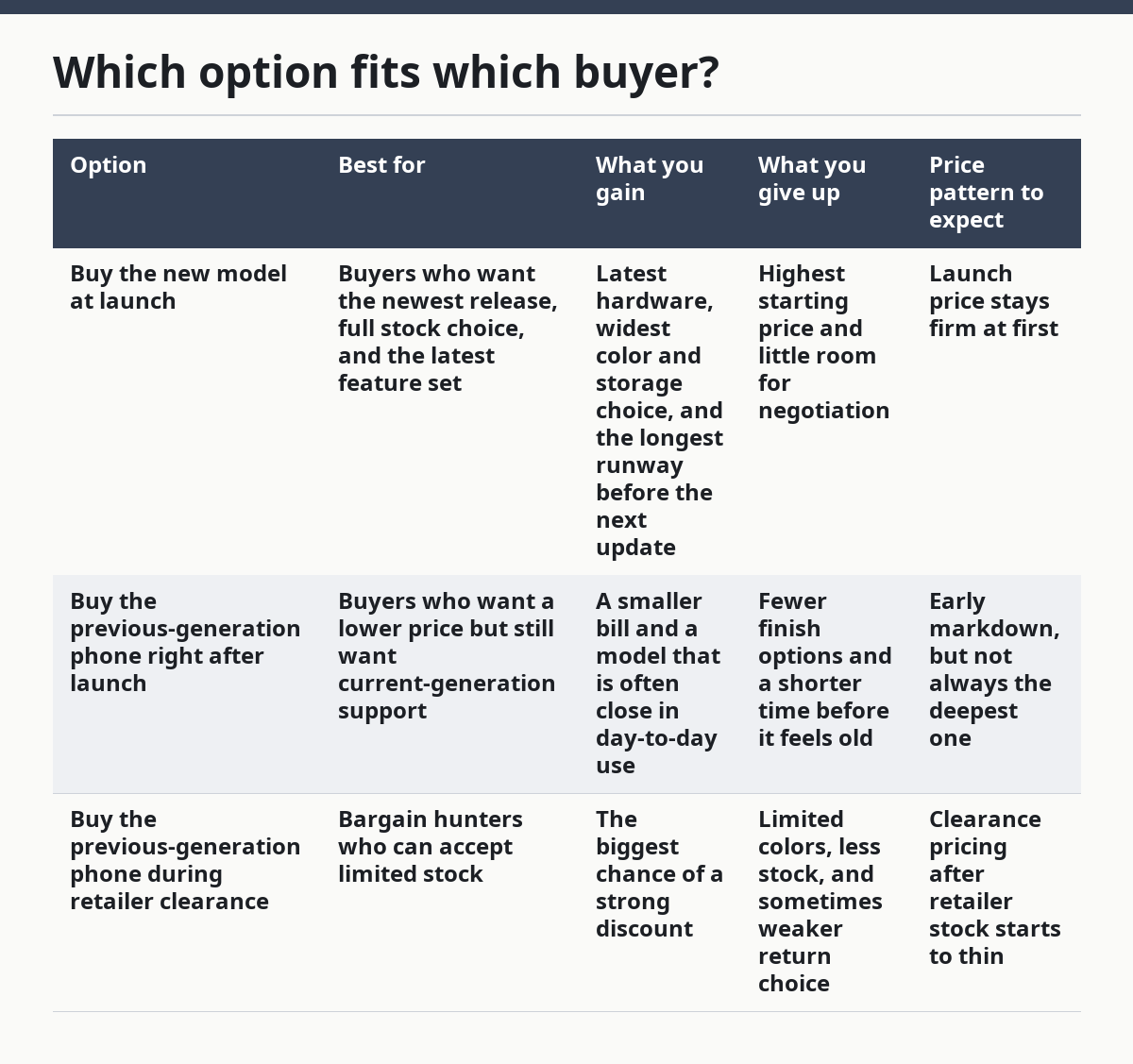
Which option fits which buyer?
The better choice depends on what matters more: the newest model on day one, or the lower price on the older phone. The right answer changes with launch-week pricing, clearance timing, and how much you care about new features.
| Option | Best for | What you gain | What you give up | Price pattern to expect |
|---|---|---|---|---|
| Buy the new model at launch | Buyers who want the newest release, full stock choice, and the latest feature set | Latest hardware, widest color and storage choice, and the longest runway before the next update | Highest starting price and little room for negotiation | Launch price stays firm at first |
| Buy the previous-generation phone right after launch | Buyers who want a lower price but still want current-generation support | A smaller bill and a model that is often close in day-to-day use | Fewer finish options and a shorter time before it feels old | Early markdown, but not always the deepest one |
| Buy the previous-generation phone during retailer clearance | Bargain hunters who can accept limited stock | The biggest chance of a strong discount | Limited colors, less stock, and sometimes weaker return choice | Clearance pricing after retailer stock starts to thin |
New model at launch: pros and cons
Pros
- You get the fresh launch price and the newest version straight away.
- Stock is usually complete, so you can choose storage and color more easily.
- If the launch adds a better camera, a new chip, or a bigger battery, you get the full upgrade right away.
Cons
- The launch price is usually the highest price in the cycle.
- The old model often falls soon after, so the premium can feel large.
- You may pay for features you will barely use.
This option suits buyers who care about being first and do not want to wait for markdowns. It is weak for pure value shopping.
Previous-generation phone after launch: pros and cons
Pros
- The phone often becomes cheaper soon after the new model appears.
- You may get a model that is still very current in day-to-day use.
- You avoid paying the launch premium.
Cons
- The markdown may be modest if demand stays strong.
- Some stores keep the price high until they see the new model selling well.
- The best storage tier may sell out fast.
This option fits most practical buyers. It is the middle path: enough savings to matter, without giving up too much.
Clearance pricing: pros and cons
Pros
- This is where the sharpest cuts often show up.
- A phone can become a very strong value if the retailer wants it gone.
- The gap between the old model and the new model can be large enough to change the decision.
Cons
- Clearance can mean limited stock, odd colors, or only one memory size.
- Returns can be less flexible if the phone is an open-box or last-stock item.
- Prices can be inconsistent across stores, so comparison takes more work.
This option is for the reader who wants the lowest number and is willing to accept less choice. It is not for anyone who needs a specific color, a specific storage tier, or easy replacement.
Is launch-week pricing ever the best time to buy?
Launch-week pricing is sometimes the best time to buy, but only if the older phone is already on a real markdown or if the new model’s launch price is still acceptable to you. For many buyers, launch week is more useful for comparison than for purchase.
That is because launch week creates the clearest contrast between the new model and the previous-generation phone. A fresh launch puts pressure on the older device, and the first markdown often shows whether the retailer is serious about clearing stock. If the previous-generation phone barely moves in price, I treat that as a warning sign that the “deal” is weak.
The opposite can happen too. If a store has excess stock, launch week can produce strong clearance pricing before the wider market catches up. That is why the best launch-week buy is often not the new model itself. It is the older phone when the store is trying to empty shelves.
This is also the stage where a generic price comparison goes wrong. A buyer who only checks one store might see the launch price and assume it is fixed across the market. It often is not. The older phone may be cheaper at one retailer and nearly unchanged at another. That gap is the real signal.
My rule is simple: if the newer model’s launch features do not matter much to you, use launch week to pressure-test the older phone’s price. If the older model has not moved enough, wait. If it has dropped hard, buy the one with the better price-to-feature balance, not the one with the bigger launch banner.
What mistakes make the comparison useless?
The comparison becomes useless when I mix models, mix storage tiers, or compare one store’s launch price with another store’s clearance price as if they were the same thing. That creates fake savings and hides the real gap.
The biggest mistake is comparing a new model’s launch price with an older model’s sale price from a different week. A 128GB phone on launch day and a 256GB phone on clearance are not close substitutes, even if the model names look similar. Storage alone can change the gap enough to make the comparison unfair.
Another mistake is ignoring retailer clearance. Some buyers assume a markdown means the phone is “on sale,” when it may really be an end-of-stock move with fewer choices. That can be fine if the only goal is a lower bill. It is a bad trade if the buyer wants a normal return window or a specific finish.
A third mistake is waiting too long and then assuming the lower price will keep falling forever. Sometimes the older phone dips after launch, then holds steady until stock runs out. Sometimes it drops again only when the next announcement cycle starts. If the model you want is down to a few units, the next price move may be out of your hands.
The cleanest comparison uses the same model family, the same storage size, and the same retail setting. Once those three match, the price story becomes much easier to read.
What price gap is worth waiting for?
The price gap is worth waiting for when the older phone’s markdown is large enough to offset the features you are giving up. If the difference is small, the new model may be the cleaner buy. If the difference is wide, the older phone usually wins on value.
I would judge the gap in practical terms, not as a percentage target. Ask whether the launch-week premium buys you a feature you will use every day. If the answer is no, a smaller old-model price is usually the smarter choice. If the answer is yes, a higher launch price may still make sense.
This is where replacement model timing matters. When the new model arrives, the older one starts losing urgency. That does not mean it becomes bad. It means the buyer has more room to wait for the right price, especially if the older model still matches the basics: screen size, battery life, camera quality, and storage. Once those needs are covered, a lower markdown is often enough.
The wrong time to wait is when a specific clearance listing appears and the stock is clearly thin. Then the choice is not between “buy now” and “buy later.” It is between “buy this one” and “accept a different model.” That is a different decision.
The right move is to compare the launch price of the new model against the discounted previous-generation phone, then decide whether the feature jump is worth the gap. If the older phone is on a strong clearance and still meets the need, I would choose that one and put the savings to better use.
For a broader buying checklist, the mobile phone prices and buying guide on this site is the right next stop.
Does the old phone get cheaper after a new launch?
Yes, the previous-generation phone often gets cheaper after a new model launch, but the size and timing of the drop vary by retailer and stock level. Some stores cut the price right away, while others wait until clearance starts. The biggest discounts usually appear when the retailer needs shelf space more than it needs the old model. For general consumer guidance, see the FTC’s advice on shopping for a phone and Consumer Reports’ cell phone buying guide.
How long after launch do prices drop?
The first drop can happen around launch week, but there is no fixed timer. Some prices move as soon as the new model is announced, while others hold until stock starts to clear. If the older phone is still widely available, the price may stay higher for longer than expected. Apple’s iPhone lineup and Samsung’s Galaxy phones pages show how launch pricing and model tiers are presented by major manufacturers.
Drafted with AI; not yet reviewed by a person.