

How to Compare Mobile Phone Prices Between Official Stores
Last updated: November 18, 2026
Quick Answer: In most cases, the safest choice is the one with the clearer terms, not the lowest sticker price. When you compare the total deal, not just the listing price, the better option often comes down to warranty length, return rules, seller rating, and whether the phone is new, refurbished, or grey-market. This article on How to Compare Mobile Phone Prices Between Official Stores and Marketplaces shows how to judge both channels without guessing.
In short: compare the total deal, not the sticker price. A phone marketplace listing can look cheaper than an official store, but the real decision turns on warranty length, return rules, seller rating, and whether the listing is new, refurbished, or grey-market.
I write about mobile buying advice with a focus on what changes the final cost and the risk you take, not on hype around launch cycles or “best” lists.
Key takeaways
- The lowest headline price is not always the lowest-risk purchase.
- Official stores usually win on warranty clarity and returns; marketplaces often win on choice and lower entry prices.
- Seller rating matters most when the phone is sold by a third-party marketplace seller, not the platform itself.
- Refurbished listings can be good value, but only when the grading, battery policy, and return window are clearly stated.
- If the price gap is small, the official store is usually the safer pick. If the gap is large, a marketplace can make sense if the seller and warranty terms are clean.
The real difference between official stores and marketplaces in How to Compare Mobile Phone Prices Between Official Stores and Marketplaces
The official store wins on predictability. A marketplace can win on price, but the number on the listing is only part of the deal, because the buyer is often comparing a brand-run storefront against a third-party seller’s offer on the same model.
That difference matters most when the listing page is vague. An official store typically states the phone’s condition, warranty language, and return window in one place. A marketplace listing may be just as clear, but it may also hide the important details in seller notes, platform policy pages, or a separate warranty section. If the page does not spell out who fulfills the order, who handles returns, and whether the unit is new or refurbished, the apparent bargain is weaker than it looks.
For this reason, the first comparison should never be “Which price is lower?” It should be “What exactly am I buying, from whom, and what happens if something is wrong?” That is the cleaner way to compare an official store against a phone marketplace listing, especially for models where one seller is offering a new unit and another is selling a refurbished one under the same name.
A useful rule: if two offers are within a small gap and the official store includes easier returns or a cleaner warranty, the official store usually justifies the extra spend. If the marketplace offer is materially lower and the seller reputation, warranty language, and return policy are all explicit, the marketplace can be the better value.
What should I check on a phone marketplace listing?
The seller identity and the return window are the first things to check. After that, read the warranty wording line by line, because the biggest mistake buyers make is assuming the platform’s protection is the same as the manufacturer’s coverage.
A solid marketplace listing should answer five things before you click buy:
- Is the phone new, refurbished, open-box, or imported?
- Who is the actual seller?
- What is the return period, and who pays return shipping if the phone arrives damaged?
- What warranty applies: manufacturer warranty, seller warranty, platform protection, or none of the above?
- Does the listing state the storage size, network compatibility, and included accessories?
Seller rating matters here, but only as one signal. A high rating cannot fix a missing warranty or a confusing refurb description. A lower-rated seller with clear terms is still a risk, but a highly rated seller with vague condition wording is not a safe shortcut. Marketplace trust is built from the full listing, not the star count alone.
This is also where refurbished listings need extra care. A refurbished phone can be a smart way to save money, but “refurbished” can mean anything from a factory-graded return to a seller-repaired device with a short seller warranty. If the page does not state battery health policy, cosmetic grade, and whether accessories are original, the listing is too thin for a serious comparison.
Therefore, treat marketplace buying like a document check, not a bargain hunt. Read the listing as if the warranty and return policy are the product, because for many buyers they are. Consumer guidance from the U.S. Federal Trade Commission and the U.K. Competition and Markets Authority both stress that clear terms and seller identity matter when you buy online.
https://consumer.ftc.gov/articles/buying-products-online
https://www.gov.uk/online-and-distance-selling-for-businesses
The official store: who should actually use it?
The official store wins for buyers who value certainty more than squeezing out the last bit of savings. That includes anyone buying a flagship phone, a gift, a work device, or a model they plan to keep for several years.
The strongest case for an official store is warranty clarity. Brand-run stores usually make it easier to see whether the device qualifies for the manufacturer’s standard warranty, and they are less likely to bury condition issues in third-party seller language. Returns are usually easier to understand, too, because the store controls the transaction from checkout to refund rather than splitting responsibility between platform and seller.
Official stores also reduce the chance of odd problems that are common in marketplace listings: region-locked variants, incomplete accessory bundles, or listings that look new but are actually refurbished or imported. The buyer may pay more, but the extra cost buys cleaner paperwork and fewer surprises.
The drawback is obvious: official store pricing is often less aggressive. That matters if the model is widely available and the marketplace discount is large. It also matters if the brand’s store has a narrow return window or slow refund processing; a polished storefront does not automatically mean the best post-purchase support.
Who should skip the official store? Anyone whose only goal is the lowest possible outlay and who is comfortable checking a third-party seller’s terms. A buyer who is comparing a standard midrange device and does not care about premium return handling may find the official store hard to justify if the gap is wide.
For readers who want fewer variables, though, the official store is usually the cleaner choice. It is especially sensible when the phone is expensive enough that a warranty dispute would be painful.
According to Apple’s U.S. store pages, the return period is 14 calendar days for eligible products, which shows why official-store terms can be easy to verify when the seller controls the whole transaction.
https://www.apple.com/shop/help/returns_refund
The specific situations where marketplaces win
Marketplaces win when the price gap is real and the listing still gives enough protection to make the risk acceptable. That is most often true for older models, refurbished units, clearance stock, and parallel offers from reputable sellers.
The strongest marketplace advantage is selection. An official store usually carries the brand’s current catalog and a small set of color or storage variants. A marketplace may show multiple sellers for the same model, including open-box, refurbished, and import versions that the brand no longer sells directly. That wider field can create better pricing and better fit if the buyer is flexible on color, storage, or condition.
Marketplaces also win for buyers who know how to read the details. If the listing clearly states that the phone is new, opened, backed by a manufacturer warranty, and sold by a seller with a long track record, the marketplace can be a perfectly reasonable place to buy. The platform’s own purchase protection can add another layer, although the strength of that protection depends on the marketplace’s current policy and the way the item is fulfilled.
The weakness is the same thing that creates the opportunity: variation. Not every seller plays by the same rules, and not every listing is complete. A marketplace listing can become a false economy if the return policy is short, the warranty is only seller-backed, or the unit is refurbished with no clear battery policy. Then the lower headline price stops being a real saving.
Who should use a marketplace? Buyers who are comfortable comparing multiple offers, who will read the return policy carefully, and who can accept a little uncertainty in exchange for a better deal. Who should not? Anyone who wants one clean answer to “Who repairs this if it breaks?” A marketplace is only attractive when the answer is already clear.
For example, Samsung’s official refurbished program in some markets has a 12-month warranty, which is the kind of concrete term that makes a deal easier to compare against a marketplace listing.
https://www.samsung.com/uk/refurbished/
The honest side-by-side
The official store wins on clarity; the marketplace wins on flexibility. That sounds simple, but the details change the buying decision fast.
| Criteria | Official Store | Marketplace | Winner for [condition] |
|---|---|---|---|
| Headline price | Usually steadier, often less discounted | Can be lower, especially on older or refurbished stock | Marketplace when the discount is real |
| Warranty clarity | Usually easier to verify against the maker’s terms | Depends on seller, fulfillment, and listing wording | Official store when you want certainty |
| Return policy | Typically simpler to interpret from one source | Can vary by seller and platform policy | Official store for low-friction returns |
| Seller trust | Brand-controlled | Set by seller rating, history, and fulfillment status | Official store for lower uncertainty |
| Choice of variants | Limited to current official catalog | Often broader, including import and refurb options | Marketplace when you need more options |
| Refurbished availability | Sometimes available, usually with clearer grading | Often more common, but grading varies | Official store if refurb terms are explicit |
| Risk of ambiguous condition | Lower | Higher if the listing is thin | Official store |
| Best fit for gift or business purchase | Stronger documentation and cleaner proof of purchase | Works only if the listing is fully documented | Official store |
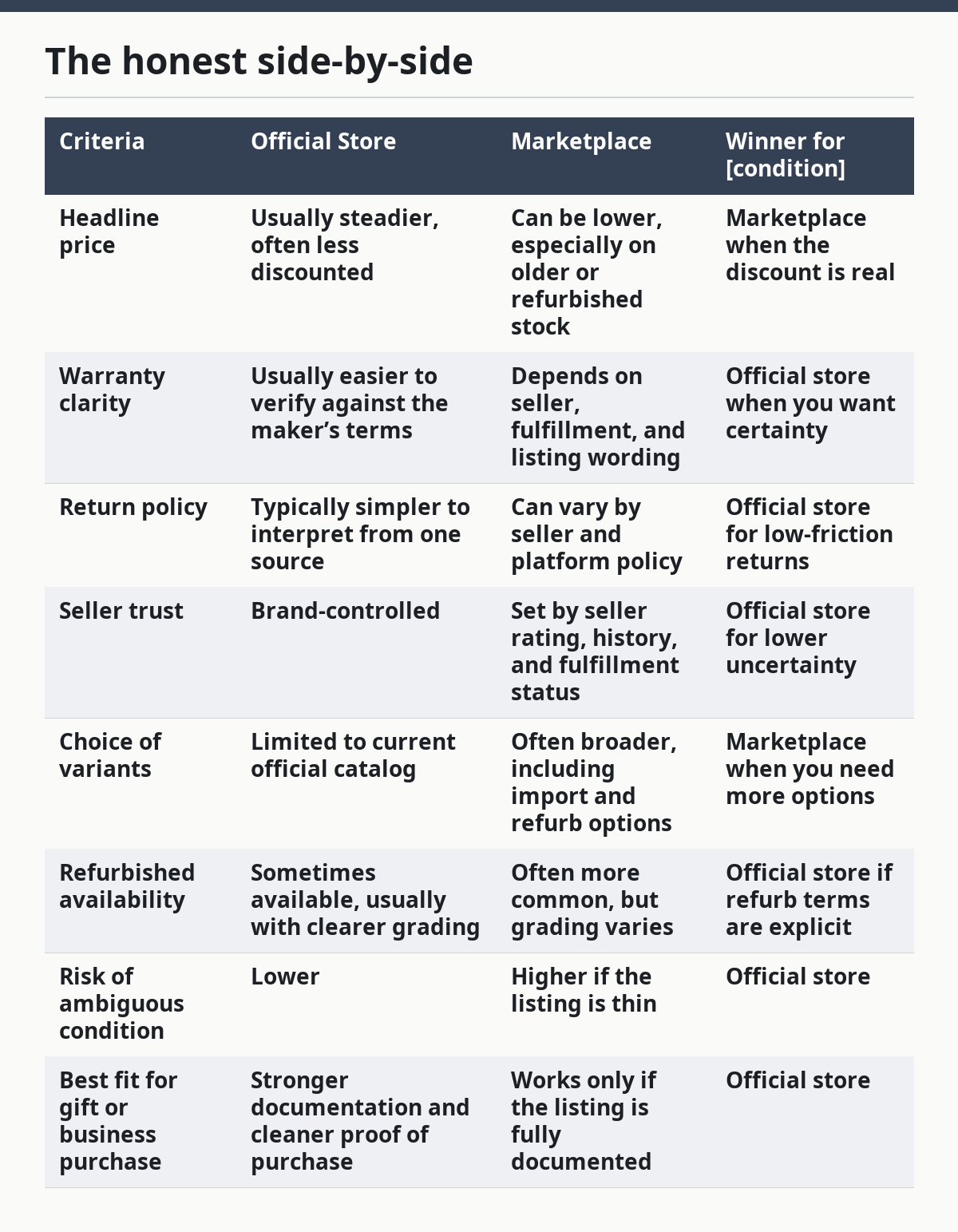
The table points to the real decision: price matters, but only after trust, warranty, and returns are visible. A marketplace listing can beat an official store on value without being the better purchase overall. The opposite is true as well.
For readers comparing a single model across both channels, the fairest method is to line up the same storage size, same color, same region, and same condition. If one side is a 128GB new unit and the other is a 256GB refurbished unit, the comparison is broken before it starts.
The Verdict: which one to choose and why
Choose the official store if you want the cleanest warranty, the simplest returns, and the least confusing paperwork. Choose the marketplace if the seller is well rated, the listing is explicit about condition and warranty, and the lower price is large enough to justify a little more checking. Neither if the listing hides whether the phone is new, refurbished, or imported, because that is where trouble starts.
That is the direct answer for most buyers. If you are buying a current flagship or a phone you expect to keep for years, the official store is the safer default. If you are buying an older model, a second device, or a refurb with a clear seller policy, the marketplace can be the smarter value play.
The part many guides miss is this: a cheaper marketplace listing is not a good deal if the return window is short and the warranty is weak. A higher official-store price is not wasteful if it eliminates a bad seller, a vague refurb grade, or a support dispute later. That is why the decision is less about the number on the page and more about the paperwork behind it.
When to reconsider the choice entirely
A phone marketplace listing is the wrong comparison point when the listing itself is too messy to trust. If the model name is vague, the storage size is missing, or the condition is buried in tiny print, stop comparing prices and look for a clearer offer.
One flip scenario is a refurbished model with a short seller warranty but a strong official-store open-box or certified-refurbished program. In that case, the official route can be the better value because the paperwork is cleaner and the risk is easier to price. Another flip scenario is a marketplace listing from the platform itself, with a transparent return window and manufacturer warranty intact. That can narrow the gap enough to justify buying there.
A third scenario: if you need the phone for work and cannot afford a delay, the channel with better fulfillment speed and clearer refund handling is more valuable than a small discount. A fourth: if the seller’s page does not specify region compatibility or charger details, the apparent bargain may be tied to a version that is not right for your network or country.
For a broader framework on comparing value across models and channels, the hub page on mobile phone price comparison and value is the right next stop. Related guides on buying refurbished phones and checking return policies can help too.
Is it safe to buy phones on marketplaces?
Yes, but only when the listing is specific enough to judge. A marketplace phone listing is safest when the seller is identifiable, the condition is clear, the return window is written out, and the warranty is not vague. If any of those pieces are missing, the risk rises fast and the lower price may not be worth it.
What should I check on marketplace phone listings?
Check seller identity, condition, warranty, return policy, storage size, and network compatibility first. Those details matter more than the headline price because they determine what you actually receive and how well you are protected if the unit arrives faulty, incomplete, or not as described.
Do official stores have better warranty terms?
Usually yes, in the sense that the terms are clearer and easier to verify. Official stores are less likely to mix seller-backed and manufacturer-backed coverage, which reduces confusion later. That does not mean every official-store warranty is longer; it means the rules are usually easier to read and enforce.
Drafted with AI; not yet reviewed by a person.