

How to Calculate the First-Year Cost of a Mobile Phone
Last updated: November 20, 2026
How to Calculate the First-Year Cost of a Mobile Phone is a practical way to total the phone price plus the extras and running costs that show up in the first 12 months. That usually includes the handset, a case, a screen protector, insurance if you choose it, a repair buffer, and a small amount for charging. For a broader view of buying options, see the related guide on Mobile Phone Buying Strategy and Total Cost.
Key takeaways
- Start with the phone’s sticker price, then add the items you are likely to buy in the first month.
- Do not stop at accessories; the first year can also include insurance, repairs, and charging.
- A lower phone price can still lead to a higher first-year total if the extras are expensive.
- The clearest way to estimate the total is to list each cost once, then add them into a 12-month budget.
- This method helps you compare phones by real out-of-pocket cost, not just the price tag.
What counts in the first-year phone cost?
The first-year phone cost is the sum of the device price, accessory costs, protection costs, repair costs, and charging costs over 12 months. If you want a realistic number, do not count only the phone itself.
The bare minimum list is simple:
- phone price
- case
- screen protector
- insurance, if you buy it
- repair buffer for damage or wear
- charging costs
A lot of buyers forget the small items because each one looks minor on its own. A case and screen protector may seem like extras, but they are part of the real purchase for most people. If you skip them in the math, the total looks cheaper than it is. Consumer guidance from the FTC on add-on products and warranties is a useful reminder to price the full purchase, not just the headline item.
This page covers the spending that belongs in the first year only. It does not try to compare phones by trade-in value or long-term ownership cost. If you want the wider buying picture, the hub on Mobile Phone Buying Strategy and Total Cost is the better next stop.
How do I calculate the first-year cost of a mobile phone?
You calculate the first-year cost of a mobile phone by adding every expected cost for the first 12 months into one total. That means the handset price, the protective accessories you will likely buy, any insurance premium, a repair allowance, and charging costs.
Use this order:
- Write down the phone price. Use the full price you expect to pay for the handset. If the phone costs $600, start there and do not leave out the sticker price.
- Add the case. Put in the cost of the case you plan to buy, even if it feels optional. A case is often the first extra people buy after the phone.
- Add a screen protector. Include the protector if you want to guard the display from scratches or cracks. If you are using one, it belongs in the first-year total.
- Add insurance if you will carry it for the year. Count the monthly premium for 12 months, then add any deductible if your plan has one. Insurance can be a steady cost, not a one-time fee.
- Add a repair buffer. Set aside money for small fixes or accidental damage that insurance does not cover. Even a modest repair fund changes the first-year total in a meaningful way.
- Add charging costs. Include the cost of the charger or cable if you need one, then add the electricity use for the year if you want a fuller estimate. For most buyers, the charging line stays small, but it still belongs in the total. The U.S. Department of Energy’s [Energy Saver](/external/energy-saver-electronics) guidance is a useful reference for keeping electricity estimates realistic.
- Add the numbers together. The result is your first-year mobile phone cost. If the total feels too high, trim accessories or pick a phone with lower protection and repair costs.
The point of this method is not perfect precision. It is to stop undercounting. A phone that looks affordable at the register can be less affordable once you include the first year of ownership.
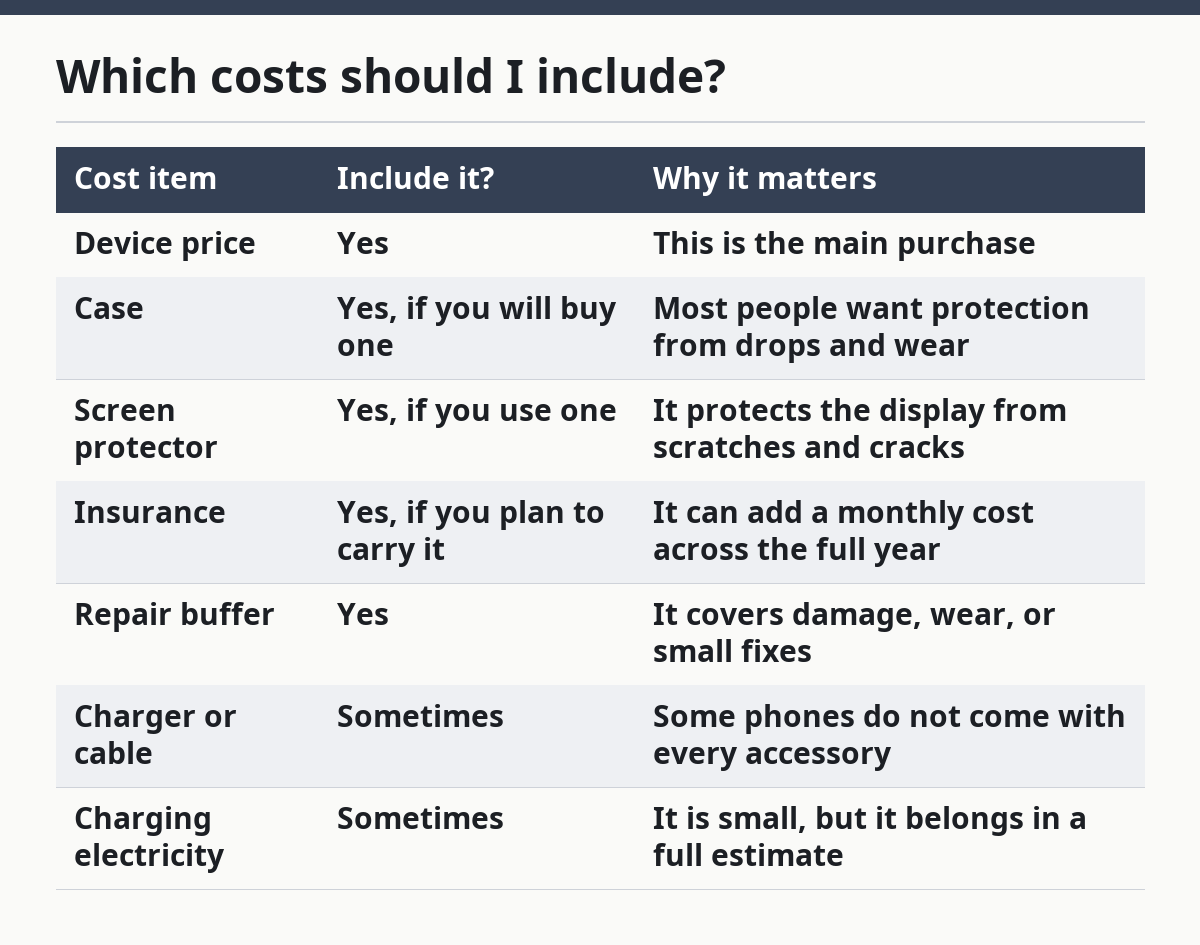
Which costs should I include?
The costs you should include are the ones you are likely to pay within 12 months, not every possible expense in a phone’s life. That usually means the handset, basic protection, and a small allowance for problems.
A useful checklist looks like this:
| Cost item | Include it? | Why it matters |
|---|---|---|
| Device price | Yes | This is the main purchase |
| Case | Yes, if you will buy one | Most people want protection from drops and wear |
| Screen protector | Yes, if you use one | It protects the display from scratches and cracks |
| Insurance | Yes, if you plan to carry it | It can add a monthly cost across the full year |
| Repair buffer | Yes | It covers damage, wear, or small fixes |
| Charger or cable | Sometimes | Some phones do not come with every accessory |
| Charging electricity | Sometimes | It is small, but it belongs in a full estimate |
The most common mistake is to include only the device and maybe one accessory. That leaves out the steady costs that pile up month by month. The second mistake is to count vague “future repairs” without setting a number. If you want a useful budget, every line needs a place in the total.
This is also why a first-year cost can differ from a simple purchase price by a lot. Two phones can have similar sticker prices and very different ownership costs once the extras are added.
How much do accessories change the total?
Accessories can change the total enough to make one phone look cheaper than another on paper, even when the first-year spend is close. A case and screen protector are small on their own, but they are part of the real price for many buyers.
The accessories that matter most are the ones you buy immediately:
- Case: protects the body and corners
- Screen protector: protects the display
- Charging gear: may be needed if the phone does not include what you want
- Spare cable or adapter: useful if you travel or keep one at work
The cost effect is simple: the more protection you want, the higher the first-year total becomes. A buyer who wants a sturdy case, a protector, and extra charging gear will spend more in month one than a buyer who uses the phone bare. That is not a flaw in the math; it is the math.
Because those accessories are part of the real purchase for many people, treating them as “optional” can make the phone seem cheaper than it really is for your use. If you know you will buy them, put them in the first-year calculation from the start. If you are unsure whether a particular accessory is worth it, it is sensible to check a retailer, carrier, or repair professional before you decide.
This is where many generic guides go wrong. They talk about the phone as if it lives alone. In real life, most phones arrive with at least one case, one protector, and one charging item attached to the purchase.
Do I need insurance and a repair buffer?
You do not need insurance for every phone, but you should still plan for repair risk in your first-year cost. Insurance shifts the risk into a monthly payment, while a repair buffer keeps cash aside if something goes wrong. For consumer protections and warranty basics, the FTC is a useful starting point.
A few useful distinctions help:
- Insurance is a predictable monthly cost.
- Repair buffer is money you reserve for a broken screen, damaged port, or other issue.
- Deductible is the extra amount you may still pay if you make a claim.
If you buy insurance, include the full 12 months of premium in your calculation. If the policy has a deductible, add that too, because it is part of what you could pay in the first year. If you do not buy insurance, you should still set aside a repair buffer. A phone can survive 12 months without an issue, but budgeting for zero risk is not realistic.
This part of the estimate is where personal choice matters most. Someone who is careful and keeps the phone in a case may choose a smaller buffer. Someone who drops phones often may prefer insurance even though it raises the total. The wrong choice is pretending the risk does not exist.
What about charging costs?
Charging costs usually stay small, but they still belong in the first-year total if you want a full estimate. The cost depends on whether you need a new charger or cable, and how much charging you do over the year.
There are two parts here:
- Hardware cost: the charger, cable, or power brick you may need to buy.
- Electricity cost: the power used to charge the battery across 12 months.
For many buyers, the hardware cost matters more than the electricity itself. If the charger is not included, or if you want a spare for home, work, or travel, that is a real first-year expense. The electricity line may be small, but it is still a cost.
Do not overcomplicate this section. A practical estimate is enough. If you are building a family budget or comparing several phones, you can keep charging costs as a small fixed line rather than chasing exact power use. The Energy Saver guidance is a good reference if you want to sanity-check the electricity line.
What mistakes make the total wrong?
The biggest mistakes are leaving out the obvious extras, guessing too low on repairs, and mixing one-time costs with monthly costs. Those errors make the first-year number look neat, but they also make it useless.
Here are the mistakes I would watch for:
- Counting only the phone price. That gives you a purchase price, not a first-year cost.
- Leaving out the case and screen protector. If you plan to buy them, they belong in the total.
- Ignoring insurance deductibles. A policy is not the whole cost.
- Using zero for repairs. That assumes the phone will have no problems for 12 months.
- Forgetting charging gear. A missing cable or charger can add a small but real cost.
The fix is plain: build the total from the ground up, one item at a time. Use the numbers you actually expect to pay, not the numbers that make the phone look cheaper. That is especially important for buyers on a tight budget, because a missed $30 or $50 line can change the decision.
This method is not for someone who only wants the sticker price. It is for a buyer who cares about what the phone really costs in the first year of ownership.
What is a simple first-year cost formula?
The simplest formula is: phone price + accessories + insurance + repair buffer + charging costs = first-year cost. If you want a cleaner budget, split the accessories into case, screen protector, and charging gear so nothing gets lost.
A plain version looks like this:
- Phone price
- Case
- Screen protector
- Insurance for 12 months
- Deductible, if needed
- Repair buffer
- Charger or cable
- Charging electricity
You can keep this in a note on your phone or on paper. The point is not to build a perfect spreadsheet. The point is to see the real spend before you commit.
A phone that costs less up front is not always cheaper in year one, especially when protection, insurance, and repair risk enter the picture. That is why the first-year number is more useful than the headline price alone.
FAQ
What costs should I include in the first year of phone ownership?
Include the phone price, a case, a screen protector, insurance if you buy it, a repair buffer, and charging costs. If you need a charger or cable, add that too. The first-year number should reflect what you will actually spend, not just the sticker price.
Is a cheaper phone always cheaper over 12 months?
A cheaper phone is not necessarily cheaper over 12 months. A lower handset price can be offset by higher accessory costs, insurance, repairs, or other add-ons. A careful total of the expected first-year costs is the best way to compare phones before you buy.
Drafted with AI; not yet reviewed by a person.