

How Import Rules, Duties, and Customs Delays Affect Phone Prices
Last updated: November 26, 2026
Quick Answer: 3 main import costs can raise the final price of a phone before it reaches the shelf. Import rules, duties, and customs delays can affect phone prices through customs duty, import VAT, and shipping or handling fees. A grey import can look cheaper at first, then cost more once the phone is inspected and charged.
Key takeaways
- A phone’s sticker price may not be the final price.
- Customs duty and import VAT can be added after the phone leaves the seller.
- A customs delay can create extra handling, storage, or re-delivery costs.
- Grey imports may start cheaper, but the total can rise once border charges land.
- The fastest-looking deal may not be the cheapest one in the end.
What charges change a phone’s final price?
A phone’s final price changes when 3 main import costs are added: customs duty, import VAT, and shipping or handling charges. These costs can be charged before delivery, at the border, or after the parcel arrives with the courier.
Customs duty is the tax or fee charged on imported goods under the destination country’s rules. Import VAT is a sales-style tax charged on the import value in many places. If a phone crosses a border as a parcel, the courier may also add an administration fee for clearing it through customs. For official guidance, see the UK government’s import tax rules and U.S. Customs and Border Protection’s customs guidance. UK government tax and duty guidance and U.S. CBP guidance on internet purchases explain how border charges can apply.
The tricky part is that the phone’s listed price is only one part of the total. A seller might advertise a handset for less than a local shop, but that price may not include border charges. Once duty and import VAT are added, the “cheap” phone can end up closer to, or even above, the local price.
This is why the same phone can have different final prices on different websites. One seller may quote a tax-inclusive price, while another shows a tax-free export price. The difference is not a trick in every case, but it does mean the buyer has to check what is included before paying.
If a page or seller only shows the handset price, the missing pieces are often the import costs. A reader comparing offers should look for three things: duty, import VAT, and any courier handling fee. That trio is where the final jump usually happens. For a broader view, see the site’s main guide to mobile phone prices.
How import rules change the total
Import rules change the total because they decide what is taxed, who pays, and when the bill appears. A phone that crosses a border may be treated differently from one sold inside the country, even if the handset is identical. Because customs rules vary by country, readers should check official guidance or a customs professional before buying.

A simple way to understand the process is to follow the parcel from checkout to delivery:
- Check the seller’s tax wording before paying. Look for terms like “duties unpaid,” “tax excluded,” or “delivered duty unpaid.” If the seller uses one of these, the final bill can rise after checkout.
- See whether the phone is a grey import. A grey import is a genuine phone sold outside the official local channel. It may be the same model, but it can follow a different tax path and warranty path.
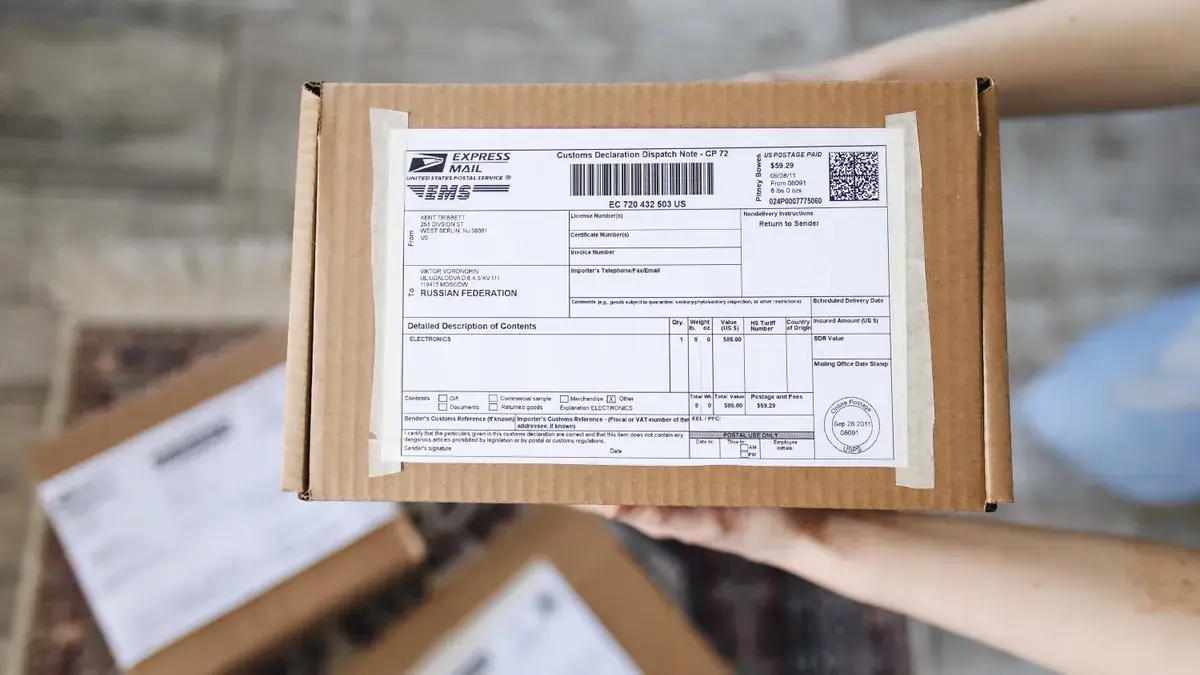
- Expect customs assessment at the border. Customs may inspect the parcel, confirm the declared value, and decide whether duty or import VAT applies.
- Wait for the courier’s clearance step. If the courier handles the customs paperwork, it may add a processing fee before delivery can continue.
- Add the extra charges to the phone price. The result is the real landed cost, not just the shop price.
The main rule is simple: the more the seller leaves out of the checkout total, the more likely the buyer is to face a higher landing cost later. That still does not mean the phone is a bad buy. It does mean the buyer should compare the complete bill, not the headline number.
This is also where country rules matter. Some places charge tax on the phone and shipping together. Others charge a separate fee only above a certain value. Because those rules change by country, the same handset can land with different cost structures in different markets. A buyer who ignores that detail can misread a “deal” by a wide margin. For a closer look at regional pricing, see phone pricing factors.
Why customs delays can add costs
Customs delays can add costs because time at the border can trigger storage fees, courier fees, missed delivery attempts, or a price change if the seller holds the order open. A delay is not just an inconvenience; it can change the final invoice.
A border inspection can happen for a few reasons: the declared value may need checking, the paperwork may be incomplete, or customs may want to verify the product type. When that happens, the parcel can sit longer than planned. The delay itself does not always create a charge, but the side effects often do.
The most common added costs are practical ones. A courier may charge a clearance fee to submit the paperwork. If the parcel needs another delivery attempt after customs releases it, a re-delivery fee can appear. If a seller charges the buyer only after customs clears the parcel, the delay can also push the payment date back, which may matter if the exchange rate moves or the seller adjusts shipping terms.
A customs delay can also make a phone more expensive in a softer way: it can remove the value of the “fast delivery” promise. A phone ordered for a birthday, work trip, or trade-in window may no longer arrive on time, so the buyer may end up paying for a replacement plan, local backup phone, or upgraded shipping later. For buyers comparing timing and cost, see shipping options.
This is one reason grey imports need careful reading. A grey import can look cheaper because the seller has not wrapped in the same border costs as an official local listing. But if the parcel is held for inspection, the buyer can end up paying both time and money. The delay does not guarantee a higher bill, but it makes the final bill less predictable.
Grey import or official local stock?
A grey import is often cheaper at checkout, but official local stock is usually easier to price accurately. That difference can matter more than many shoppers expect, because the cheapest-looking option is not always the cheapest after customs.
| Option | What the buyer sees first | What can raise the price later | Best for | Weak point |
|---|---|---|---|---|
| Official local stock | Higher or steadier sticker price | Fewer surprise import charges | Buyers who want a clearer final total | Less chance of a bargain at checkout |
| Grey import | Lower starting price | Customs duty, import VAT, courier handling, border inspection delay | Buyers who can check tax rules carefully | Final cost can drift upward |
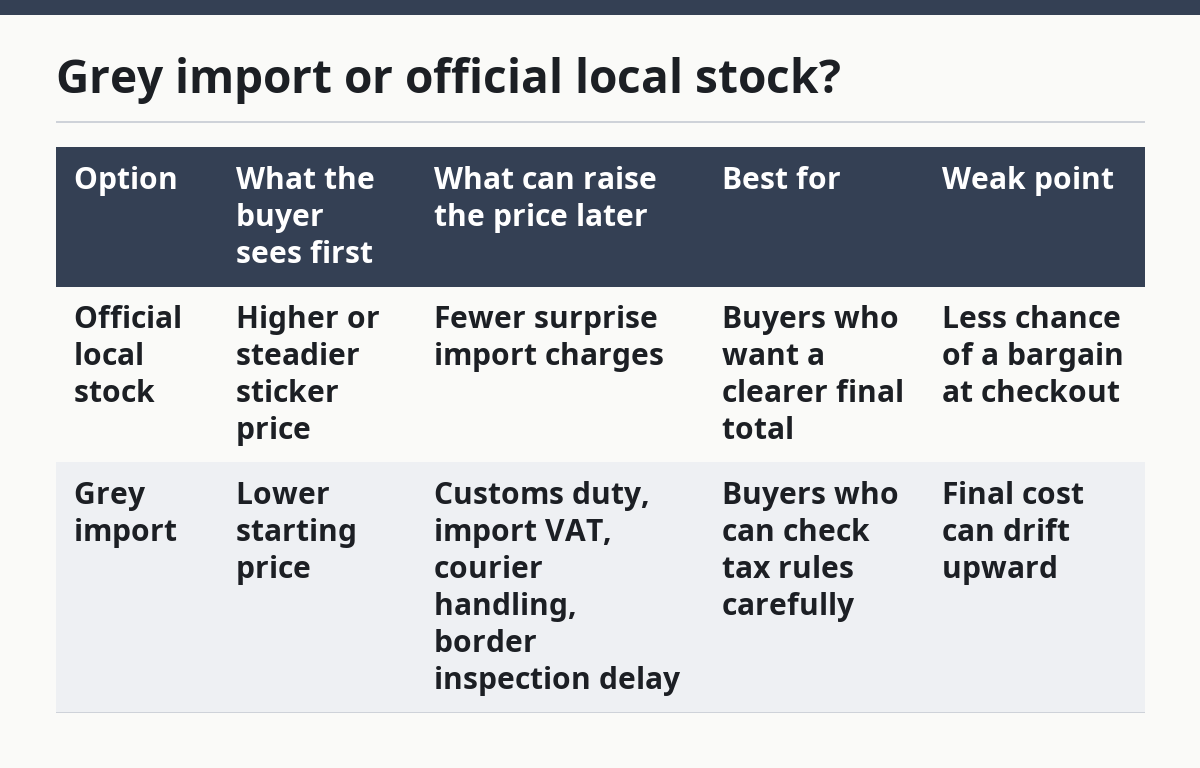
The appeal of a grey import is obvious: the headline price can be lower. The risk is that the missing taxes and fees show up later, and the buyer loses the advantage. A grey import can also be more complicated if the phone needs to return under warranty, though warranty is separate from customs and still worth checking. For related advice, see phone warranty help.
Official local stock is not always cheaper, but it is usually easier to understand. The seller is more likely to build the local tax into the price, which means the buyer sees the near-final figure sooner. That can be worth more than a small discount on paper, especially when the phone is expensive and the extra charges are hard to predict.
The wrong choice for a buyer is the option that hides the full cost. If the goal is to save money, the buyer should compare the landed cost, not the listed price. If the goal is certainty, local stock often wins even when the sticker price is higher.
What should you check before ordering?
You should check 4 details before ordering so the phone does not arrive with surprise charges. The goal is to know the landed cost before the parcel crosses the border.
Start with the seller’s tax wording. If the listing says tax excluded, duties unpaid, or shipped from overseas, assume the checkout price is not final. Then look for any mention of customs duty, import VAT, and clearance fees. Those 3 items are the usual cost drivers.
Next, check who handles customs paperwork. Some sellers include it in the shipping charge. Others leave it to the buyer or courier. If the courier acts as the importer’s agent, the courier may add a service fee before delivery. That fee can be small compared with the phone price, but it still changes the total.
A short checklist helps:
- Read the tax line on the listing. If it is vague, treat the price as incomplete.
- Look for the shipping charge separately. International shipping can be a real cost on its own.
- Check whether the parcel may face border inspection. A delay can mean extra handling or rescheduling.
- Add any courier fee to the total. The final number should include delivery and clearance, not just the handset.
The buyer who skips these steps often compares the wrong number. The result is a false bargain. A phone that looks cheaper by a small amount can become more expensive once duty and import VAT are added. That is why the cleanest comparison is always the full landed cost.
For anyone trying to understand the bigger picture, this topic sits inside the wider set of factors that shape mobile phone pricing. Import charges are only one part of that picture, but they are one of the few that can change after checkout. See also buying a phone guide.
Which costs are easy to miss?
The easiest costs to miss are shipping charge, clearance fee, and import VAT on the full value. They are easy to miss because they do not always appear in the first price the buyer sees.
A phone can be listed at one price, shipped for another, and cleared for a third. That split is common with cross-border sales. The listing may show the device cost only, while the shipping page adds a courier fee and the customs desk adds tax. Each step is legal and ordinary in many markets, but it makes the total harder to read.
One common mistake is assuming a “free shipping” label means no border cost. Free shipping only removes one line item. It does not stop customs duty or import VAT. Another mistake is assuming the customs value equals the phone price alone. In some cases, shipping is part of the taxable base, which makes the final bill higher than expected.
The cost of these mistakes is simple: the buyer loses price certainty. If the phone was meant to fit a tight budget, the extra charge can break the plan. If the buyer already paid, the surprise fee can feel like a penalty even when it follows the rules.
The safer move is to treat any cross-border phone purchase as a 3-part total: handset price, delivery charge, and import cost. If the seller cannot show those clearly, the buyer should assume the final number may be higher than the headline price.
What import fees can change the price of a phone?
Customs duty, import VAT, shipping charge, and courier handling fees can all change the price of a phone. The final cost can also shift if the parcel is inspected and held longer than expected. A grey import is the version of this that catches the most people, because the first price can look lower than the real landed cost.
Can customs delays make phones more expensive?
Yes, customs delays can make phones more expensive by adding courier handling, storage, or re-delivery charges. A delay can also push the buyer into a worse timing window if the seller reissues the bill or if the shipping terms change. The delay itself is not always charged, but the costs around it often are.
Why do grey imports cost less or more?
Grey imports can cost less at checkout because the seller may not include local taxes in the listed price. They can cost more later if customs duty, import VAT, or courier fees are added after the order. The buyer may save money, break even, or end up paying more, depending on the border rules and the seller’s tax handling.
What happens when a phone is held at customs?
When a phone is held at customs, the parcel usually waits for paperwork, value checks, or tax assessment. The buyer may need to pay duty, import VAT, or a courier clearance fee before release. Delivery can stall for a short time or longer, and the longer wait can create extra handling costs or missed delivery attempts.
Drafted with AI; not yet reviewed by a person.