

How to Compare Mobile Phone Prices When a Model Is Being Replaced
Last updated: November 20, 2026
Quick Answer: compare three prices—the current phone, the replacement model, and the closeout price—and if you can match storage and carrier status, a difference of even $50 to $100 can change which option is the better buy. When a phone model is being replaced, the right comparison is between the current-generation phone, the replacement model, and the previous-generation closeout price. That is how to tell whether the lower price is a real saving or just the last shelf label before stock disappears. For the wider shopping context, see our mobile phone prices and buying guide and phone buying checklist.
Key takeaways
- Compare three prices, not one: the phone on sale now, the replacement model, and the older model still being cleared out.
- A lower sticker price can hide trade-offs such as fewer colors, less storage, or only one retailer still holding stock.
- The best deal is often the one that fits the spec you want at the best price, not simply the cheapest phone.
- Replacement announcements often help buyers, but they can also make the exact model you want harder to find in a given color or storage size.
- If you need a phone for a long time, the replacement model may cost more now but be easier to live with later.
What is replacement cycle pricing?

Replacement cycle pricing is the short window when a phone model is still on sale but a newer model is already taking its place. In that window, the current-generation phone, the replacement model, and the previous-generation phone can all sit side by side with different prices.
That matters because a price drop does not always mean the phone got cheaper for the same reason. Sometimes the seller is clearing old stock. Sometimes the manufacturer has shifted attention to the next generation. Sometimes the only units left are the less popular colors or the smallest storage option, which changes the real value.
A reader comparing prices in this window should treat the phone as three separate offers: the exact model on the shelf today, the new model that is replacing it, and the earlier model that may still be sold as retail closeout pricing. If you are unsure about carrier locks or warranty terms, check the seller’s policy and the FTC’s guidance on buying and opening mobile devices: FTC consumer advice. The comparison only works if the storage size, carrier lock, and condition are the same. A 128 GB phone and a 256 GB phone are not the same deal, even if the model name looks close.
This page is for the person who wants to know whether to buy now or wait a little longer. It is not for someone trying to compare launch dates or map release calendars across regions. Those are different questions. For the broader shopping context, the hub article on mobile phone prices and buying guide is the better starting point.
How do I compare the three prices side by side?
You compare the three prices by lining up the current model, the replacement model, and the closeout model on the same spec sheet and asking what changes besides price. Start with the exact storage size, carrier status, color, and condition, then look at which model gives the best fit for your budget and how long you plan to keep it.
Use a simple table before you click “buy.” If one phone is $50 less but has half the storage, the lower number may not be the better deal. If the replacement model is only a little more than the current one, the newer phone may be the better buy because the older model is already moving into clearance territory.
| Option | What it usually means in a replacement cycle | Price signal to watch | Who it suits | Main risk |
|---|---|---|---|---|
| Current-generation phone | The model still being sold while its successor is coming in | A modest drop, or no drop yet | Buyer who wants the present model and can live with stock changes | Price may look stable until clearance starts, then stock disappears fast |
| Replacement model | The new phone taking over the line | Higher starting price, then gradual settling | Buyer who wants the newest version and longer shelf life | Paying more for features that may not matter |
| Previous-generation phone | The older model being cleared out | Lower price, often the sharpest markdown | Buyer who wants the cheapest acceptable option | Fewer colors, fewer storage choices, and limited stock |
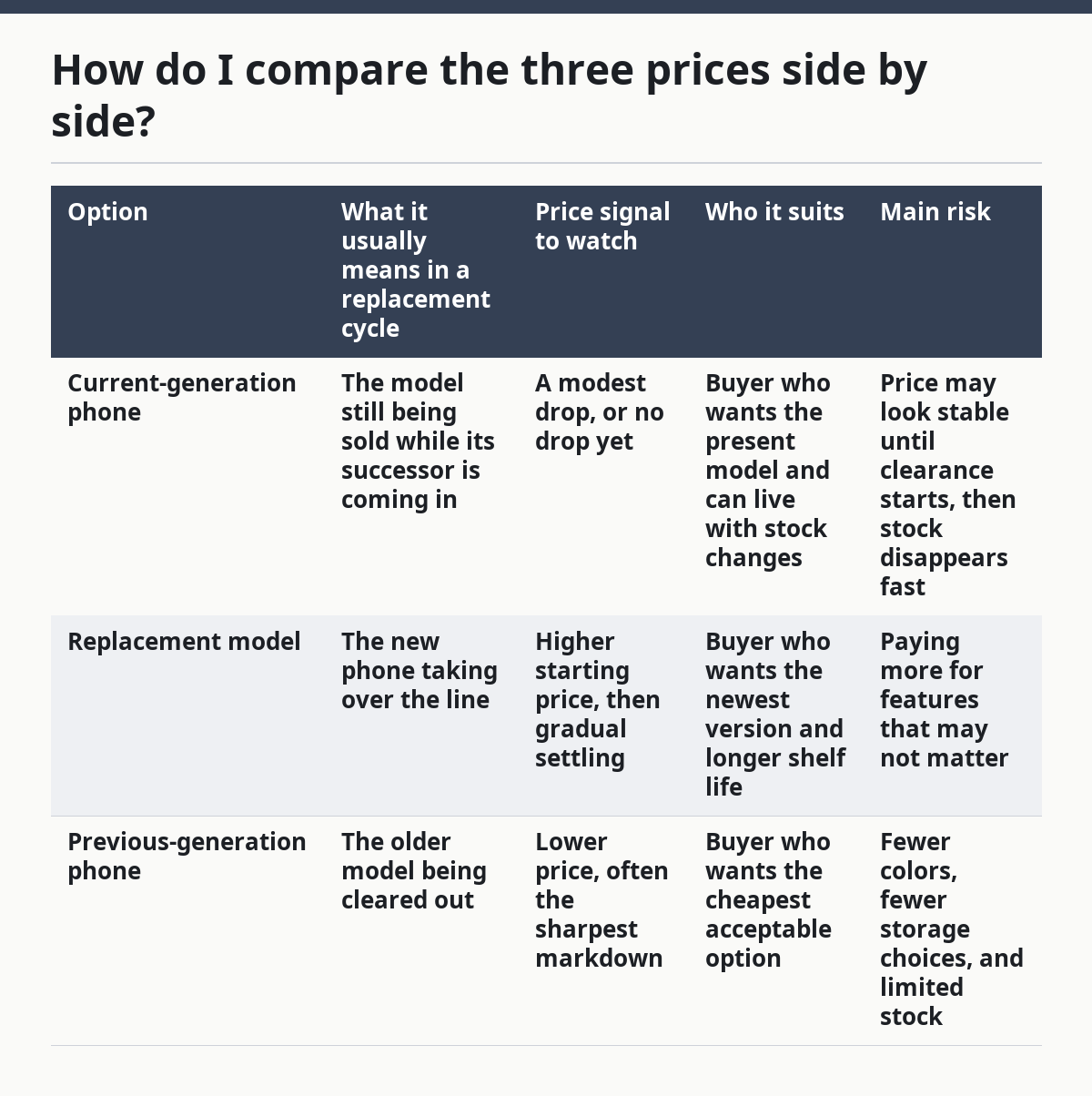
Once the table is filled, compare the total package, not just the headline number. A retail closeout on a 256 GB model can be better value than a smaller, newer model if the gap is small enough. A replacement model can also be smarter if the price difference is small and you want the phone to stay current for longer. For a broader approach, see how to choose phone storage and refurbished vs new phones.
Which option is the best buy?

The best buy is usually the option that gives the right balance of price, stock, and how long the phone will stay useful. That is not always the cheapest phone, and it is not always the newest one.
A replacement model is the best choice when the newer phone is only slightly more expensive than the current model and you plan to keep it for several years. It is also the safer choice if the older phone is already disappearing from stores, because the last few units can be hard to compare fairly.
A current-generation phone is the best choice when its price has already fallen but the replacement model is still well above your budget. It can be a strong middle ground because you may get a familiar model at a better price without going all the way to a clearance unit.
A previous-generation phone is the best choice when your target is simple value and you do not care about having the newest model. That works best if you are satisfied with the storage size on offer and you can accept fewer color choices. It is the wrong choice if you need a specific configuration, because clearance stock tends to thin out first in the least common versions. For a second opinion on trade-offs, check our best time to buy a phone guide.
Here is the short version.
Current-generation phone
- Best for buyers who want a known model and a lower price than launch.
- Good when the replacement is close but not cheap enough.
- Weak point: stock can shrink quickly once the replacement is public.
Replacement model
- Best for buyers who keep phones for a long time.
- Good when the price gap is small.
- Weak point: the price is often still near the top of the range.
Previous-generation phone
- Best for buyers chasing the lowest workable price.
- Good when stock is still healthy and the specs match.
- Weak point: colors, storage options, and return windows may be less attractive.
If the choice is between a heavily discounted older phone and a slightly more expensive replacement model, the safer pick is often the replacement model. If the gap is wide, the older phone can be the smarter budget move. The wrong answer is “always buy the cheapest,” because a low price on a near-end-of-life model can hide a poor choice of storage or a model that is already hard to replace if it fails.
What should I check before I trust the deal?
You should check stock, storage, carrier lock, and timing before you trust the deal. Those four things decide whether the price is real value or just a low number attached to a weak offer.
Start with the exact model number and storage size. A 128 GB version and a 256 GB version can differ enough that price comparisons become useless if you mix them. Then check whether the phone is opened or tied to a carrier, because carrier lock changes how usable the phone is after purchase. Apple’s support pages explain that carrier policies and opening rules vary by carrier, and the FTC also advises buyers to confirm compatibility before purchase: Apple carrier support and FTC buying/opening advice.
Next, look at whether the seller is clearing old stock or listing the replacement model at a normal price. A retailer can mark down the older phone by a useful amount, but that markdown means little if the only color left is one you would not want. The same issue shows up with accessories and warranty terms, which can differ from model to model even when the phone name looks almost the same.
A simple step-by-step check helps keep the comparison clean:
- Write down the exact phone model, storage size, and carrier status for all three options. The result should be a like-for-like list, not a mix of versions.
- Put the three prices on one page and note which one is current-generation, which one is the replacement, and which one is the closeout unit. The result should show the price gap plainly.
- Check remaining stock in the colors and storage sizes you can live with. The result should tell you whether the deal is still available or already half gone.
- Compare the price gap against how long you plan to keep the phone. The result should tell you whether a newer model is worth paying for now.
- Buy only when the configuration, price, and availability line up at the same time. The result should be a match, not a compromise you regret.
The biggest mistake is comparing a clearance phone to a replacement model without matching storage. Another mistake is waiting too long for a price that may never come back once the last units sell out. The opposite mistake is rushing into the first “sale” banner without checking whether the phone is already the last old unit in stock.
When does the replacement cycle actually help?
The replacement cycle helps most when the new model is announced or clearly entering the market and the older model is still widely available. That is the point where the old stock begins to move, but there is still enough inventory to compare real options instead of scraps.
The cycle is less useful when stock is already thin. If only one carrier or one retailer still has the older model, the advertised price can look attractive while the real choice is poor. At that point, the phone is no longer in a healthy comparison window; it is a leftover.
This is also where timing matters. If the replacement model is priced only a little above the current model, waiting for the older one to fall farther may not pay off. A small extra amount can buy a longer runway before the model disappears from shelves. That matters more if you keep phones for 2 to 4 years than if you change devices often.
The trade-off is simple. Waiting can save money, but waiting can also shrink your options. That is especially true for specific storage sizes or less common colors, which often disappear first during retail closeout pricing. A buyer who only wants the cheapest phone can wait longer. A buyer who wants a particular configuration should move earlier, before the shelf thins out.
What do replacement announcements usually change?
Replacement announcements usually push the older model into a slower, shorter, and less predictable price drop. They also make the replacement model easier to compare, because the market now treats it as the next phone in line rather than a rumor.
That shift can help a buyer because it creates a clear comparison point. The current-generation phone, the new replacement, and the older closeout model become easier to separate. It also helps a buyer see whether the older model’s discount is meaningful or just a small nudge. A tiny markdown does not matter much if the replacement model is only slightly more expensive and offers a cleaner long-term buy.
The downside is that announcements can make stock unstable. Once the market knows a model is being replaced, stores may stop restocking the older one. That can leave only leftover units in the less popular colors or the odd storage sizes. A good price on a weak configuration is still a weak buy.
For that reason, a replacement announcement is not a reason to buy blindly or wait blindly. It is a signal to compare faster and more carefully. If the older model now costs close to the replacement model, the newer phone may be the better buy. If the older model is far cheaper and still fits the spec you want, the closeout unit can be the better deal.
Final rule for choosing the right phone price
The right phone price is the one that matches the model stage, the spec you need, and how long you plan to keep the device. If the replacement model is only a little more than the current-generation phone, the newer one is often the cleaner choice. If the previous-generation phone is much cheaper and still available in the storage you want, the closeout deal may be the better value.
Do not compare sticker prices alone. Compare the phone that is being sold, the phone that is replacing it, and the phone that is being cleared out. That three-way view turns a noisy sale into a real buying decision.
When is the best time to buy before a replacement arrives?
The best time to buy is when the current-generation phone still has healthy stock but the replacement model is already close enough to compare. That is the point when there is still choice in color and storage, yet the price gap can already be meaningful. Waiting longer can cut the price, but it can also cut the options.
Do replacement announcements lower prices?
Replacement announcements often put downward pressure on the older model, but they do not guarantee a clean price drop. Some sellers mark down the current-generation phone, while others hold the price and let stock run out first. The real change is often in availability, not just price, so the best deal can disappear before the biggest discount appears.
Drafted with AI; not yet reviewed by a person.