
How to Compare Mobile Phone Prices in the First Month After Release
Last updated: November 20, 2026
The cleanest way to compare mobile phone prices in the first month after release is to compare each listing against the msrp, then sort the offers by preorder terms, launch stock, and the size of any launch markup. That tells you if a phone is still priced for early adopters or if the street price has already started to soften.
Key takeaways
- The first month is not one price period. Preorders, launch-day stock, and the first small discounts often look different.
- MSRP is the anchor. If a listing sits above it, the gap is usually launch markup, not value.
- Preorders can look cheap or expensive depending on bundles, trade-in credits, and contract terms.
- If stock is thin, early-adopter pricing can hold for days or weeks even when the phone is already out.
- The safest buy for most people is often the first real discount below msrp, not the first listing that appears.
What are you actually comparing?
You are comparing the phone’s msrp, the preorder price, and the street price during the first 30 days after release. That sounds simple, but those three numbers can tell very different stories. A preorder page may show the same sticker price as msrp while also adding a trade-in bonus, while a launch-week reseller may ask more than msrp because launch stock is tight.
Start by separating the price on the official product page from the price on retail sites and carrier offers. The official number is your anchor. The other prices show how much demand is pushing the market up or down. That matters because the first month is usually driven less by product quality and more by early adopters, low supply, and limited color or storage options.
A useful rule is this: if a phone is available only in one or two configurations, compare the exact model, not the family name. A 128GB model and a 256GB model can sit at very different prices in the same week. If you compare the wrong storage tier, you may think the market has moved when it has only shifted inventory.
For a model page reference, the manufacturer product page is the cleanest place to find the baseline number, while a retail page shows how the market is treating that number. Apple’s iPhone pages and Samsung’s Galaxy pages are good examples of where msrp, preorder terms, and model variants are usually displayed on the same page.
Which price source should you trust first?
You should trust the official preorder page first, then the major retailers, then marketplace listings. The order matters because each source behaves differently in the first month.
| Price source | What it tells you | Best use | Main drawback |
|---|---|---|---|
| Official preorder page | Baseline msrp and launch terms | Set your reference point | May not show real street pressure |
| Major retailer launch listing | Early market reaction | See if markup is appearing | Can stay at sticker price even when supply is thin |
| Carrier offer | Effective price after credits or contract | Compare if you already plan to finance | Credits can hide the real cost |
| Marketplace listing | Scarcity-driven price swings | Spot launch markup fast | Price may be inflated by early adopters |
| Discount retailer after launch | First sign of price softening | Find the first real drop | Stock may be limited to odd colors or bundles |
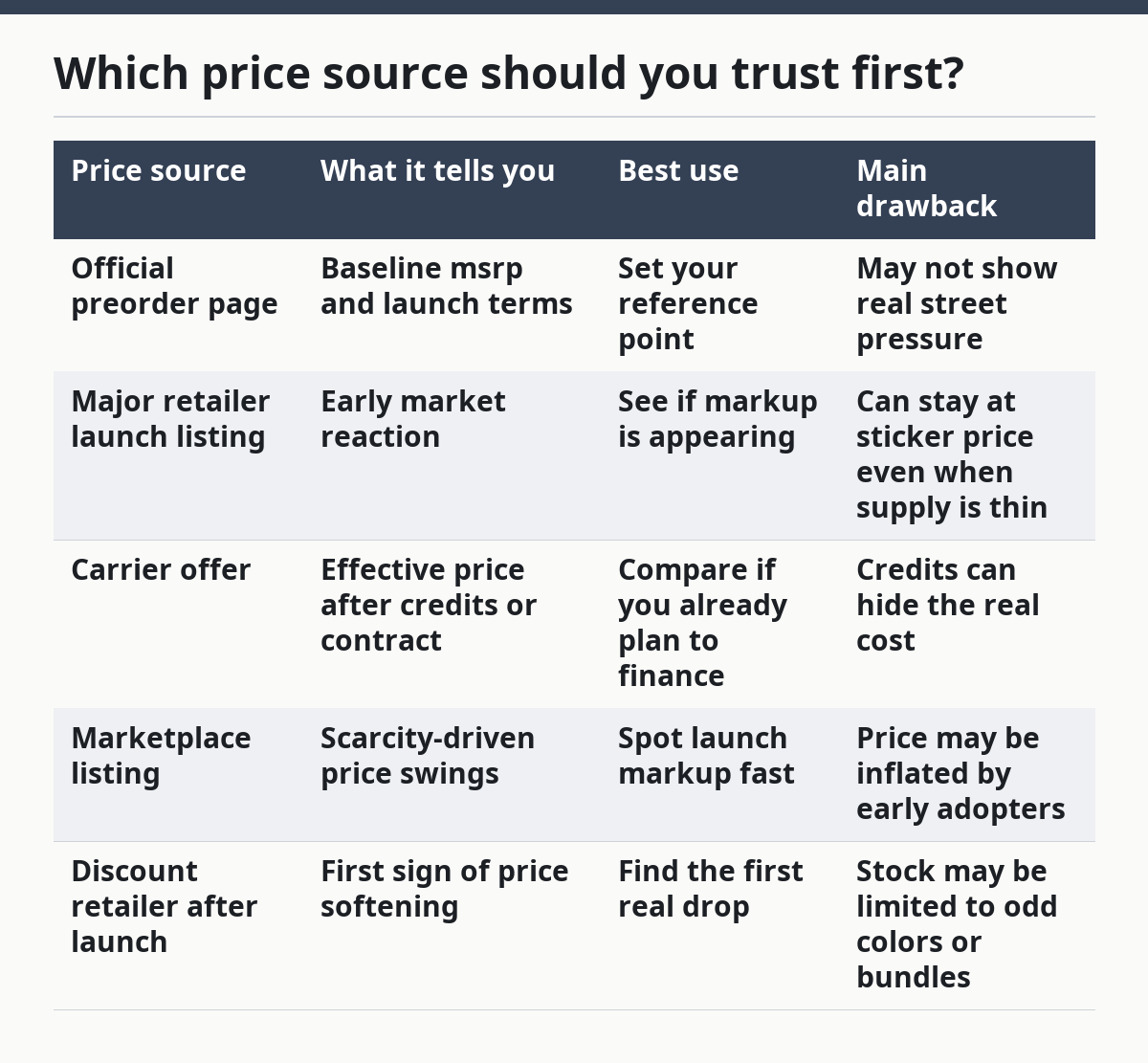
The official preorder page is the only place where msrp and preorder details are usually meant to be read together. Major retailers are useful because they show whether launch stock is holding at sticker price or drifting upward. Marketplace listings are the most volatile, and they are where launch markup shows up fastest.
Carrier offers deserve a separate look. A phone that appears cheap with a 24-month credit can still cost more than an opened model at msrp if the monthly plan is expensive. If you compare carrier pricing, compare the full phone cost and not just the monthly bill.
How do you compare launch pricing step by step?
You compare launch pricing by checking the same model, storage, and condition across the same 7-day window. That keeps the comparison fair and makes the street price easier to read.
- Record the msrp for the exact model. Write down the storage tier, color, and opened or carrier-locked status. A 128GB opened model is not the same comparison as a 256GB carrier version.
- Check the preorder listing on release day. Note whether the price matches msrp or includes a bundle, credit, or trade-in requirement. The result is your launch baseline.
- Check two or three major retailers in the same 24-hour period. If all are at msrp, supply is likely still tight. If one is already below msrp, that is a first sign of price softening.
- Search marketplace listings only after you know the official price. Compare the listing price to msrp, not to another seller’s asking price. That shows whether the seller is charging a launch markup.
- Repeat the same check after 7 to 14 days. A real drop usually shows up as a lower street price, not as a longer rebate list or a larger trade-in credit.
- Compare the final cash cost. Include taxes, shipping, and any required plan or trade-in condition. That gives you the price that actually leaves your account.
This method works because the first month is messy. Early adopters accept higher prices, launch stock can be thin, and some sellers test the ceiling before demand cools. If you only look at one listing, you may mistake scarcity for value.
The easiest mistake is to compare a preorder page with a resale listing and call it a fair comparison. It is not. A preorder can include a future shipping date, a warranty, or a bundle credit. A resale listing may include none of that and still cost more. Compare like with like, then decide whether the extra speed is worth the premium.
When is the price still inflated?
The price is still inflated when most listings sit at msrp or above it and the lowest prices come with catch conditions. That often means launch stock is still tight and sellers know early adopters will pay to get the phone first.
A clear sign of inflation is a listing that adds a small accessory bundle while keeping the phone itself above msrp. The bundle can make the offer look better than it is. Another sign is a reseller price that is much higher than the official preorder price for the same model and storage tier. That gap is usually launch markup, not added value.
The first month is also when some buyers overrate scarcity. A phone that is hard to find in one color is not necessarily overpriced across the board. Sometimes only the top storage tier is expensive while the base model stays close to msrp. That is why the exact configuration matters.
If you want a simple cutoff, use the official msrp as the line. Above that line, the phone is still in its launch-demand phase. At or below that line, you are starting to see normal market pressure. The question is not “Is the phone available?” but “Has the market stopped charging for urgency?”
What is the first real discount worth waiting for?
The first real discount is the first price drop below msrp that does not depend on a trade-in, a long contract, or a bundle you do not want. That is the signal that the market has started to cool.
For many buyers, this is the sweet spot in the first month. It is often better than paying launch markup, but it does not require waiting for a deep discount cycle. The downside is that you may miss the exact color or storage tier you want. The phone you can buy at a lower price may be the phone you are less excited about.
Here is a simple way to judge the first discount:
- If the price is below msrp by a small amount and the phone is opened, that is a real discount.
- If the “discount” depends on trade-in credits, treat it as a promotion, not a price cut.
- If the price is lower but the model is a different storage tier, do not compare it as the same deal.
This is the best option for buyers who want a new phone soon but do not need day-one ownership. It is not the best option for collectors, reviewers, or anyone who wants the exact launch color. It also is not the best choice if a carrier credit is the only way the price looks low.
Which option should you choose?
You should choose the option that matches your urgency, because first-month pricing rewards different buyers in different ways. The best choice for most readers is to wait for the first real discount below msrp unless launch stock is abundant and the preorder terms are unusually good.
| Option | Best for | Pros | Cons |
|---|---|---|---|
| Preorder at launch | Early adopters who want day-one access | Locks in the model fast; may include preorder bonuses | Can be tied to trade-in rules; no price drop yet |
| Buy during launch week | Buyers who want fast delivery without preordering | You can compare several live listings | Launch markup can still be high; stock may be thin |
| Wait 1 to 4 weeks | Buyers who want the best price-to-patience balance | More likely to see a street price below msrp | Exact colors or storage tiers may disappear |
| Buy from marketplace listings | Buyers chasing a specific model fast | Can surface hard-to-find stock | Highest risk of launch markup and inflated prices |
Preorder is for the buyer who values certainty more than price. Launch-week buying is for the buyer who wants the phone quickly but still wants a chance to compare live offers. Waiting 1 to 4 weeks is for the buyer who can tolerate a short delay in exchange for a cleaner price comparison.
This is where many generic guides get it wrong: they treat “new release” as one phase. It is not. The first few days are about scarcity, the middle of the first month is about supply pressure, and the end of the month is often where the first honest discount appears. If your goal is value, not novelty, waiting usually beats chasing the first shiny listing.
For a broader price-planning view, the hub guide to mobile phone prices and buying guide is the better next stop once you know which timing bucket fits you.
Is it cheaper to wait after a phone launches?
Yes, waiting is often cheaper after a phone launches, but not always in the first few days. The first month can still carry launch markup, especially when launch stock is thin and early adopters are buying fast. The lowest price often appears only after the market has had time to settle and the first real discount shows up below msrp.
Do phone prices drop in the first month?
Yes, phone prices can drop in the first month, but the size of the drop depends on supply, demand, and the exact model. Some phones stay near msrp for most of the month, while others show a small street-price cut within 1 to 4 weeks. The key is to compare the same storage tier and the same condition each time.
Drafted with AI; not yet reviewed by a person.